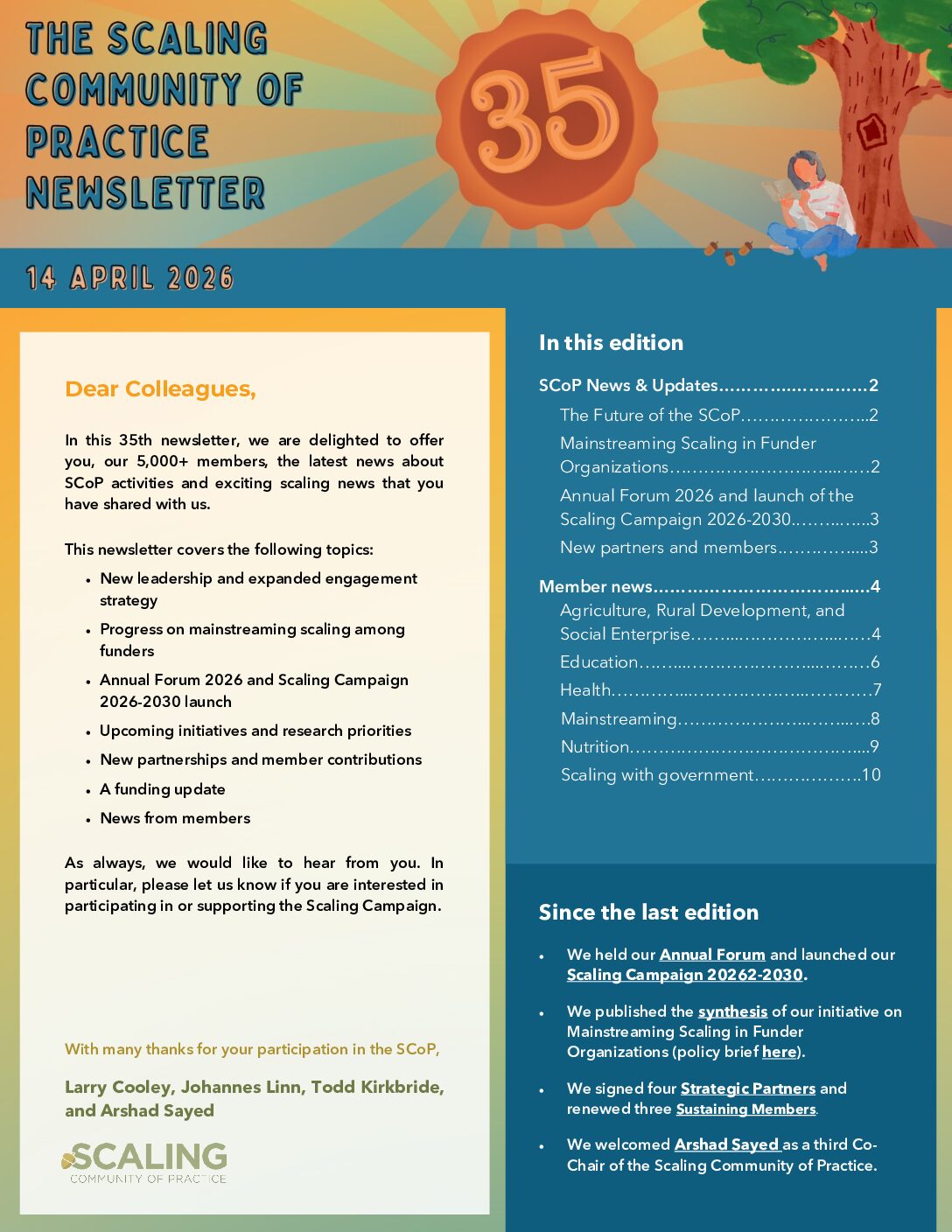
Dear colleagues,
In this 35th newsletter, we are delighted to offer you, our 5,000+ members, the latest news about SCoP activities and exciting scaling news that you have shared with us.
This newsletter covers the following topics:
- New leadership and expanded engagement strategy
- Progress on mainstreaming scaling among funders
- Annual Forum 2026 and Scaling Campaign 2026-2030 launch
- Upcoming initiatives and research priorities
- New partnerships and member contributions
- A funding update
- News from members
As always, we would like to hear from you. In particular, please let us know if you are interested in participating in or supporting the Scaling Campaign.
With many thanks for your participation in the SCoP,
Larry Cooley, Johannes Linn, Todd Kirkbride, and Arshad Sayed
Co-Chairs, Scaling Community of Practice
SCoP News and Updates
Newsletter 34 provided updates on work conducted from July 2025 to September 2025. Below, we provide an update on work from October 2025 to March 2026. We also preview upcoming events and activities.
The future of the SCoP
We are pleased to welcome as a Co-Chair on the Scaling Community of Practice’s Senior Leadership Team. Arshad will energize our fundraising and communications efforts, with a focus on engaging the private sector in the scaling agenda.
Current SCoP funding runs through June 2026 (donate now!). The Secretariat is actively exploring three paths to ensure the organization’s continuity and growth:
- Securing core funding from philanthropic and official donors.
- Expanding our Sustaining Members program to increase contributions from committed partner organizations
- Engaging in specific projects which include funding for core SCoP activities.
Our ongoing work with Rockefeller Foundation Catalytic Capital on Reimagining Humanitarian Nutrition Security is an example of our project work. The project pilots a locally led, climate‑adaptive model for humanitarian food assistance in fragile contexts, aligning with long‑term nutrition security. By embedding scaling principles and intentional program design from the outset, the initiative aims to generate sustainable, scalable impact and inform broader policy and systems change.
Projects in the pipeline
- The SCoP is developing a ‘room’ for the ‘17 Rooms’ initiative of the Brookings Institution. Traditionally, rooms bring together leaders focused on each of the 17 Sustainable Development Goals. This ground-breaking ‘room’ will take a cross-sectoral approach, to embed scaling into the SDG ecosystem and explore especially the role of country coordination platforms.
- Jointly with our partner Spark Health Africa, we are pursuing a research project on how scaling has been approached within the Health Sector. The Health Sector is ahead of the curve in embedding the scaling agenda, so we want to learn from their example to understand what works well, where challenges often emerge, and opportunities for improvement. We are currently working with funders to refine the scope, considering specific sub-sectors as well as depth and breadth of analysis. Please reach out if you would like to contribute substantively or to the prioritization process.
We will keep members informed as other opportunities develop and warmly welcome introductions to potential funders or institutional partners.
Mainstreaming Scaling in Funder Organizations
The SCoP’s flagship Initiative on Mainstreaming Scaling in Funder Organizations is coming to a close. The three-year action-research project documented the experience of 28 development and climate funders in integrating scaling systematically into their operational policies and practices. It successfully accumulated a wealth of knowledge on best practices, major challenges, and effective approaches for funder organizations to promote scaling. The case studies cover a wide range of funder organizations from multilateral and bilateral official funders to foundations and international non-governmental organizations. Published reports address evaluation practices, recipient perspectives, and approaches to track mainstreaming. Summary reports provide overarching findings and lessons of the Initiative.
The case studies demonstrate that funders operate at different points along the scaling pathway — from ideation and research and development to transition to scale, scaling, and sustained operation at scale. While funders exist at all stages, major gaps persist in practice, especially in scaling and sustainable operation at scale. These gaps are primarily due to weak coordination and handoffs between early- and later-stage funders. Moreover, funders that could serve as intermediaries, with the intent to accompany systems actors on the entire journey to scale, generally do not have access to funds to bridge the gap thereby creating the well-known “Valley of Death”.
As this three-year initiative draws to a close, it marks a pivot point for the SCoP. The lessons, relationships, and tools developed through the Mainstreaming Initiative are being channelled into the Scaling Campaign 2026–2030. The Campaign aims to transform the documentation and learning of the Mainstreaming Initiative into action by working with and influencing the international development and climate change communities.
Annual Forum 2026 and launch of the Scaling Campaign 2026-2030
The SCoP’s Annual Forum 2026 took place virtually from 23 February to 6 March. Over one thousand members from around the world registered for the event which had three plenary sessions and seven Working Group sessions. The plenary sessions presented the findings and lessons of the Mainstreaming Scaling in Funder Organizations Initiative, formally launched the Scaling Campaign 2026–2030, and mapped out next steps for the SCoP. Working Group sessions explored current scaling issues across sectors, with a focus on concrete lessons learned and what needs to be done going forward. Summaries of each of the sessions have been compiled into a Proceedings Report.
The Forum culminated in a Call to Action, which will serve as the basis for the Scaling Campaign: international development and climate actors must collectively take specific action not only for transactional one-off short-term project outputs, but for transformational long-term, locally led sustainable impact at the scale of the problem.
We invite all members to consider how your organization can engage, whether as a Strategic Partner, by supporting specific Campaign initiatives, or by contributing to Working Groups. If you are interested in participating in or supporting the Scaling Campaign, please let us know at info@scalingcop.org.
Communications updates
As part of the Scaling Campaign, we are expanding our communications approach to reach new members and expand our influence over the scaling agenda. We also hope to deepen our engagement with you. To this end, we have significantly updated our website, giving it a new look and adding pages related to Sustaining and Strategic Members, the Scaling Campaign and its Programs, and more.
We have also become more active on LinkedIn. We increased the frequency of posts on our LinkedIn Page from 7 posts last February to 27 this February. Much of this change was achieved by reactivating the Working Groups to lead biweekly posting drives. We also launched a LinkedIn Group. On the group page, you, our members, can their own initiate conversations about scaling topics. We encourage you to post directly to the LinkedIn Group (due to LinkedIn permission structures members cannot initiate their own post threads on the Page).
New partners and members
At the Annual Forum, the SCoP launched its new Strategic Partners program, which establishes deeper, formalized partnerships with organizations committed to advancing the SCoP’s mission and the Scaling Campaign 2026–2030. This program will accelerate and magnify Campaign outcomes practical, purposeful, and action-oriented relationships. Partners will:
- Share networks, resources, knowledge, and technical expertise to advance shared objectives.
- Co-design fundraising and implementing initiatives that create mutual value and measurable impact.
Building on these partnerships, as well as project-specific partnerships (as with Spark Health Africa), the SCoP will convene a self-directed Scaling Coalition of Strategic Partners dedicated to advancing the Campaign’s goals. Participating organizations will share relevant activities and updates with one another. The SCoP will compile and periodically refresh this information to support coordination and collective learning and action.
We are also pleased to announce the renewal of three Sustaining Members. Sustaining
- Influence the global scaling agenda. Your organization will hold a seat on the SCoP Executive Committee, helping shape scaling principles, tools and advisory work that guides how major development and climate actors plan and finance their portfolios and encouraging alignment with your own organization.
- Showcase your scaling practice. The SCoP will co-design and promote a webinar that highlights your experience and lessons on scaling to its global network of practitioners and decision makers.
- Increase your visibility as a scaling leader. Your logo will be featured as a Sustaining Member on the SCoP website and in relevant Campaign communications, signaling your leadership on impact at scale to funders, peers and partners.
We encourage organizations interested in becoming Strategic Partners or Sustaining Members to contact the Secretariat to learn more.
Member news (by working group)
Agriculture, Rural Development, and Social Enterprises
BRAC
New Interactive Tool Maps Two Decades of Global Poverty Research – This Evidence Map on Graduation Programmes is a comprehensive, interactive tool hosted by the London School of Economics. It consolidates 112 studies from 40+ countries across Africa, Asia, and Latin America on the Graduation approach and its component parts. It organizes research by intervention components (such as asset transfer, coaching, and financial services access) and outcomes (including income, consumption, health, education, and resilience), making it easy to explore what evidence exists and identify remaining gaps. The map can be used when discussing the Graduation approach in communications, proposals, and advocacy work. Research on specific intervention components can inform program design and updates. Members are encouraged to help BRAC keep the map current by sharing new studies with graduation.evidencemap@brac.net. They can also share feedback or tell the BRAC team how the map was used.
Courtney Calardo
CoolVeg Foundation
Scaling Without Supply Chains: Lessons from Clay Pot Coolers – In the Sahel, where food insecurity is high and options for fruit and vegetable storage are limited, simple clay pot coolers can significantly reduce food loss and improve diets. Rather than distributing the devices, CoolVeg scales adoption through a training program that teaches people how to build and use coolers with local materials, building on existing knowledge of evaporative cooling. Delivered through trusted local networks, this knowledge diffusion approach drives high adoption and has reached tens of thousands of households. The case shows that for simple technologies, cost-effective scaling can be achieved through knowledge sharing rather than product distribution.
Eric Verploegen
Grameen Foundation
Scaling Digital Agricultural Advisory Services Requires Community-based Agents – Digital agricultural advisory services (DAS) applications hold great promise for improving sustainability across food systems by supporting smallholder farmers in availing information and improving their capacity to use it. However, DAS applications, particularly those based on smartphone technology, have reached only a fraction of smallholder farmers in low-income countries and evidence regarding their effectiveness is limited and mixed. AgriPath is a consortium of researchers from the Centre for Development and Environment of the University of Bern, the University of Lausanne, digital agriculture innovation leaders Grameen Foundation USA and Garmeen Foundation India, the International Centre of Insect Physiology and Ecology, and the technology start-up Farmbetter Ltd. Agripath designed a toolkit to support DAS providers in scaling their innovations through the use of a community-based agent-led business models. The toolkit provides template-based resources organized in six phases of scaling, including understanding digital ecosystems; developing scalable business models; identifing existing community-based agent networks; and recruiting, training, and monitoring community-based agents.
Bobbi Gray
Responsible Innovations
GenderUp Virtual Trainings on Inclusive Agricultural Innovation – The Responsible Innovations Academy is hosting GenderUp trainings on April 21&22 and August 11&12. These trainings support practitioners in integrating responsible scaling approaches into their agricultural innovation work. GenderUp provides practical tools and frameworks that help ensure innovations are widely adopted and equitably beneficial, with attention to the systemic barriers that often limit women’s participation and outcomes. Interactive sessions are tailored for researchers, program implementers, and policymakers working across food systems and agriculture, with a focus on translating gender concepts into actionable strategies for inclusive impact. Upcoming training dates are now open for registration; learn more about GenderUp on our website.
Erin McGuire
Education
TaRL Africa
What Zambia’s Catch Up RCT Tells us about Sustaining Government Led Educational Interventions – Zambia’s Catch Up programme — grounded in the Teaching at the Right Level approach — started with 80 schools in 2016. It has now reached over 6,000 schools, making it one of the most ambitious government-led remedial education efforts in Africa. A randomized controlled trial of the program, led by Principal Investigator Andreas de Barros, followed learners over a two-year period and confirmed that Catch Up is delivering measurable, meaningful improvements in foundational literacy and numeracy. The study confirms that the programme can deliver consistent, replicable results at scale, even when implemented by government teachers nationwide. Authors found 0.10–0.15 standard deviation learning gains, equivalent to 2.2–2.8 additional months of learning. These gains place Catch Up within the top 20–30% of large education interventions globally. Opportunities to strengthen future program delivery include reducing high absenteeism, refining structured support for teachers, and exploring pedagogical adaptations to boost higher order skills.
Anna Murru, Daniele Ressler
Room to Read
Scaling Foundational Literacy through Government Systems – For the past ten years, Room to Read has been working towards scaling up its evidence-based early grade foundational literacy programs through government education systems across several countries. The overall approach involves integrating and embedding the program into a government system and strengthening the system to deliver and sustain the new components. Strong evidence of impact, strategic advocacy, co-creation of content, and continuous engagement with all levels of government officials including ‘champions’, have been successful strategies towards system integration.
While such integration is a necessary first step towards government-led scale-up, most initiatives fail during implementation. An ecosystem-based approach is needed to address common implementation barriers at scale, such as insufficient funding, materials delays, limited local book markets, diluted training, weak coaching and monitoring, low awareness among mid-tier officials, and lack of regular assessments. For scale up initiatives to be sustainable, transferring knowledge and responsibility to government through a gradual release of responsibility model, engaging communities, building cross-sector collaborations and strengthening teacher agency are critical.
Sourav Banerjee
Health
Chair in Shared Decision Making, VITAM, and SPOR-CIHR
Building a Scaling Architecture: Our Outputs, Lessons, and Perspectives – This annotated bibliography provides an extended list of scaling resources developed in French and English. It presents empirical studies, systematic and umbrella reviews, real‑world case studies, scalability assessment instruments, documentation guidance, and training resources. Together, these efforts strengthen system capacity to plan, assess, and implement scaling initiatives more rigorously. The annotated bibliography highlights key lessons learned from the overall body of work — particularly the importance of evidence, equity, engagement, and adaptation — and outlines ongoing projects aimed at advancing scalable practices at the policy, organizational, and community levels.
Construire une architecture du passage à l’échelle : nos productions, enseignements et perspectives – Cette bibliographie annotée propose une liste élargie de ressources sur la mise à l’échelle, développées en français et en anglais. Elle présente des études empiriques, des revues systématiques et des revues parapluies, des études de cas issues de situations réelles, des outils d’évaluation de la scalabilité, des orientations pour la documentation, ainsi que des ressources de formation. Dans leur ensemble, ces travaux contribuent à renforcer la capacité des systèmes à planifier, évaluer et mettre en œuvre des initiatives de passage à l’échelle de manière plus rigoureuse. La bibliographie annotée met en évidence les principaux enseignements tirés de l’ensemble de ces travaux, en soulignant en particulier l’importance des données probantes, de l’équité, de l’engagement, et de l’adaptation. Elle présente également les projets en cours visant à faire progresser les pratiques de mise à l’échelle aux niveaux des politiques publiques, des organisations et des communautés.
Odilon Quentin Assan, Claude Bernard Uwizeye, Oscar Nduwimana, Ginette Saucier, Roberta de Carvalho Côroa, Amédé Gogovor, Briscia Anaid Tinoco, Ana Luisa Zapata Viveros, Georgina Suelene Dofara, France Légaré
ExpandNet Secretariat
Government Workshop to Embed Scalability Thinking in Decision-making – Many health interventions that succeed in a pilot stage fail to achieve sustainable scale up because scalability is not systematically addressed early in their design. A recent two-day workshop in Nigeria, organized by ExpandNet’s local Affiliate Organization – the Development Outcomes Support (DOS) Center – sought to address this gap by strengthening government capacity to apply a structured, systematic scale-up lens before adoption decisions are made. The workshop brought together senior government representatives from the Federal Ministry of Health and Social Welfare and State Ministries of Health from Kaduna, Kano, and Lagos. It focused on equipping leaders with practical skills to apply ExpandNet/WHO’s systematic approach to assess scalability, identify design and system constraints, and strengthen pathways to institutionalization. As one federal-level director noted, “This training made the invisible visible—many of these principles were implicit, but we now have a structured way to see and apply them.”
Laura Ghiron and Sada Danmusa
Mainstreaming
Agence Française de Développement
Research on the Limits of the Project-based Approach – The project-based approach has been the foundation of international development interventions since their inception. There is now broad consensus on the need to move beyond it and implement transformative scaling approaches to reach larger populations. The implication of this continued reliance on the project-based approach is that donors are satisfied with the results, but what results, exactly? This analysis of the rural drinking water sector in Ghana offers a critical examination of how aid has been approached over the last 20 years and what has been achieved. Building on these findings, and drawing on the work of the Scaling Community, this report calls for a different path forward.
Eric Beugnot
CARE
Designing for Scale: CARE’s New Scaling Playbook – CARE is pleased to share the launch of its new Scaling Playbook, developed in partnership with IDinsight. The Playbook is grounded in a rigorous analysis of CARE legacy models that surfaced an insight many in the scaling community know too well: effectiveness alone rarely predicts scalability, and complexity — no matter how elegant — collapses under the weight of real‑world systems. It lays out a disciplined, evidence‑driven approach that can be used to determine whether an existing intervention should scale, or to design leaner models that are simple, affordable, and feasible for local systems to adopt and sustain. The Playbook aligns ambition with reality by elaborating sharply defined methods, including a rigorous evidence review, competitive landscape analysis, cost and affordability assessments, and scalable Theory of Change co-design. It invites practitioners to confront uncomfortable but necessary questions:
- When is our model genuinely the best tool for the job?
- When is someone else’s solution already more scalable?
What would it mean to design every intervention for eventual ownership by local doers and payers, not as a philosophical stance but as a design constraint?
Anita Sundari Akella
Nutrition
HarvestPlus
A New Innovative Tool to Track the Progress of Biofortification Programs – Biofortification has proven to be a cost-effective, food-based solution to address hidden hunger. Millions of farming households and non-farming consumers access these foods, but measuring their exact numbers remains challenging. A new methodology paper published in Current Developments in Nutrition introduces a practical, scalable, and cost-effective approach to estimating the reach of biofortified foods across food systems, enabling policymakers, practitioners, and partners to better understand and strengthen program impact.
Using this new tool and 2023 data, researchers from the International Food Policy Research Institute’s HarvestPlus program, in collaboration with GroundWork and the Alliance of Bioversity & CIAT, estimate that up to 293 million people consumed at least one of four biofortified crops in the three countries studied. When this methodology was applied to 2025 data, the estimate increased to 640 million people eating biofortified foods across 13 countries where HarvestPlus operates. The tool is available free of charge, and HarvestPlus researchers are available to train users on how to apply it.
Bho Mudyahoto, Jen Foley, Munawar Hussain
Impact and Innovations Development Centre
Scaling Up REAL Fathers in Uganda: Emerging Evidence – First developed in Northern Uganda and Karamoja, this program uses respected older fathers as community mentors to support young fathers (ages16–25) with children under three years old. Through seven structured mentoring sessions—combined with engagement of spouses and community members—fathers build skills in: non-violent parenting, respectful couple communication and conflict resolution, and active father involvement in early childhood development. With demonstrated success, REAL Fathers has been formally endorsed under Uganda’s National Development Plans III and IV and aligned with national early childhood development and family strengthening frameworks. REAL Fathers aligns closely with Uganda’s existing community development structures and national priorities on early childhood development, gender-based violence prevention, and family strengthening—making it well suited for government-led or hybrid scale. A costing analysis is underway and will be available in late 2026 to guide scale and sustainability planning. It is currently implemented across six subregions of Uganda.
IIDC
Scaling with Government
International Budget Partnership
Scaling Up Urban Service Delivery through Collaboration: Lessons from Asivikelane’s Evolving Approach in South Africa – Operating through networks of community facilitators who conduct real-time surveys on WASH conditions, the Asivikelane (‘Let’s protect one another’) campaign has contributed to large-scaleservice delivery improvements in South Africa’s eight largest cities. Its approach has evolved across three phases: building credibility through comparative data during COVID; deepening relationships with government at multiple levels; and transitioning to a ‘hub’ model that convenes communities, civil society, and local and national government to solve systemic bottlenecks collaboratively. A key lesson from Asivikelane is that scaling responsive public services in historically neglected communities requires building the enabling conditions for genuine collaboration: building trust, strengthening relationships, realigning incentives, and mitigating systemic bottlenecks.
Brendan Halloran
Nutrition
HarvestPlus
Scaling Success: Vitamin A Maize Reaches over 65 Million in Nigeria – In Nigeria, HarvestPlus and partners introduced biofortified maize to combat widespread vitamin A deficiency. Through persistence, innovation, and partnerships, HarvestPlus achieved a huge success in facilitating development, dissemination, and scaling of climate-smart, vitamin A maize varieties, reaching over 65 million people in the country. Approximately 2 million farmers now cultivate vitamin A maize, which is becoming a staple in Nigerian markets and homes. The initiative strengthened seed systems, created demand, and built market infrastructure, ensuring sustainability. With government support, vitamin A maize is now part of Nigeria’s long-term strategy to combat malnutrition. The scaling journey demonstrates how science, partnerships, and community action can transform food systems, improve nutrition, and bring economic empowerment.
Faith Okiror, Munawar Hussain
Spring Impact
How are nonprofits scaling with government right now? – Scaling with government is essential for achieving impact at scale, but strong ideas alone are not enough. A clear pathway is often missing. As pre-work for its upcoming report, Spring Impact reviewed dozens of case studies to understand how organizations can embed innovations in public systems in practice. Developed with Instiglio and LGT Venture Philanthropy, the literature review brings together insights on four key questions that shape the journey: what solutions governments can adopt, how to identify the right champions, how to set up for success, and how to support government ownership.
Spring Impact