Over 2.5 billion people can’t afford a healthy diet. Over half of all children and two out of three women globally are deficient in the essential micronutrients they need to thrive—affording nutritious foods is out of reach for many. For more than two decades, biofortification has proven to be a cost-effective, food-based solution to address hidden hunger. Scaling has gained momentum and millions of farming households and consumers in non-farming households globally, are now growing and eating biofortified foods, making tracking progress in a scaling phase of a technology complicated. So, one critical question has persisted: How do we accurately measure who is accessing these foods?
A new methodology paper published in Current Developments in Nutrition marks an important step forward. It introduces a practical, scalable, and cost-effective approach to estimating the reach of biofortified foods across food systems, enabling policymakers, practitioners, and partners to better understand and strengthen program impact.
Using this new tool and 2023 data, researchers from the International Food Policy Research Institute’s HarvestPlus program in collaboration with GroundWork and the Alliance of Bioversity & CIAT estimate that in total, for four crops in the three countries studied, up to 293 million people consumed biofortified foods.
Measuring Impact at Scale
HarvestPlus and HarvestPlus Solutions use this methodology to track the progress of its programs in the countries where they operate. When this methodology was applied to 2025 data, it reveals an estimate that up to;
- Over 640 million people were eating biofortified foods across 13 target countries, thanks to effective partnerships among HarvestPlus, HarvestPlus Solutions, CGIAR, multiple donors, and national partners.
- In Bangladesh: 36.7 million people (nearly 21 percent of the population) were eating zinc-enriched rice – 3.9 million of these were children under five years
- In Pakistan: over 198 million people (76 percent of the population) were eating zinc-enriched wheat, including more than 31 million children under five.
- In Nigeria: over 72 million people (more than 31 percent of the population) were eating vitamin A maize, including more than 11 million children under five.
- In Kenya: over 10 million people (about 18 percent of the population) were eating iron beans, including more than 1.3 million children under five.
- In Uganda: over 13 million people (more than 31 percent of the population) were eating vitamin A sweet potato, including more than 2.2 million children under five.
- In Malawi: nearly 9.6 million people (46 percent of the population) were eating iron beans.
It is worth mentioning, this reach relates to 13 countries in which HarvestPlus, HarvestPlus Solutions, and our national partners work to scale up biofortified crops. There is an additional reach of biofortified crops through organizations such as the International Potato Center (CIP), the Alliance of Bioversity International and CIAT, IITA, and other civil society actors.
This progress indicates that, by working with public and private sector partners, HarvestPlus and HarvestPlus Solutions are on track to reach 1 billion people eating biofortified foods by 2030.
Beyond these target countries, biofortification continues to expand globally. More than 493 varieties of 13 biofortified staple crops are now available to farmers across 41 countries, reflecting growing adoption and sustained investment.
These numbers underscore both the scale achieved and the urgency of measuring it effectively, providing national governments with an evidence-based approach to increase investment in scaling biofortification to reach those who need it most.
From Outputs to Outcomes: Why Innovative Measurement Matters in a scaling phase of technologies
Biofortification programs operate across complex systems—from seed development and distribution to farmer adoption, markets, and consumption. While progress has been significant, measuring reach and coverage has often been challenging. Although it is relatively straightforward to track progress during technology introduction and piloting, assessing reach and coverage during accelerated scaling phase requires creative approaches that make use of limited monitoring data and reliable secondary data from credible sources.
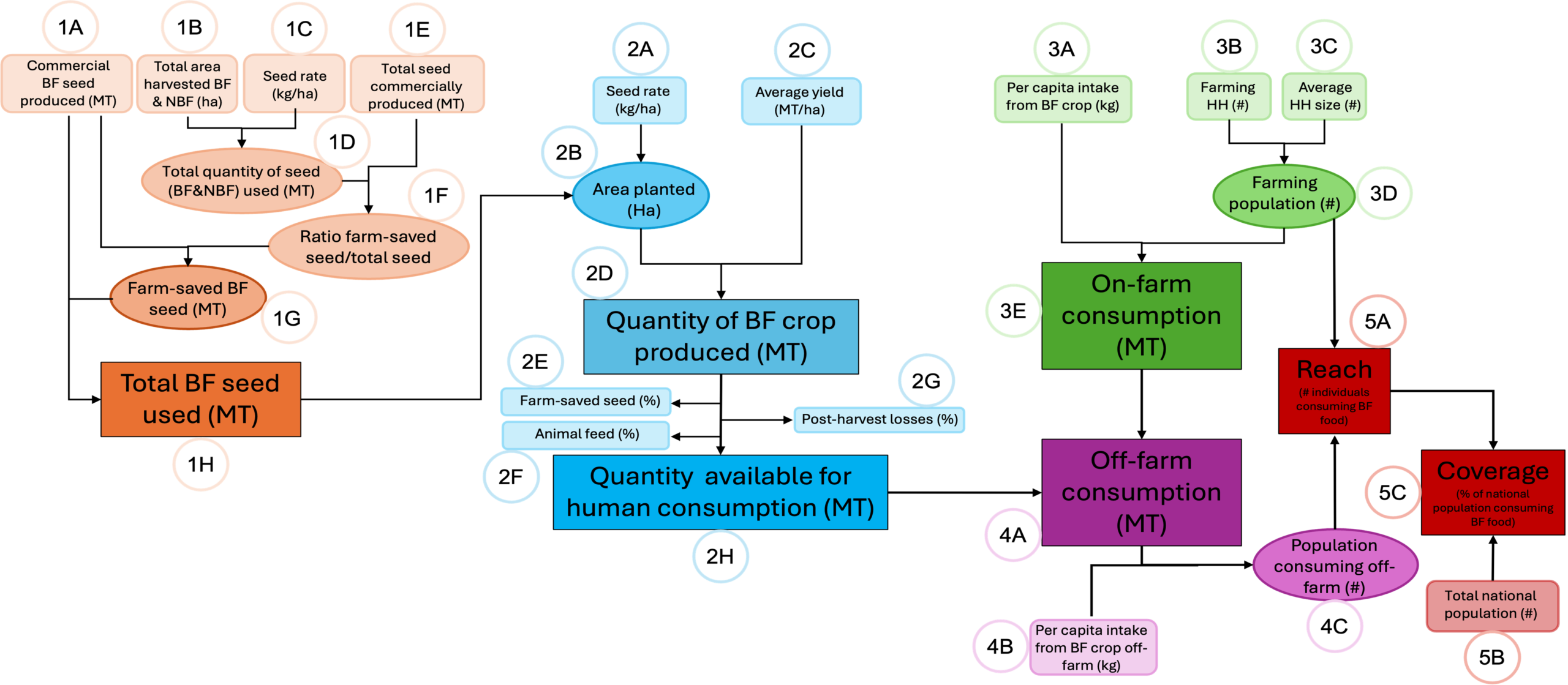
The new tool addresses this gap by outlining a standardized framework of indicators and methods that track progress across the entire impact pathway—from seed supply to consumption.
This shift is critical. It moves the conversation beyond “how much seed was distributed” to how many people are actually eating nutrient-rich foods—and benefiting from them.
A Practical, Scalable Methodology
One of the tool’s strongest contributions is its applicability across several crop types—from vegetative propagated, open-pollinated, and self-pollinating varieties to hybrids, each with distinct multiplication and production methods. It also addresses the challenge of estimating the quantity of farm-saved seed, which is often difficult to measure.
To test its robustness and replicability, the methodology was applied across multiple countries and crops, including iron beans and pearl millet, vitamin A maize and orange sweet potato, and zinc wheat and rice, consistently producing credible results.
Beyond estimating population-wide reach and coverage, the methodology has enabled HarvestPlus and HarvestPlus Solutions to estimate crucial variables, such as the share of crop area planted with biofortified varieties and the share of harvested crops that are biofortified—both critical metrics for scaling and food systems transformation.
While the methodology does not measure impact, the results it generates are essential for modeling the contribution of biofortification to reducing micronutrient deficiencies at the population level.
The diagram below illustrates the key features of the methodology.
This makes the framework not just academically robust—but also highly actionable for national governments, policy makers, and implementing partners. The tool could be accessed here.
Key Takeaways for Scaling Impact
1. Measurement Must Match Complexity
Biofortification operates across agriculture, nutrition, and markets. Measuring its success requires integrated, system-level approaches, not isolated indicators.
2. Standardization of measurement
While the use of a common set of indicators enables cross-country comparison, aggregation of results, and shared learning, this tool also ensures comparability across geographies and programs, helping build a unified global picture of progress at scale.
3. Practicality Drives Adoption
Low-cost, easy-to-implement methods are more likely to be adopted by governments and partners, ensuring sustainability.
Conclusion
The methodology for estimating reach and coverage comes at a time when measuring the progress and off-farm reach of biofortification has often seemed elusive. Its cost-effectiveness, replicability, and applicability across diverse geographies and crop types provide governments with a powerful tool to assess the impact of their investments in nutrition initiatives. The tool does not, however, replace the need for strong monitoring and evaluation systems; rather, it relies on robust monitoring and secondary data to generate an accurate picture of reach and coverage. The tool is available free of charge, and HarvestPlus researchers are available to train users on how to apply it.