The Sahel—home to approximately 180 million people living in off-grid, rural communities—is among the world’s most food-insecure and climate-vulnerable regions. Insufficient access to effective storage solutions leads many women and girls to make frequent and lengthy market trips, contributes to significant food losses, and limits regular consumption of nutritious fruits and vegetables.
Clay pot coolers are simple, affordable, and effective devices that can solve these challenges for many families and improve food security for communities. CoolVeg’s clay pot cooler training program offers a useful case study in scaling the adoption of a physical device by knowledge diffusion rather than product distribution.
A Simple and Effective Solution
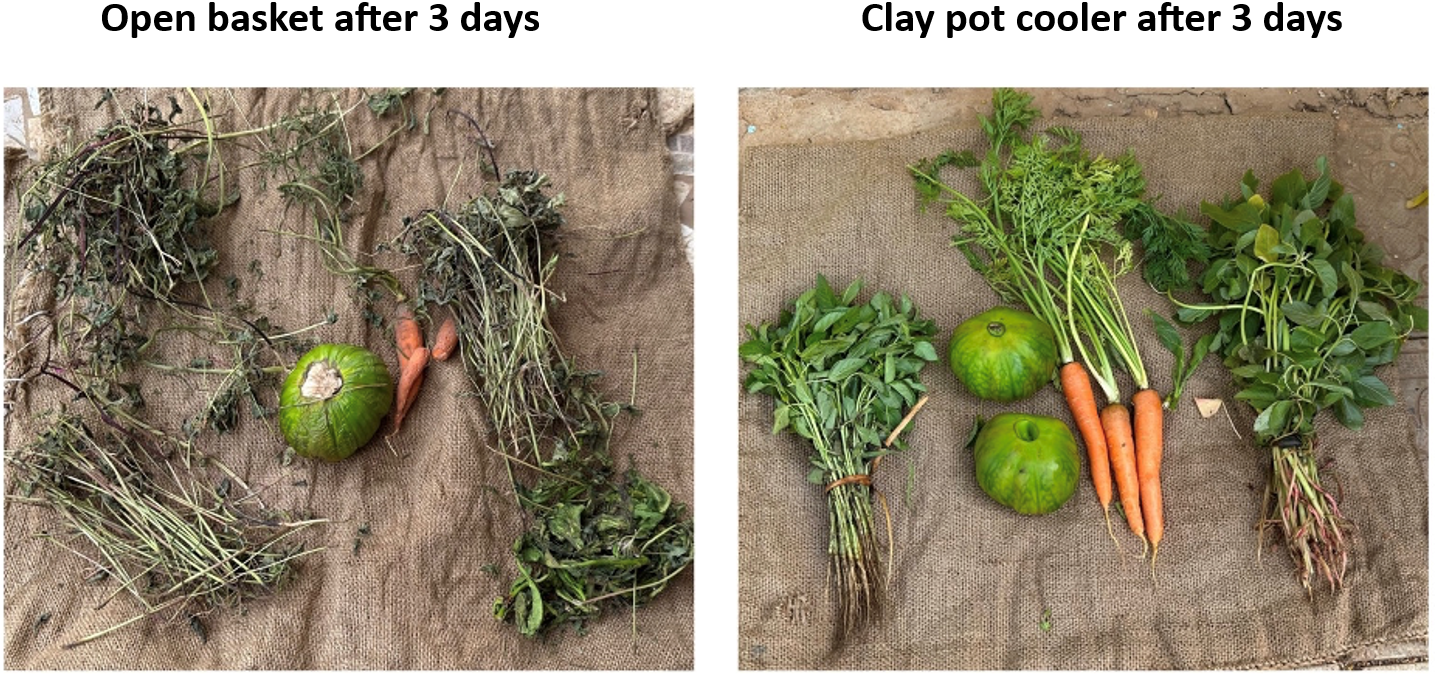
Most households in hot, dry regions of Africa use clay pots to store water, taking advantage of evaporative cooling as moisture seeps through the walls and cools both the pot and the water inside. This idea can be extended to fruit and vegetable storage: produce is placed in a clay pot, which is then set inside a second pot or a plastic dish filled with wet sand. As the water evaporates from the cooler, a cool and humid storage environment is created, improving the shelf-life of many common fruits and vegetables. A clay pot cooler costing between $2 and $10 can increase the shelf-life of leafy greens from 1 day to 6 days, African eggplants from 3 days to 15 days, and carrots from 3 days to 18 days.[1]
The idea of using clay pot coolers for storing fruits and vegetables is not new. Some organizations[2] have worked with local potters to produce and sell the devices, but these efforts have struggled to achieve sustained adoption or scale because users depend on others to make and supply the cooler.
While evaporative cooling is widely understood for water storage, application for fruit and vegetable storage—assembly details, crop selection, maintenance, and use conditions—is not common knowledge. This reframes the problem: the barrier is not the supply of a physical device; it is information and behavior change.
CoolVeg’s Training Program: Knowledge Diffusion
Researchers at MIT D-Lab, the World Vegetable Center (WVC), and Mali’s Institut d’Economie Rurale (IER) identified clay pot-in-dish designs that are easier to make with locally available materials, compared to the more common pot-in-pot or “Zeer” pot design, which typically requires custom clay pots. After testing these variants and confirming they provide comparable improvements in shelf-life, the team developed a training program to share the designs with clay potters in the Mopti region of Mali.
Kadidia Nienta, a clay potter from Mopti, told the team she had limited success selling clay pot coolers on her own. She suggested that trusted local institutions could help raise awareness among potential users—an insight that shaped the training program. In response, the program was adapted to include not just potters, but also fruit and vegetable producers, vendors, and consumers. This approach creates both supply and demand for clay pot coolers.
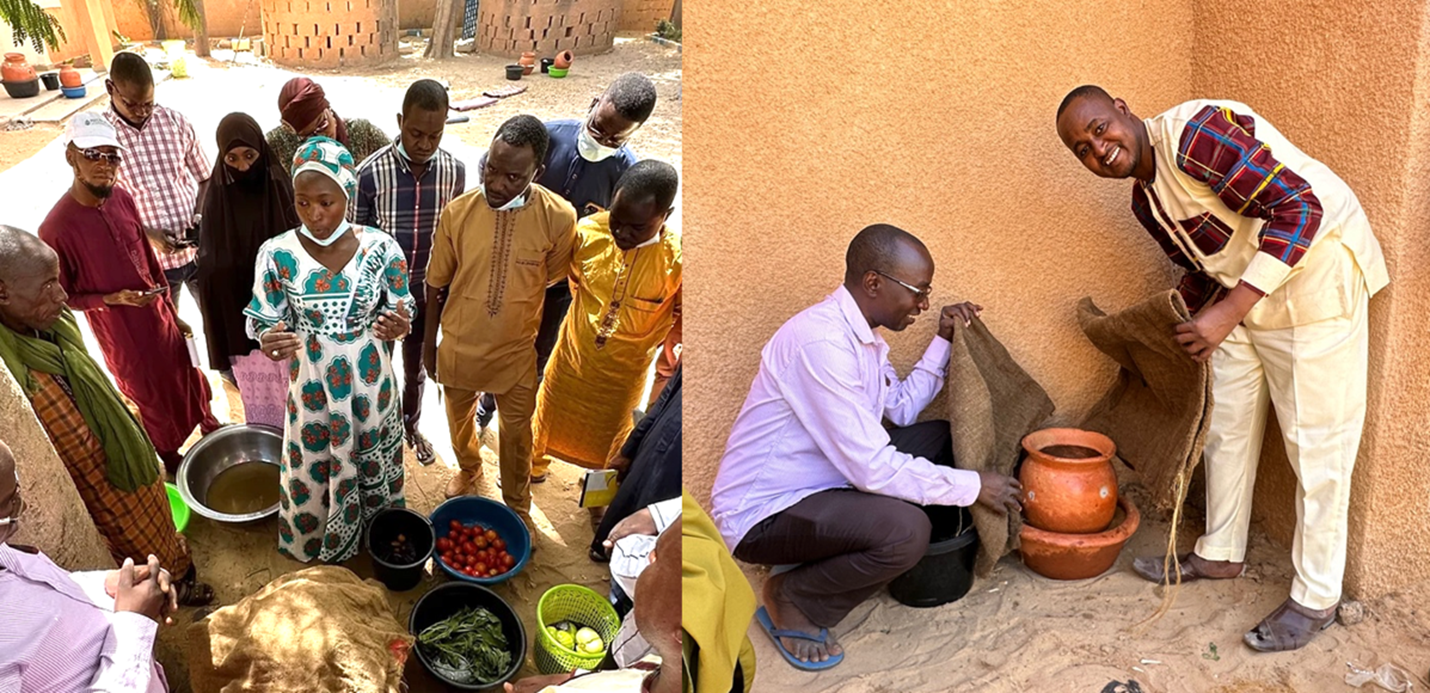
Using a cascade training approach, agricultural extension agents and farming cooperative members are trained by the CoolVeg team to lead village-level training sessions with simple content that relies heavily on images and hands-on activities. After the training sessions, participants continue to circulate knowledge about clay pot coolers in their communities.
Training Program Outcomes and Impact
To date, more than 320 training sessions have been conducted in Mali[3] and Niger[4], directly reaching over 8,000 participants. One year after attending a training session, 88% of training participants had either assembled a clay pot cooler for themselves or purchased one from a clay potter. Among these users:
- 85% eat more fruits & vegetables
- 88% spend less time going to the market
- 95% have less food waste
Beyond the adoption by training participants, the informal sharing of knowledge (spillover) about the clay pot coolers has led to an estimated 35,000 households adopting clay pot coolers for fruit and vegetable storage, benefiting over 200,000 people. When delivered at scale, this training program is highly cost-effective, with the potential to deliver lasting food-security gains for less than $1 per person reached.
Lessons Learned and Practitioner Takeaways
Several factors were critical for the success of the knowledge diffusion approach:
- Ease of understanding and assembly: connection to indigenous practices of using clay pots for water storage.
- Use of inexpensive, locally available materials: the simple pot-in-dish design is critical.
- Use of trusted local networks in the cascade training program.
- Creation of supply and demand by training a range of stakeholders.
The knowledge diffusion approach would not be possible for devices like solar lights or most cookstoves due to challenges with accessing key materials and the complexity of the construction.
This knowledge diffusion intervention as an alternative to product distribution is successful because:
- It is cost-effective: centralized manufacturing and distribution of this relatively heavy, large, and fragile product would likely cost more than the device itself.
- It is less vulnerable to supply chain disruptions in unstable regions like the Sahel.
- Local artisanal clay potters benefit when they are selling assembled clay pot coolers or just the components.
- Knowledge remains in communities after the training program ends. Users are not reliant on a third party to provide the device.
The results from the work to date show high adoption rates without providing materials or subsidies for households to purchase clay pot coolers. CoolVeg is working to scale the program further, expanding and deepening partnerships, and transitioning from donor-supported rollout to sustained public sector ownership.
[1] Eric Verploegen and Nethra Shankar “Clay Pot Coolers: Preserving Fruits and Vegetables in Mali: Report 2016-2021” MIT D-Lab (2021) https://www.coolveg.org/_files/ugd/dd0aa0_423769596fe2443182981539a1fff1fe.pdf
[2] Oluwasola, O. (2011). Pot-in-pot Enterprise: Fridge for the Poor. UNDP: Growing Inclusive Markets. https://www.yumpu.com/en/document/view/40867517/pot-in-pot-enterprise-fridge-for-the-poor-growing-inclusive-markets
Best Innovations of 2001: Food Cooling System. Time Magazine (2001). http://content.time.com/time/specials/packages/article/0,28804,1936165_1936254_1936632,00.html
Rinker, P. (2014) The clay pot cooler – an appropriate cooling technology Information on construction and usage. Movement e.V. (Accessed on October 10, 2024). https://movement-verein.org/wp-content/uploads/2015/07/informationen_projekte_clay_pot_cooler_2014_en.pdf
[3] Mogannam, L., Cissé, F., Cissé, K, S., Ognakossan, K. E., Verploegen, E. (2022). Clay Pot Cooler Training in Mali: Outcomes and Impacts. Copyright © Massachusetts Institute of Technology (Accessed on March 1, 2026). https://www.coolveg.org/_files/ugd/dd0aa0_8fdaabb157214feea2201b1d15d2bf6e.pdf