PROGRAMS
A growing portfolio of initiatives that leverage the SCoP’s scaling expertise to deliver scalable, evidence‑driven impact across development and climate priorities
At a glance
The Reimagining Humanitarian Nutrition Security (RHNS) initiative pilots a locally led, climate‑adaptive model for humanitarian food assistance in fragile contexts, aligning with long‑term nutrition security. By embedding scaling principles and intentional program design from the outset, the initiative aims to generate sustainable, scalable impact and inform broader policy and systems change.
Implementation period
December 2025 – December 2027
Funding organization

Background and rationale
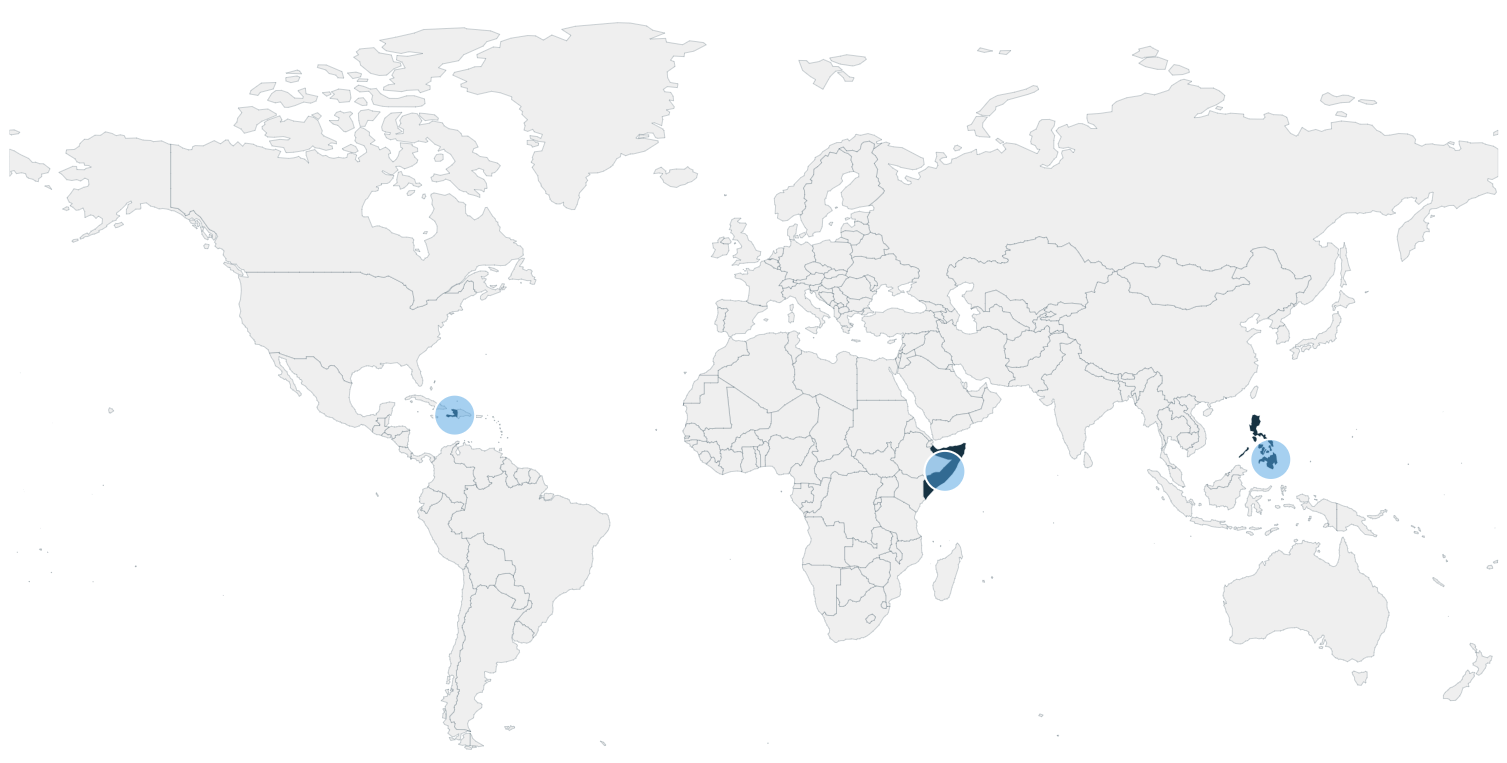
The Rockefeller Foundation Catalytic Capital (RFCC) launched the Reimagining Humanitarian Nutrition Security (RHNS) initiative, a 2+1-year pilot in three fragile states (Somalia, Haiti, Philippines-Mindanao region) to advance a shared vision of humanitarian food assistance aligned with long-term nutrition security and climate adaptation plans. Locally led by design, the program will help build resilient, community-anchored food systems. At its core, this reimagined approach embeds scaling principles into the design and implementation of three integrated components to ensure that, after the pilot, the program remains scalable, sustainable, and adaptable across diverse institutional, political, and geographic contexts.
The Scaling Community of Practice (the SCoP), in collaboration with Dalberg Catalyst, will support this initiative through a structured advisory role guided by the following Theory of Change: if scaling is intentionally integrated into program design from the outset—and regularly updated through iterative learning, stakeholder engagement, and adaptive management—the probability of achieving sustainable, scalable impact increases substantially. The SCoP will apply this theory across all components, ensuring that scaling is systematic, evidence-driven, and aligned with good scaling practice, while strengthening institutional capacity and creating an enabling environment for long-term impact.
Country Pilots Component: Rockefeller will engage implementing organizations in three fragile states to integrate anticipatory data systems into humanitarian planning and action to strengthen resilience in agriculture, food, and nutrition systems. Each pilot will develop methods for delivering data outputs to actors on the ground (delivery), helping them interpret and act on the information (decision making and action). The SCoP will work during the inception phase with implementing partners and local stakeholders to create a scaling vision and pathway, embedding scaling principles into pilot design and implementation. It will provide iterative advisory support to ensure adaptive management, continuous learning, and alignment with sound scaling practice, and will assist in developing transformational country platforms where appropriate to institutionalize, sustain, and expand impact.
MEAL for Scaling and Policy Dialogue Component: This ambitious component will pilot approaches to: (i) providing reliable, high-quality data and weather advisories for climate adaptation; (ii) creating viable delivery mechanisms; and (iii) ensuring users translate information into improved decision making and impact. Each area will face challenges in technology, institutions, and political economy. Capturing learning from pilots will be critical to inform global policy dialogue, scaling efforts, and future applied research. The SCoP will lead cross-country learning, synthesis, and dissemination of evidence, ensuring scaling is fully integrated into MEAL to support adaptive management, track progress in scaling, and shape the enabling conditions required for sustained policy influence and systems transformation.
Resources

At a glance
The Scaling Up Country Platforms Room, part of the 17 Rooms flagship, convenes diverse leaders and experts to explore how nationally led country platforms can be reimagines as infrastructure for transformational scaling. Through an action-oriented process, the Room seeks to fortify practical pathways that align coordination, incentives, and learning around sustainable impact at scale, informing future policy, practice, and investment.
Visit the Brookings site for more information.

Convening Period
June – July 2026
Funding organization


Overview
Overview
The Scaling Up Country Platforms Room aims to develop an action-oriented program that explores how country platforms can be reinforced by a systematic focus on transformational scaling, and how transformational scaling efforts can be supported by effective country platform coordination mechanisms.
Problem
Country platforms — nationally-led coordination mechanisms designed to align public, private, and international stakeholders around shared development or climate goals — have gained significant prominence in recent years across health, education, nutrition, and climate action. At the same time, scaling development impact has become of growing concern for many international funders and country-level development actors.
Yet country platforms and scaling methodologies remain largely disconnected in practice. Country platforms often fail to achieve transformational impact at scale because they are not designed with transformational scaling as an explicit, systemic goal. Conversely, scaling efforts frequently stall because they lack the country-level coordination infrastructure that platforms can provide. Moreover, both country platforms and scaling tend to operate in transactional rather than transformational modes, missing opportunities for sustained impact at the scale of the problem.
The current crisis in development and climate finance — and the acute need to do more with less — has made this gap more consequential. A more effective, systematic approach to achieve transformational scaling of country platforms is urgently needed.
Innovation in the how
The innovation for this Room is to address the gap between country-level coordination and transformational scaling by reimagining country platforms from coordination mechanisms into transformational scaling infrastructure: nationally led mechanisms that do not merely coordinate actors around transactional, one-off projects in support of short-term results targets, but instead organize stakeholders, finance, evidence, incentives, and institutional capacity for achieving the enabling conditions (policies, institutions, political viability – localization, in essence) that are needed for a long-term pathway to sustainable impact at the scale of the development problem.
This shifts the purpose of a country platform from aligning actors around individual projects to closing the missing link between coordination and scale: what needs to grow, what systemic conditions need to change, who must sustain and expand the programs, and how progress can continue beyond any single funding cycle or initiative.
In short, the Room will explore the necessary incentives and structure for country platforms to move from development coordination to driving transformational scaling.
Room focus
The Room will test a practical proposition by drawing primarily, but not exclusively on the experience in the health and climate areas: country platforms can become vehicles for transformational scaling if they are designed around a small set of mechanisms that convert coordination into sustained system change.
Based on the current state of the scaling and country platform literature and practice, the Scaling Community of Practice has tentatively identified the following key mechanisms that could define an effective approach to pursue transformational development and climate impact at scale with country platforms:
- Scale pathway: Define the development or climate problem at national scale, the long-term impact goal, and the pathway from current interventions to systemic change.
- Institutional anchoring: Identify the domestic institutions, intermediaries, or coalitions with the mandate, capacity, and legitimacy to sustain the pathway over time.
- Inclusive structure: Involve the private sector and CSOs effectively in transformational country platforms; for the private sector this means not only unlocking of individual transactions, but importantly the shaping of markets, including capital markets, for transformational impact at scale; for CSOs, it means empowering them for active participation.
- Incentives, finance, and accountability: Align government, funder, private-sector, CSO and implementation incentives around long-term scale goals, not just project-level outputs.
- Adaptive learning: Build evidence, monitoring, evaluation, and learning systems that support course correction as the scaling pathway evolves.
- Funder alignment and handoff: Ensure external funders support nationally led scaling pathways, coordinate their instruments, and plan for responsible transition to domestic ownership.
- Political constraints and opportunities: Account for the realities in which country platforms and scaling operate at country, regional and global level.
- Managing tradeoffs: Recognize and transparently manage inevitable tradeoffs, including broad, integrative versus narrow, targeted scope; inclusive participation and ownership versus narrow participation of principal actors needed for implementation; focus on immediate, impactful results versus pursuit of long-term system-strengthening actions.
Questions to be addressed
- What would it take for country platforms to become true vehicles for transformational scaling rather than coordination mechanisms for projects and funding flows? Does it require a transformational scaling approach to be taken by the main participating actors?
- What are the main barriers preventing country platforms from achieving systemic impact at scale, and how can they be overcome?
- How can country platforms better align political and institutional incentives, institutional capacity, financing, and stakeholder participation around long-term national transformational scaling pathways?
- What does genuine country ownership look like in transformational country platforms, particularly in relation to external funders and private-sector actors?
- What practical changes in platform design, governance, financing, and learning systems are needed to sustain impact beyond individual projects or funding cycles?
- Is there any CP that is functioning along the lines discussed earlier? Is there a concrete suggestion for a sector/country where the group’s thinking could be applied?
Background reading
Country platforms
“County Platform Development Note” (Tanaka et al., ODI 2025)
Scaling
“Scaling Fundamentals” (Cooley and Linn, SCoP, 2024)
Scaling and country platforms
“The Potential Role of Scaling and Country Platforms in Forging Multistakeholder Partnerships for Transformational Impact at Scale” (Kirkbride and Linn, 2026 draft)
“GFF Experience with Scaling and Country Platforms” (Linn, 2024)
At a glance
The Scaling Coalition (SC) brings together leading global partners to address collective challenges in scaling agrifood innovations that no single organization can solve alone. Aligned with the SCoP’s mission, the SC seeks to strengthen the global scaling ecosystem by accelerating the reach, efficiency, and sustainability of proven solutions at scale.
Visit the Scaling Coalition’s site for more information.
Partners





Objectives and activities
Objectives
The Scaling Coalition aims to:
- Build a global scaling ecosystem that ensures agrifood innovations reach those in need faster, more efficiently, and cost-effectively
- Co-create solutions to collective challenges that constrain the scaling of innovations
- Bring diverse partners together to transform fragmented scaling efforts into better aligned scaling investments, frameworks, standards, knowledge, tools, etc.
- Provide a space to exchange, learn, collaborate, and co-design solutions that benefit the agrifood sector of developing countries
Approach
The SCoP, through its Agriculture, Rural Development and Social Enterprise Working Group (ARDSEWG), supports the Coalition by leveraging its global community to:
- Engage the SC in two-way flows of scaling ideas, discussions, and solutions
- Amplify SC reach and visibility within the broader scaling community
- Connect SC work to both Solution Group participants as well as a wider audience of practitioners and stakeholders
Activities
Key areas of collaboration include:
- Supporting active ARDSEWG participation and in-kind contributions to Scaling Coalition Solution Groups
- Collaborating to identify major bottlenecks and establish new Solution Groups
- Conducting outreach and engagement across SCoP membership to mobilize contributors to priority topics
- Providing neutral, third-party support (analysis, convening, coordination guidance) to founding members
- Disseminating updates, learning outputs, and engagement opportunities through SCoP channels (newsletter, website, social media)
- Producing meeting summaries, action points, and coordination notes, including participation tracking
- Providing operational and administrative support for convenings (webinars, communications, reporting, formatting outputs)