What does it take to scale responsive public services in communities that governments have long neglected? This case examines that question through the experience of Asivikelane (‘Let’s protect one another’ in isiZulu), a South African campaign focused on water, sanitation and hygiene (WASH) services in informal urban settlements. Launched in 2020 during the COVID pandemic, Asivikelane has contributed to thousands of service delivery improvements reaching millions of informal settlement residents across South Africa’s eight largest cities, while evolving and deepening its scaling approach over time.
The central lesson from Asivikelane is about what it takes to build the conditions for collaborative engagement between communities and government for service delivery, shifting deeply embedded dynamics of exclusion and frustration. Asivikelane’s journey illustrates what this looks like in practice, and lessons for scaling impact for urban services.
Asivikelane is part of the SPARK program supported by the International Budget Partnership. This case is adapted from blogs previously published by the Governance Action Hub[1].
The Challenge: A Vicious Cycle of Unresponsive Service Delivery
As of 2022, 10 million South Africans were living in informal settlements or slums — an increase of 1.5 million over the previous decade, according to the UN Human Settlements Programme. Most informal settlement residents have some access to WASH services, but the large majority these services are communal and inadequate for household needs.
The consequences fall hardest on women, who spend significant time collecting water for household use and report feeling unsafe using communal facilities at night. Infrastructure is often in disrepair: only 20% of informal settlement residents report broken taps and toilets being repaired within a month. Nearly half say repairs never happen.
Informal settlements in South Africa are caught in a vicious cycle. Low government responsiveness produces frustration and disengagement. Disengagement deepens distrust. Deeper distrust produces further distance between community and government. Those who feel excluded by the dominant system may feel that visible, disruptive protest is their only option.
The general failure of government service provision had, over time, generated increasingly widespread and often violent protests. But frequent and largely uncoordinated protests were not translating into improved public services.
What does it take to strengthen responsiveness for WASH service delivery in informal settlements?
Breaking out of this vicious cycle is far from straightforward. Previous efforts have had mixed results, particularly those that have focused on providing information to government about service delivery gaps on the assumption that action would be taken based on this information. Rather, effort needs to be directed at strengthening the enabling conditions for government actors and communities to work together to address service delivery needs and priorities.
Collaboration requires a minimum enabling environment: some degree of access, some degree of trust and accountability, and some degree of political stability. As the Asivikelane case demonstrates, some enabling conditions can be created and strengthened, but in some contexts this remains out of reach. Furthermore, collaboration needs to be bolstered by accountability to ensure ongoing responsiveness, thus media and oversight institutions need to be considered as part of the ‘accountability ecosystem’ enabling collaborative engagement.
Collaborative engagement between communities and government offers real benefits. It can leverage diverse perspectives, information and capacities. Collaboration can build relationships and trust that can enable virtuous cycles over time, shifting how government actors think about their role and responsibilities toward informal settlement residents.
But collaborative approaches carry risks. They can become narrow, focusing on a small set of willing government actors while leaving broader systemic factors unaddressed. Even where government actors respond, action may remain at the discretion of a single decision-maker, leaving power asymmetries intact and raising sustainability concerns. Community actors have limited time and energy for continuous engagement; a drop in participation can quickly cause a slide back to low-responsiveness patterns.
These risks mean that collaborative engagement must be grounded in a broader analysis of the actors and factors shaping responsiveness — including the incentives that limit it and the bottlenecks that constrain even willing government actors. This kind of systemic, adaptive approach is often not found in purely technical or advocacy-based approaches.
This analysis and adaptation is also fundamental to creating and strengthening the enabling conditions for collaboration between informal settlements and government in the first place, as the Asivikelane case demonstrates.
Asivikelane’s Evolving Approach
Phase 1: Information and Incentives (2020–2021)
Asivikelane was launched as a national campaign by a group of civil society organizations focused on urban services during the COVID crisis, when city governments had strong incentives to be seen as responsive to public health needs. Its initial focus was on generating and sharing real-time, comparative data on WASH service delivery across South Africa’s eight largest cities.
At the center of this approach was a network of community facilitators — most of them women, all living in informal settlements — who conducted the Asivikelane survey. The survey used a consistent methodology, producing credible evidence on WASH services and gaps. This allowed Asivikelane to provide both a real-time snapshot of overall WASH performance across eight cities and targeted information about specific service failures.
During this initial period, the credibility of the data — and of the campaign itself — was established. This opened doors to government actors and built the foundation for deeper engagement.
Phase 2: Relationships and Systemic Engagement (2022–2023)
As the campaign deepened, the emphasis shifted. Data remained central, but Asivikelane invested more heavily in building relationships with government actors at multiple levels — front-line service providers, managers and directors within each city, and relevant national institutions including the Treasury and the Auditor General.
Engagement between community facilitators and government actors enabled many service delivery improvements. Asivikelane’s civil society members complemented survey data with technical research on underlying bottlenecks — weak procurement practices, inadequate reporting mechanisms for faulty infrastructure, misaligned budgets — that led to repeated service failures.
Engagement with city actors became more normalized, and in several cases institutionalized, as cities integrated Asivikelane data. This included Asivikelane supporting informal settlement residents to participate in formal city budgeting processes. Across eight cities and several national institutions, Asivikelane sought to make progress on the underlying bottlenecks driving service gaps.
But the picture was uneven. Many government actors became more responsive. Others remained or became less so, especially where challenging political dynamics in several cities made sustained engagement difficult. The limits of a primarily information-and-engagement approach were becoming clearer.
Phase 3: The Hub Model (2023–present)
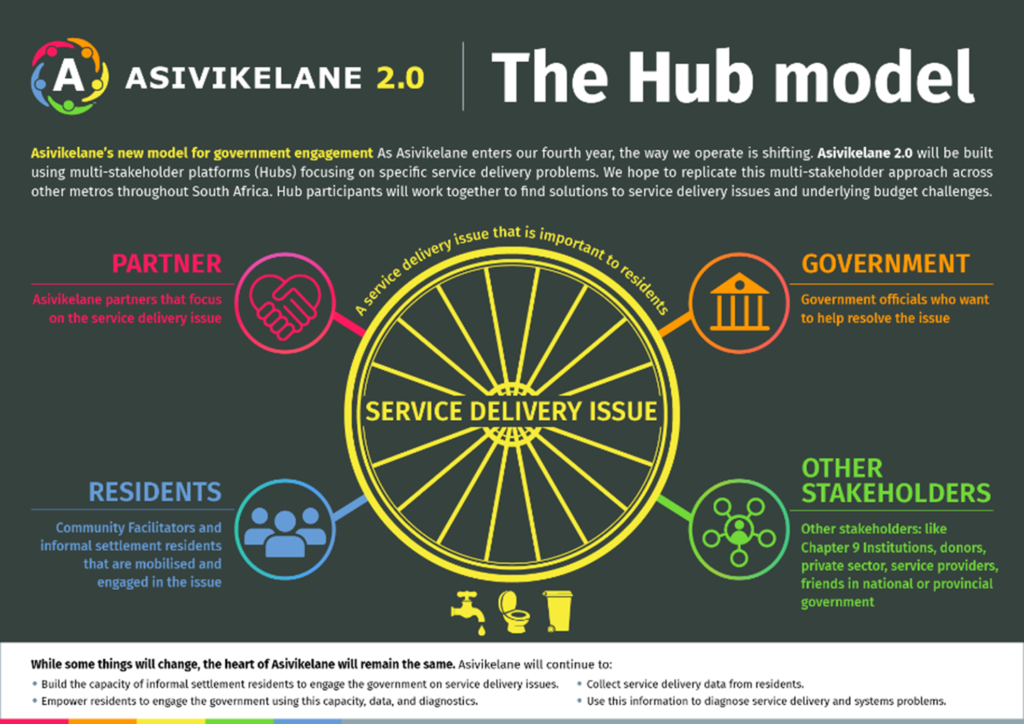
Starting in 2023, reflection on advances and limitations prompted a more concrete shift. As noted, despite notable gains, further progress – particularly on addressing structural bottlenecks – was mixed. It was becoming clear that addressing systemic bottlenecks required a deeper collaborative problem solving approach involving communities, civil society organizations, local and national governments, and other relevant stakeholders.
Asivikelane responded by shifting toward a ‘hub’ model: focused on specific geographies, specific services, and specific stakeholders, with Asivikelane acting as convener. The Hub approach requires a minimum enabling environment and could be applied uniformly across all cities, particularly in a fraught political context.
In 2025, this approach was illustrated by the Sustainable Informal Settlement Infrastructure Summit, which brought together informal settlement residents, civil society, and local and national government representatives. The summit produced agreement on a collaborative approach that recognizes and supports community-based solutions while also addressing policy and budgetary constraints. If implemented, this could unlock complementarities between community and government efforts and drive further WASH impacts.
Collaborative engagement for WASH impacts at scale
Asivikelane’s evolving collaborative approach has contributed to many positive improvements in WASH service delivery. This is more notable given prevailing unresponsiveness of city authorities to informal settlements at the time Asivikelane was initiated.
Asivikelane’s evolution reflects a continued deepening of understanding of the service delivery systems in informal settlements in South Africa. This includes analysis of public finance and service delivery systems as well as nuanced understanding of the capacities, incentives, relationships and attitudes of individual government actors and service providers. This exemplifies how collaborative engagement with government needs to be informed by a broader analysis of the actors and factors shaping and constraining responsiveness and service delivery, including the incentives that limit responsiveness and the bottlenecks that could undermine the capability of government actors and service providers to respond to community priorities.
This initial and ongoing analysis by collective civic actors and their government allies can inform more nuanced, adaptive and systemic approaches to collaborative engagement, rather than more linear or simplistic approaches. Asivkelane’s Hub approach seeks to balance breadth and depth of engagement, thus enabling more systemic impacts on service delivery systems. The collaborative multi-stakeholder Hub approach requires a minimum enabling environment that is not present in every city, thus Asivikelane has had to adapt its scaling approach based on these realities.
Overall, Asivikelane demonstrates that there is no silver bullet or single pathway to responsive public services. Rather, Asivikelane provides a platform for informal settlement residents and their allies in civil society and government to understand, navigate and – over time and where possible – collaboratively shift the formal and informal public resource governance system that enables and constrains responsive service delivery. This requires incentives, attitudes, trust and relationships to work collaboratively across differences in roles, responsibilities, and life experiences. These are key enablers that Asivikelane has worked hard to establish, maintain, and leverage for meaningful change in urban service delivery in South Africa. The campaign continues to learn and adapt both its overall approach and the engagements it supports among specific hubs of stakeholders in order to deepen and sustain responsiveness going forward.
[1] Collaborating for Responsiveness? Asivikelane’s Evolving Approach to Community Engagement with Government to Improve Service Delivery in South Africa – Part 1 – Governance Action Hub,