INTRODUCTION
The OECD has invited stakeholder input into its Review of the Development Assistance Committee, explaining the context and purpose as follows:
“Development co-operation is facing unprecedented challenges and longstanding calls to better reflect the reality of today’s world. In response, the OECD Development Assistance Committee (DAC) has launched a review process to examine the implications of this changing landscape on its roles, tools and partnerships. The DAC is a unique international forum of many of the largest providers of bilateral aid. Its overarching objective is to promote development co-operation and other relevant policies that contribute to the sustainable growth of developing countries. The ultimate aim is a future in which no country will depend on aid. The DAC is organizing its reflections within this review across four workstreams (see the terms of reference for each workstream):
- Enhanced, transparent and timely data on official development assistance (ODA), as well as other official and private flows;
- Role of ODA within total development finance flows;
- Country eligibility and the ODA graduation process; and
- DAC ways of working.”[1]
“The key vision of the DAC Review remains to carefully review and improve our role, tools, and partnerships, in light of the dramatic geopolitical and geoeconomic changes taking place and as these changes affect the international development co-operation ecosystem, of which DAC is an important part. In doing so, we must explore all necessary changes to better respond to the financing and development needs of partner countries and to do so in an open and inclusive manner that will make the DAC fit for purpose and for the future.”[2]
The Global Community of Practice on Scaling Development Outcome (Scaling Community of Practice, or SCoP for short) respectfully submits its input into the DAC Review under workstream 2 (“Role of ODA within total development finance flows.”) The main goal of this input is to get the DAC and its members to mainstream a systematic transformational scaling approach into their standards, guidance and operational practices for development co-operation. Specifically, this input proposes that:
- DAC include criteria of transformational scaling in the OECD-DAC evaluation and peer review methodologies and practices, into its work on trilateral co-operation, and into its newly initiated workstream on digital transformation in low and middle-income countries;
- DAC support its members in implementing the recently issued DAC Guidance on Scaling Development Outcomes;[3]
- DAC develop a new work stream on country coordination platforms; and
- DAC partner with the Scaling Community of Practice in the design and implementation of the Scaling Campaign 2026-2030.[4]
This input document briefly reviews the rationale for transformational scaling and for the four proposed DAC initiatives. It also provides background on and references to the work of the Scaling Community of Practice and the Scaling Campaign 2026-2030.
CLICK HERE TO READ MORE
RETHINKING DEVELOPMENT CO-OPERATION: THE TRANSFORMATIONAL SCALING AGENDA[1]
Since 2000, $3.4 trillion has flowed into international development assistance but the good intentions of the 2005 Paris Declaration on Aid Effectiveness were never realized. The gap between actual impact and possible population-level impact remains stubbornly wide, not because of bad intentions, but because of a broken system and practice of development co-operation.
- Aid fragmentation increased as the number of donor agencies trebled 2004-2023 and average grant size shrank.
- Most donor-funded interventions fail to scale due to lack of local ownership, of planning beyond project end, of systematic hand-off from one funder to the next, and of sustained efforts to address systemic constraints.
- As a result, only a fraction of potential beneficiaries are reached and the “scaling dividend” goes unclaimed.
Based on over two decades of evidence, there is now an opportunity to rethink development co-operation by making transformational scaling the standard practice across global development and climate ecosystems:
→ From projects to systems development
→ From donor agency to local agency
→ From short-term results to pathways addressing unmet needs
→ From fragmented aid to funding scaling platforms
→ From ex-post evaluation of project impact to real-time scaling progress assessments
Development co-operation that works via partnerships in support of nationally owned transformational scaling pathways will build systemic capacities and generate dynamic enterprise, investment and employment growth, which fragmented project-based co-operation fails to do. The current crisis in international development and climate finance heightens the urgency of a more effective use of national and external resources.
Three key insights change the way the international community needs to think about development co-operation:
1. From transactional support to transformational scaling
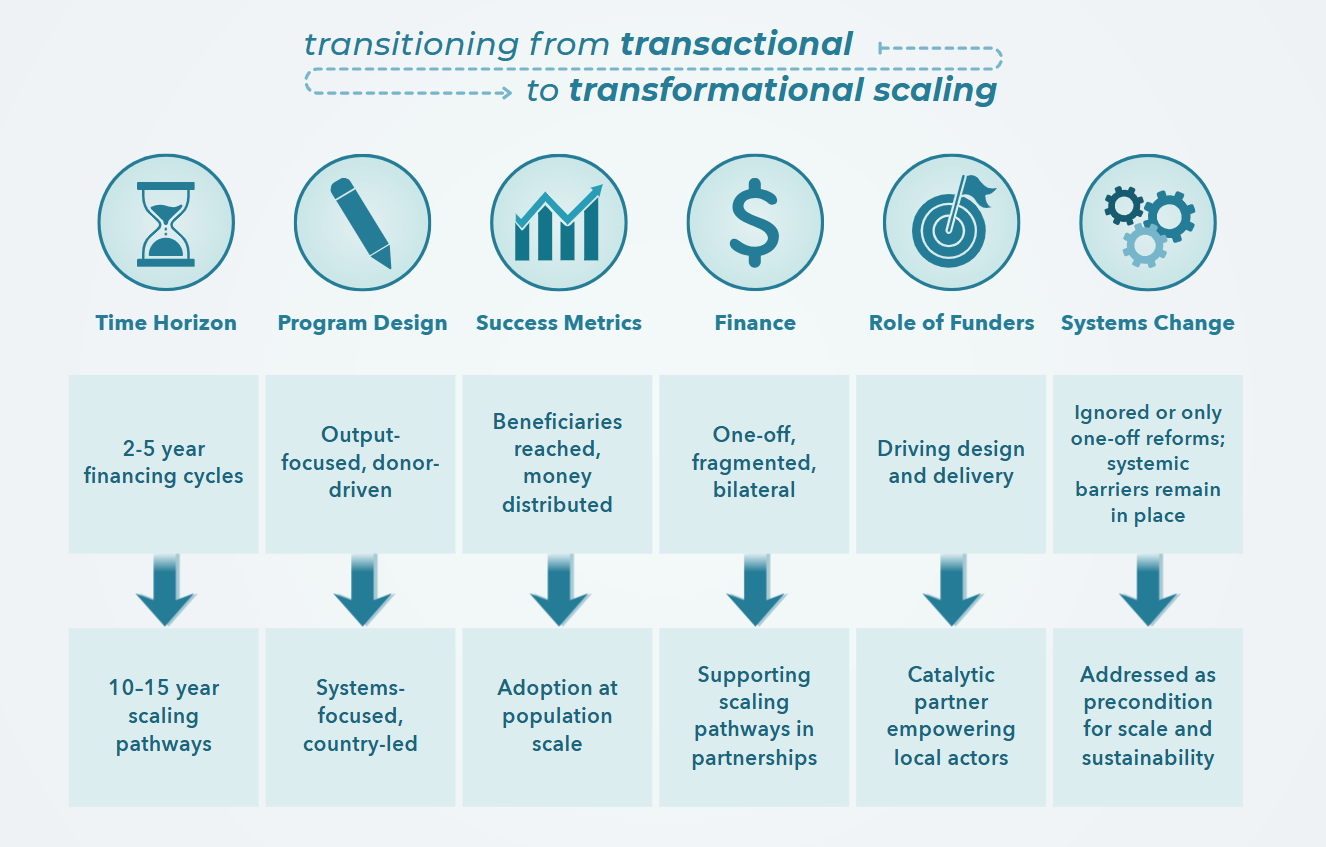
Development assistance has offered “transactional” support with one-off, fragmented projects or simply doing more of the same. Instead, it needs to pursue “transformational scaling” by reframing the entire logic of intervention design, incentives, and impact measurement. (Figure 1)
|
Figure 1: Transitioning from transactional to transformational support to transformational scaling
|
2. From transactional to transformational country coordination platforms
Country coordination platforms are important instruments to align national stakeholder and external funder interests with a country’s long-term development agenda. However, the platforms must be transformational in design and implementation, underpinned by a transformational scaling approach by each of the participating organizations. Regional and thematic platforms can support transformational scaling at country level, including recent initiatives by the international funder community, such as Mission 300 for energizing Africa, Health Works, Water Forward and the Global Energy Alliance.
Transformational country-led platforms coordinate key domestic and international stakeholders in support of transformational scaling with
- Country ownership
- A long-term vision (associated with SDGs)
- Strategies (adaptive, inclusive, long term pathways matched to the scale of needs)
- Modalities (scaling platforms, with necessary facilitation processes and resources)
- Financing (budgets, local banks – private and public, medium and long term funding from bilateral and multilateral sources)
- Evaluation (real time appraisals of evolving pathways and opportunities)
Principal stakeholders have to mainstream transformational scaling pathways into their operational practice if they are to be effective in supporting transformational country platforms.
3. From transactional to transformational development co-operation
International development funders in general, and ODA in particular, contribute generally only a fraction total development financing needs, but they have a special responsibility to mainstream a transformational scaling approach into their operational practice rather than continue what has been the widely prevalent transactional approach:
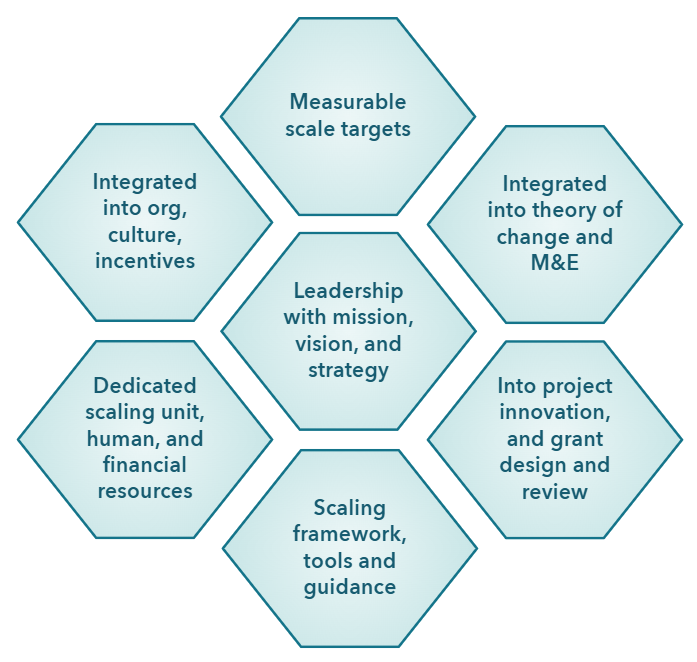
- Mainstreaming means integrating the scaling perspective throughout the funder organization (Figure 2, next page).
- Mainstreaming doesn’t happen on its own. It involves a systematic institutional change process.
- Mainstreaming needs persistent leadership to change internal culture, incentives, resource allocation, operational processes and monitoring and evaluation.
|
Figure 2: Key elements of a mainstreaming scaling in funder organizations
|
Many development and climate finance leaders have in recent years stressed the importance of achieving impact at scale, including the heads of major bilateral and multilateral development and climate finance organizations. These signals from the top are essential, but they have to be followed up and implemented through systematic action at the level of each funder organization. DAC can provide helpful support in the form of shared experience, standards and guidance.
PROPOSED ACTIONS FOR DAC TO INTEGRATE SCALING INTO ITS DEVELOPMENT CO-OPERATION APPROACH
As noted in the Introduction, this input proposes four areas in which DAC can integrate scaling into its development co-operation approach and support its membership and partners countries in doing the same. This section briefly explains the actions to be undertaken in each area.
1. Integrate scaling into current DAC workstreams: evaluation, peer assessments, trilateral co-operation and digital transformation.
DAC has a number of current work streams where scaling should be integrated for greater development effectiveness.
DAC evaluation criteria. DAC has played a highly effective lead role in articulating and promoting common evaluation criteria. The DAC evaluation criteria[2] are universally referred to and used by development evaluation organizations and experts. The DAC Secretariat also serves as the secretariat for EvalNet, the network of the evaluation offices of DAC members and affiliated development and climate finance organizations.[3] A recent review of the DAC evaluation criteria by the Scaling Community of Practice revealed that scaling in general, and key elements of transformational scaling in particular are currently no represented in the criteria and no guidance is offered to evaluation offices and practitioners on how to evaluate development actions from a scaling perspective.[4]
Proposal 1: Integrate transformational scaling in to the DAC evaluation criteria and provide guidance to evaluation offices and practitioners on how to evaluate development actions from a scaling perspective.
DAC Peer Review methodology. DAC provides peer assessments of member development co-operation practices.[5] It has developed a peer assessment methodology which so far does not effectively incorporate a scaling perspective, according to a review of its approach by the Scaling Community of Practice.[6] As the members are increasingly paying attention to scale it will be important that the peer review practice reinforce this salutary trend and offer members a systematic and transparent approach to assess progress. The Scaling Community of Practice has developed a Mainstreaming Tracker Tool (MTT)[7] that allows funder organizations to assess their mainstreaming efforts across a number of key elements. This is available for DAC use and adaptation in its peer reviews.
Proposal 2: Integrate transformational scaling into the DAC peer review methodology and provide guidance to peer reviewers on how to evaluate the mainstreaming by DAC members into their development funding practice.
This proposal also applies to the assessment methodology of the Multilateral Performance Network (MOPAN), which assesses the performance of multilateral development finance agencies and is affiliated with OECD-DAC,[8] since it currently does not effectively include scaling in its assessment methodology.[9]
OECD Trilateral Co-operation support. According to its website, OECD supports triangular partnerships between governments and other stakeholders for sustainable development with data, analysis, tools and advice.[10] Triangular co-operation reflects by design a scaling approach as it is supports the sharing of lessons and co-operation across multiple partners. The challenge for OECD is to ensure its support focuses on transformational scaling approaches, i.e., supports triangular partnerships that go beyond one-off, transactional engagements and instead form longer-term transformational bonds that allow the partners to work together along longer-term scaling pathways.
Proposal 3. Review the current methodologies of OECD support for trilateral partnerships with a view to integrating a transformational scaling perspective.
DAC support for digital transformation. DAC has recently launched a work stream on digital transformation in low and middle-income countries. As the discussions at the virtual launch event demonstrated, there are great opportunities for scaling up digital capacity in these countries. Scaled up digital capacity is in turn critical for supporting transformational scaling pathways across all development sectors. It will be important that this work is effectively resourced and sustained by DAC for it to reach its potential.
Proposal 4. Support the new workstream on digital transformation with sufficient resources on a sustained basis so it can reach its large potential impact.
2. Support members in implementing the recently issued “DAC Guidance on Scaling Development Outcomes”
OECD issued the “DAC Guidance on Scaling Development Outcomes in December 2024 with the assistance of the Scaling Community of Practice.[11] This guidance document is intended to help members integrate a scaling perspective into their funding approaches. This will require systematic follow up by the DAC Secretariat by engaging with members, supporting those ready to do what is needed to respond to the guidance, monitor progress across the DAC membership, and learn lessons that can in turn inform the guidance offered by DAC. The guidance document is also an essential resource for the OECD-DAC evaluation, peer assessment, trilateral co-operation and digital transformation.
Proposal 5. Support members in implementing the recently issued “DAC Guidance on Scaling Development Outcomes” and develop lessons from its implementation in co-operation with the evaluation, peer review, trilateral co-operation and digital transformation workstreams
3. Develop a new work stream on country coordination platforms
As noted in Section B above, country coordination platforms are potentially very useful in supporting transformational scaling pathways in particular sectors or subsectors. They have long been a focus of health service funding agencies (such as the Global Fund, Gavi and the Global Financing Facility), but have also been deployed in other sectors and for humanitarian and reconstruction purposes. More recently, they have received a lot of attention in the climate action area. At COP30 in Belém, Brazil, a new Country Platform Hub was established with the goal to support the development of country platforms for climate action in multiple countries. As argued by the Scaling Community of Practice, it will be critical that these platforms are based on transformational scaling practices by their participants if the platforms in turn are to be transformational in impact, and not merely reflect one-off, transactional engagement by the participants. DAC can play a supportive role by monitoring and assessing country platform experience across different countries and sectors and advise its members and partner countries on how best to support country platforms.
Proposal 6. Develop a new workstream on country coordination platforms across sectors and countries.
4. Partner with the Scaling Community of Practice in the design and implementation of the Scaling Campaign 2026-2030.
The Scaling Community of Practice (SCoP) is the major global institution dedicated entirely to building, advancing, and mainstreaming the science and practice of scaling in international development and climate action.[12] Founded in 2015, the SCoP has spent a decade doing the foundational work no one else was doing. It currently has over 5,000 members from 1,300 organizations in 127 countries. It has created a strong track record and organizational capacity for exchange of scaling experience, generating the evidence base, connecting the practitioners and changing institutional practice in support of scaling efforts.[13] The SCoP has had a fruitful partnership with OECD-DAC in connection with the preparation of the DAC Guidance on Scaling Development Outcomes.
The SCoP has recently launched the Scaling Campaign 2026-2030.[14] The Campaign mobilizes a five-year coalition that will help create a tipping point where a systematic emphasis on transformational scaling becomes standard practice across the global institutional development and climate ecosystems. It is designed to create three coalitions:
- A coalition of implementers, funders and civil society of scaling action at country level
- A coalition of strategic partners
- A coalition of funders
For the initial phase of the Scaling Campaign, the SCoP has identified a number of possible initiatives[15] which include a number that could be of interest to the DAC:
- Country strategies as a locus for scaling
- Country experience with transformational scaling
- Mainstreaming of scaling by innovation funders
- Scaling of digital and AI innovations and the use of digital mechanisms as scaling pathways
- Mainstreaming scaling in official evaluation methods and practice
The SCoP is very interested in continuing its engagement with DAC in these and other areas by seeking the involvement of DAC in the Scaling Campaign 2026-2030. The SCoP in turn stands ready to support DAC if it decides to pursue the proposals 1.-6. above.
Proposal 7. Partner with the Scaling Community of Practice in the design and implementation of the Scaling Campaign 2026-2030 and in the design and implementation of proposals 1-6 above.
[1] https://www.oecd.org/en/events/public-consultations/2026/04/call-for-input-review-of-the-development-assistance-committee.html
[2] https://one.oecd.org/document/DCD/DAC/RD(2026)9/FINAL/en/pdf
[3] See “DAC Guidance on Scaling Development Outcomes” (2024). https://www.oecd.org/en/publications/dac-guidance-on-scaling-development-outcomes_621810cc-en.html This guidance document was prepared with the support of the Scaling Community of Practice. It represents a very useful resource for the implementation of the DAC scaling agenda proposed in in this input.
[4] https://scalingcommunityofpractice.com/wp-content/uploads/2025/11/SCoP-Scaling-Campaign-2026-2030-Brochure-Final-Nov-2025.pdf
[1] For further details on transformational scaling and references in the literature see these documents of the Scaling Community of practice: https://scalingcommunityofpractice.com/wp-content/uploads/2026/05/The-Transformational-Scaling-Agenda-MAIN.pdf and https://scalingcommunityofpractice.com/wp-content/uploads/2026/04/The-Transformational-Scaling-Agenda-ANNEXES.pdf
[2] https://www.oecd.org/en/topics/sub-issues/development-co-operation-evaluation-and-effectiveness/evaluation-criteria.html.
[3] https://www.oecd.org/en/networks/dac-network-on-development-evaluation-.html
[4] https://scalingcommunityofpractice.com/wp-content/uploads/2025/04/FINAL-Evaluation-Guidelines-of-Official-International-Development-Funders.pdf
[5] https://www.oecd.org/en/topics/development-co-operation-peer-reviews-and-learning.html
[6] https://scalingcommunityofpractice.com/wp-content/uploads/2025/04/FINAL-Evaluation-Guidelines-of-Official-International-Development-Funders.pdf
[7] https://scalingcommunityofpractice.com/wp-content/uploads/2025/03/Final-MTT-Abridged-1.pdf
[9] https://scalingcommunityofpractice.com/wp-content/uploads/2025/04/FINAL-Evaluation-Guidelines-of-Official-International-Development-Funders.pdf
[10] https://www.oecd.org/en/topics/sub-issues/development-co-operation-in-practice/triangular-co-operation.html
[11] See “DAC Guidance on Scaling Development Outcomes” (2024). https://www.oecd.org/en/publications/dac-guidance-on-scaling-development-outcomes_621810cc-en.html.
[12] www.scalingcommunityofpractice.com
[13] See https://scalingcommunityofpractice.com/wp-content/uploads/2026/04/SCoP-Value-Proposition-v2.pdf and https://scalingcommunityofpractice.com/wp-content/uploads/2025/11/SCoP-Scaling-Campaign-2026-2030-Brochure-Final-Nov-2025.pdf
[14] As for footnote 17.
[15] https://scalingcommunityofpractice.com/wp-content/uploads/2025/12/SCoP-Campaign-Initiatives-Dec-2025.pdf