A. Introduction
The world faces enormous development, humanitarian, and climate challenges at the very time when traditional sources of international financial support are suffering major cutbacks. Likewise, governments in the Global South, the private sector and civil society are under stress, while communities face major challenges to their cohesion and traditions of civic culture. This puts a premium on ensuring that the available financing shifts its focus from funding innovative standalone projects to increasing the capacity of governments, social enterprises, and the private sector to deliver long-term impacts that address global problems sustainably and at the scale of the problem.
A recent report by the Scaling Community of Practice (SCoP) assesses to what extent and how 28 public and private funders (see the Annex for a full list of case studies) have mainstreamed consistent approaches to scale and scaling into their policies,multi practices and priorities and synthesizes lessons from their experience. Case studies for this mainstreaming initiative were purposively selected to examine a wide range of funder organizations known to be making serious efforts to mainstream scaling into their core operations. Following an “action research” approach, funder staff wrote or supported the writing of all 28 case studies. The Synthesis Report also draws selectively on the related experience of the three authors with a range of other funders.
This note focuses specifically on the implications of the mainstreaming initiative for large multilateral and bilateral official funders supporting international development and climate action in multiple sectors.[1] These organizations potentially play key roles in supporting the pursuit of sustainable impact at scale. The paper concludes that they have so far insufficiently focused on supporting transformational scaling, since they have remained generally wedded to the traditional operational model of support for one-off projects without systematic attention to longer-term scaling pathways and their enabling conditions. However, there are indications that the senior managements of some of these funder organizations are now focusing increasingly on impact at scale. It will be important that they pursue not just transactional scaling but ensure that their frontline staff are empowered and incentivized to support transformational scaling by their development partners on the ground.
The note summarizes in Section B the general findings and lessons for funder organizations that also apply to multilateral and bilateral official funders. Section C presents findings and lessons that apply specifically to multilateral and bilateral official funders. Section D offers concluding observations. Annex 1 contains a list of all 28 funder case studies. Annex 2 reviews recent announcements and initiatives by the World Bank to strengthen its focus on impact at scale, especially in the health sector.
CLICK HERE TO READ MORE
B. General Findings and Lessons
The main findings and lessons of the mainstreaming initiative can be summarized as responses to the key questions addressed. These findings apply to funders in general, including multilateral and bilateral official funders working in developing countries.
1. To what extent have funder organizations mainstreamed a systematic focus on scaling?
- Scaling is a topic of rapidly growing and now widespread interest in the funder community.
- Overall, funders have made the most progress in incorporating a scaling focus in statements by agency leadership and embodying it in mission statements. There is frequently a gap between high-level aspirations and implementation of the needed internal changes in incentives, systems and metrics.
- Trade-offs, such as scale and equity, scale and quality, etc., do not get the attention they merit.
- Insufficient attention is paid to funder collaboration, to handoffs among funders, and to engaging institutions with the ability and incentive to fund and provide services over time.
- The distinction between transactional and transformational scaling is of central importance but not widely recognized. Transactional scaling focuses on one off increases in impact, measured against a base line rather than a long-term goal. Transformational scaling requires a long-term vision of scale and scalability from the beginning and measures progress in terms of impact and progress relative to the long-term goal. It has an explicit and sustained focus on systemic change, persistence in engagement, a focus on localization and partnerships, and frequent adaptation in response to lessons learned.
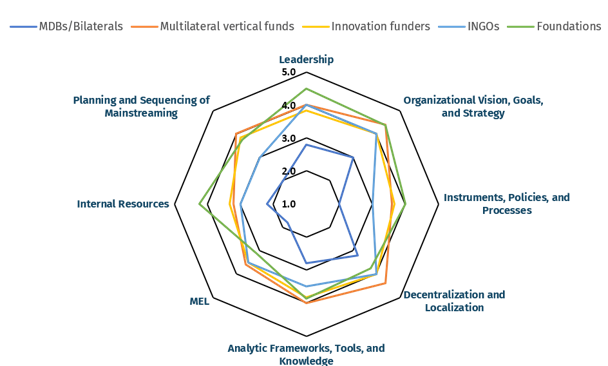
- An AI-based analysis of the case studies, drawing on key elements of the Mainstreaming Initiative’s Tracker Tool,[1] allows a comparison of mainstreaming across types of funders, by rating them according to eight criteria of mainstreaming drivers. Figure 1 below summarizes the results of the AI analysis. It shows that foundations, innovation funders, and vertical funders are farthest along in mainstreaming scaling, followed by INGOs in the middle, while Multilateral Development Banks (MDBs) and bilateral official funders lag behind. The remainder of this section provides a detailed assessment of the mainstreaming experience across all funder categories.
| Figure 1. Mainstreaming score by funder type and factor
Source: Mainstreaming Initiative Synthesis Report https://scalingcommunityofpractice.com/wp-content/uploads/2026/03/FINAL-Mainstreaming-Initiative-Synthesis-Report.pdf |
2. What funder practices are most critical in supporting transformational scaling?
- Initiate scaling from the beginning (“start with the end in mind”): It is not sufficient for funders to focus on scaling at the end of an innovation process or when exiting a project. There needs to be a clear vision from the outset of what successful scaling looks like. The conditions that allow scaling to happen – primarily alignment with domestic priorities and resource and implementation constraints at scale – have to be addressed from the beginning of the scaling pathway.
- Incorporate scalability assessment: A systematic assessment of scalability helps guide, monitor, and evaluate the design and implementation of the scaling process by assessing the enabling conditions of scaling – demand, costs, incentives, financing, capacity, political support, etc. – and drawing attention to issues such as complexity; potential opposition; ease of production and delivery by suppliers; ease of adoption by end users; unit cost; and availability of a “funder at scale.”
- Integrate systems change with scaling support: Achieving impact at scale requires funders to systematically identify and address institutional, policy, and political constraints alongside scaling investments to increase the probability of successful scaling and impact.
- Consider equity and inclusion explicitly: Scaling efforts can unintentionally reinforce inequality or create other unintended consequences such as adverse environmental impacts. Increased inequality is driven by the fact that reaching marginalized and vulnerable groups often requires greater time, effort, and unit cost. Funders should make equity tradeoffs explicit and target optimal — not maximum — scale.
- Double down on country ownership and localization: Transformational scaling depends on domestic actors — government, business, and civil society — owning the vision of impact at scale, the solutions and the scaling pathways, and having the capacity and mobilizing the domestic resources to sustain them. Localization too often continues to be interpreted as consultation rather than genuine changes in historical power dynamics.[2]
- Invest in partnerships with other funders: Because no single funder spans the full scaling pathway nor is best placed to undertake all the tasks needed at a given scaling stage, effective scaling requires partnerships — often through country platforms, collaborative financing mechanisms, and coordinated handoffs across scaling stages. All funders are challenged by the often unanticipated costs of developing and maintaining partnerships, which take time, resources and a willingness to harmonize processes, to share control, and to co-brand.
- Build support for scaling into monitoring, evaluation and learning: Effective scaling requires monitoring not only outputs but also impacts, enabling conditions, the continued relevance of the long-term goals and the scaling process itself. Learning from experience has to be used to revise and update objectives and scaling strategies; support adaptive, flexible management; and ensure accountability.
- Elevate the role of intermediaries: The lack of effective intermediation across the scaling pathway contributes to the stubborn persistence of unscaled pilots and the “Valley of Death” for promising innovations and interventions. Funders can be of great assistance when they go beyond traditional project financing and support local intermediaries – or use their own good offices – to broker handoffs across scaling stages, convene partners, and strengthen coordination structures.
3. What are the principal obstacles to mainstreaming scaling that funders have encountered?[3]
- The project mindset: timebound funding delivers outputs, not sustainable impact. Funders typically support time-bound (2-5 year), one-off projects that focus on delivering outputs, or at best outcomes, but not necessarily development impact. Moreover, they typically focus on outputs that can be achieved during the project’s duration, but not beyond project closeout.
- Misaligned incentives and metrics. Funder middle management and staff feel overburdened with unfunded mandates and resist additional priorities that are added on top of existing mandates. Moreover, they are often rewarded for presenting projects to their management and boards, and for disbursement, on-time delivery, and achieving their output objectives by project end. Staff receive less recognition, if any, for supporting ambitious longer-term goals of scale and sustainability. Similarly, the design and implementation of projects typically do not measure sustainability and scalability by others beyond project end. Follow-up to previous projects is often less valued by management than starting new ones. These incentive structures are often reinforced by governance and board-level expectations.
- Lack of alignment with local and national priorities. Funders often fail to align adequately with local and national priorities and ownership. The fact that local actors often have short-term goals rather than longer-term scale objectives and pathways reinforces the tendency among funders to pursue one-off interventions.
- Institutional strengthening and capacity building are missing, inadequate, or not targeting sustainable scaling. While many funders do some institutional strengthening and capacity building during the project lifetime, often these are incomplete given short project duration. More importantly, they frequently fail to address critical constraints on financial resources that stand in the way of long-term, sustainable scaling.
- Poor donor coordination, duplication, and burdensome siloed reporting versus mutually reinforcing activities. Despite decades of efforts at and exhortations for coordination and collaboration, funders operating in the same development space (geography, sector, thematic area, etc.) continue to evidence poor coordination, siloed reporting systems, duplicative efforts, etc. While partnerships are always necessary for successful scaling, international development and climate funders continue to struggle to overcome systemic obstacles to successful collaboration, especially a lack of internal organizational incentives that support and reward effective cooperation with others.
- Monitoring and evaluation methodologies and practice track outputs and outcomes against baseline, not impact against long-term targets and not enabling conditions for scaling. Project monitoring and evaluations focus on delivery against project plans, timely disbursement of funds, and narrow results targets. Monitoring and evaluation processes usually fail to generate data on scalability to support future scaling efforts and rarely examine whether projects put in place conditions for sustainability and scaling impact beyond project end.[4] More specifically, these systems and metrics typically do not distinguish between need and demand; evaluate the impact and cost effectiveness of competing approaches; assess the extent of changes from existing behaviors and practices required by adopters and implementers; measure unit costs and evaluate potential for economies of scale; identify the role of context, social issues, and the political economy across relevant stakeholders; or assess constraints to scaling in the policy enabling environment or relevant market systems.
4. What factors drive the mainstreaming of transformational scaling within funder organizations?
- Leadership must drive support for scaling. Embedding scaling across a funder organization requires leadership at all levels, but sustained change must be led from the top. Governing bodies and chief executives need to set a long-term vision for transformational impact, ensure continuity through leadership transitions, and translate commitments to scale into operational practice. The emphasis on impact at scale should not remain aspirational or merely transactional, but must be matched by changes in incentives, resources, and management systems. Clear direction, accountability, and support are essential to move from rhetoric on scaling to action.
- Corporate mission, vision, goals and definitions have to focus on transformational impact at scale. This requires funders to define what they mean by scale and transformational scaling and to establish clear, measurable long-term impact goals. Broad mandates make this more challenging, but evidence shows that the clearer and more specific the institutional commitment to achieving specific sustainable outcomes at scale, the more effectively these commitments are reflected in operational practice.
- Financial and operational instruments, policies and practices have to support a scaling approach. Funders’ financial and capacity building instruments, operational policies, appraisal criteria, monitoring and evaluation systems must explicitly incorporate scaling considerations and preconditions, shifting the focus beyond short-term project outputs toward long-term, sustainable, and scalable outcomes supported by the needed enabling conditions.
- Dedicated organizational, staff and budget resources have to be committed to scaling. Funders that have most effectively mainstreamed scaling have invested in dedicated units, staff, and budgets to build capacity, incentives, and a culture supporting transformational scaling. While centralized support and focused accountability are often necessary initially, scaling must ultimately be owned by front-line operational staff and their managers.
- Decentralization can support scaling but is not a panacea for localization. Many funders have realized the importance of localization and especially the larger ones have decentralized their operations by placing staff in country or in regional hubs. This closeness to the client helps with consultation and coordination, but it does not guarantee that funder staff pursue scaling and localization effectively, especially when funders’ institutional priorities, resources and incentives are not aligned with national priorities and locally defined needs. Clear institutional direction, aligned incentives, delegated authorities, and resources are needed to ensure decentralized teams support nationally driven, locally defined scaling pathways.
- Analytical tools, learning, and knowledge are important for mainstreaming scaling. While more remains to be done, several of the funders we studied have adopted or developed analytical tools, training, and advisory support to enable scaling. Experience shows that these tools and learning capacities make an important difference if, but only if, scaling is firmly embedded in performance expectations, resourcing, and decision-making
- Monitoring and evaluation must support the mainstreaming process. Monitoring and evaluating should be used to assess, guide, and drive funders’ internal mainstreaming processes by analyzing the extent to which strategies for organizational change are having the desired effect of institutionalizing a systematic focus on transformational scale[5].
- Mainstreaming ideally follows a planned, phased approach, beginning with leadership commitment followed by clear definitions, alignment of mission, development of policies, allocation of resources, adoption of tools and adaptation of monitoring and evaluation practices. In practice, organizations advance through iterative learning and adaptation rather than fixed blueprints.
C. Mainstreaming Scaling in Multilateral and Bilateral Official Funders
Findings and lessons for large official funders are summarized in this section. The seven funders included in our sample (see Table 1 on the next page) are diverse in terms of size and breadth of engagement. The findings should be interpreted as indicative rather than conclusive given the small sample size and the bundling of multilateral and bilateral funders.[6] However, this report also draws on the authors’ experience of working with several other multilateral and bilateral official funder organizations (including Asian Development Bank, United Nations Development Program [UNDP], the Swiss Agency for Development and Cooperation [SDC], and others).[7]
Table 1. Large official funders included as cases in the mainstreaming initiative
| Funder | Area of engagement |
| African Development Bank (AfDB)[8] | Africa; multisectoral |
| Interamerican Development Bank (IDB) | Latin America and Caribbean; multisectoral |
| World Bank[9] | Global; multisectoral |
| International Fund for Agricultural Development (IFAD)[10] | Global; rural development, agriculture and food security |
| Agence Française de Développment (AFD) | Global; multisectoral |
| Gesellschaft für Internationale Zusammenarbeit (GIZ) | Global; multisectoral |
| USAID | Global; multisectoral |
These funder organizations generally work across a broad range of sectors and thematic areas and are either global or regional in their client base. They generally support investment projects of significant size (with financing at least in the 10’s of millions of US dollars, but often in the hundreds of millions, and even billions). They generally employ a traditional, time-bound (typically 3-5 year) project model for appraising, approving, monitoring (“supervising”) and evaluating the performance and impact of the projects that they finance. Most of them combine their project financing with analytical work on country and sectoral development challenges, and with support for policy reform and capacity building. In the remainder of this section, we highlight some of the salient aspects of the opportunities and challenges in mainstreaming scaling in large official funder organizations.
1. Large official funders potentially have a major role in supporting transformational scaling.
Given the size of resources directed and leveraged by the large official funders and their ability to integrate systems change and capacity building elements within or alongside conventional project interventions, the potential role of large official funders in supporting transformational scaling is significant. Especially in the lower income countries that have limited access to private foreign investment, these funders are the main source of external finance for development and climate action and could effectively support the scaling up of proven innovations and interventions for ultimate hand-off to national sources of funding for further scaling and sustainable operation on a sustained basis. (See Figure 2 below) However, this requires that they systematically and persistently focus on the scaling agenda at country level.[11]
Figure 2: Large official funders are in principle well placed to support the scaling pathway
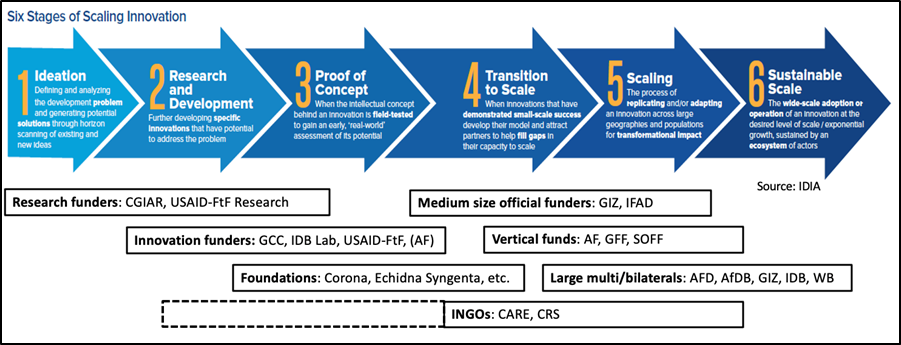 Note: This figure is only a linear approximation of the process of scaling, especially in stages 1-3. Scaling is often non-linear, iterative and simultaneous. For example, systems strengthening and capacity building can often occur concurrently with innovation, piloting, or initial projects; precede them; or be characterized by alternating systems changes and design-test-learn-revise cycles. HarvestPlus and Lincoln Institute operate across the entire pathway and are, therefore, not included. For CARE and CRS, the dotted line indicated a movement over time from the earlier to the later scaling stages. Source: Mainstreaming Scaling in Funder Organizations: A Synthesis Report (2026) https://scalingcommunityofpractice.com/wp-content/uploads/2026/03/FINAL-Mainstreaming-Initiative-Synthesis-Report.pdf |
2. The leadership of some of the large official funders have announced support of the scaling agenda and special scaling initiatives, but much of the focus in their regular financing operations remains on transactional rather than transformational scaling.
Selected MDBs (incl. AFDB, IFAD, IDB and the World Bank), bilateral funders (incl. AFD, FCDO, and SDC), and the emerging mobilization of public development banks in the Global South indicates that these funders have undertaken efforts to explore how to support scaling more systematically than in the past. While these are in many cases driven from the bottom up by managers and staff committed to the scaling agenda, there are also organizations whose leadership has committed to pursue impact at scale. Moreover, there are some high-level global initiatives, including several championed by key MDBs and supported by bilateral official funders, that facilitate scaling and signal a shift from transactional to transformational approaches to scale. For example, the joint “Mission 300” initiative of the World Bank Group and the African Development Bank is designed to connect 300 million people in Africa to electricity by 2030. This initiative is also an example of the critical role of partnerships in scaling; several major foundations (Rockefeller, Bezos, and Ikea) are supporting Mission 300. Annex 2 provides a high-level assessment of the alignment of the World Bank’s flagship initiative “Health Works” with the principles of transformational scaling.
However, despite these encouraging moves toward an increased focus on scale and scaling, questions remain whether and how far these steps, while important and salutary, actually change the general operational practice of these funder organizations, and whether the commitment they reflect can survive changes in leadership.[12] To do so will require significant changes in prevailing operational practices.
3. The traditional project approach and the related incentives for middle-level management and staff remain the main obstacles to an effective focus on transformational scaling by official funders.
Official donors traditionally have internal operational processes and incentives that focus on the number of projects taken to their boards, the amount of money disbursed, the delivery on promised project targets, and compliance with strict fiduciary, social, and environmental standards. This is matched by a high degree of risk aversion and disincentives for adaptation and flexibility during implementation. Project preparation and supervision budgets are stretched by the many “unfunded mandates” that project teams face from their boards and top management, and result in predictable resistance to take on additional mandates, such as focusing on transformational scaling. The lack of funders’ persistence and institutional memory at country level, reinforced by frequent manager and staff rotation, adds to the difficulty of supporting transformational impact at scale. Some official funders (including IFAD, SDC, and the World Bank) have introduced multiphase programmatic financing approaches that, in principle, allow for long-term support of scaling pathways (10-12 years); but in practice, with the exception of SDC, these approaches apparently have not been utilized widely or effectively.[13] Pursuit of a limited number of large-scale flagship initiatives and of multi-stage, long-term funding approaches has the potential to help but without more fundamental recalibration of the basic operational modalities of these funders, these efforts may not achieve sustainable and transformational impact at country level and will likely not change the standard ways most official funders are doing business.
4. Large official funders do not effectively serve as intermediaries (or as “transmission belts”) for the scaling of innovations supported by smaller funders (foundations, innovation and research funders, etc.) onto scaling pathways ultimately taken over by national government and/or the private sector.
While in principle, as noted above and in Figure 2, the large official funders could play a key role in supporting the later stages of the scaling pathways by supporting proven innovations and interventions that smaller funders have supported, the case studies demonstrated that such “handoffs” are the exception rather than the rule. Systematic handoff would require that smaller funders and larger funders engage earlier and operate in close consultation with national development partners and with each other through systematic consultation and alignment of goals and operational plans. With a few notable exceptions[14] the case studies demonstrate a lack of such consultation, largely due to failure to align internal incentives, resources and capacities with the longer-term scaling approach and partnerships that would allow for a systematic handoff. It is encouraging that MDB heads have committed to their organizations partnering more effectively with each other and with other funders, including private foundations. But much will depend on whether or not frontline teams have the resources and incentives to implement effective, transformational partnerships.
5. Large official funders support system change and capacity building, but much of their engagement remains transactional and intermittent, rather than sustained and linked to effective scaling pathways.
The large official funders, especially the MDBs, have over the last decades increasingly supported countries’ systemic reforms and institutional capacity building, often with loans and grants that provide overall or sectoral budget support for the governments concerned. These efforts by official funders often fall short of achieving lasting changes in systemic conditions, not only because of lack of domestic political and institutional support, but because the funders’ engagement in support of the reform efforts has tended to be short-lived and intermittent. Budget support operations typically are limited to 1-2-year time horizons and tend to focus on one-off action in legislation, regulation and institutional changes rather than longer-term implementation or the sequence of complementary reforms required for effective long-term transformational impact at scale. Moreover, there remains a significant gap in linking support for policy reform and capacity building more systematically with longer-term financing of investments.
6. Decentralization is progressing, but effective localization at country-level remains an elusive goal.
The large official funder organizations recognize the importance of being close to the client and hence have progressed significantly over the last 2-3 decades in decentralizing their operational management and staff to serve in national offices or regional hubs. This is an important shift and offers the potential for more effective partnership with national stakeholders and with other international funders operating in a particular country. However, as the case studies demonstrate, decentralization does not necessarily result in significant localization of decision making about funding priorities and approaches, nor in substantial improvements of coordination with other development and climate actors.
Some funders, e.g., the World Bank, have gone further than others in empowering their country directors on the ground to make operational decisions, while others, e.g., UNDP, have strong cadres of local staff that provide persistent support and close contact with domestic stakeholders. But generally, decentralized managers and senior technical staff are international personnel with limited-duration postings in country, with limited knowledge of country conditions, with limited connection to local actors, and with changing priorities as they come and go in 3-5-year rotations.
7. Country coordination platforms are potentially useful tools to support transformational scaling, but the large official funders have not yet fully embraced these platforms as instruments for transformational scaling.
In some countries, national and sectoral coordination platforms have been established to support harmonization and alignment among national actors and international funders for the design and implementation of national and sectoral programs. However, the lack of effective long-term managerial and staff engagement by the large official funders and their continuing focus on transactional approaches mean that their engagement with country coordination platforms tends to focus on the coordination associated with individual one-off projects and programs, and to be limited in time and scope. This continues a long and disappointing history of country coordination efforts organized by funders and governments.
The most prevalent examples of successful funder coordination focus on humanitarian relief, post-conflict and post-disaster reconstruction.[15] These cases usually focus more on meeting immediate needs than on durable change. The GFF’s country engagement model is another example of what is possible in developing a truly transformational approach:[16] the GFF cofinances projects funded by the World Bank’s International Development Association (IDA), and supports the development and implementation of nationally-led long-term investment plans, along with analytical and capacity building efforts, national policy reform and domestic resource mobilization, and intensive monitoring and evaluation. Dedicated health sector country platforms have been set up in many countries with the support of the GFF to facilitate and reinforce the coordination and alignment of national and international actors around the transformational scaling agenda of each country. These platforms have been more successful in some countries than in others, but the GFF grants have generally served as an important incentive to assure that the national actors and the World Bank constructively engage in these country platforms.
8. Knowledge management, tools, and training need more attention in supporting transformational scaling.
When IFAD made a major push to mainstream scaling in its operational work in the early and mid-2010s, it developed an effective knowledge platform, tools and training activities to support its frontline staff in developing and applying systematic scaling approaches in IFAD-funded projects and programs. These efforts waned subsequently as IFAD’s leadership shifted focus.[17] GIZ also developed a useful framework document for its operational managers and staff in the 2010s, though its guidance was not widely applied in GIZ’s operational work.[18] AFD developed a practical framework to mainstream scaling in its operations, but it has not yet been implemented by its front lines.[19] SDC prepared internal guidance documents, videos and tools (including an AI-based tool) to support potential scaling by its staff. However, as with other official agencies, there has to date been limited use of these tools internally in SDC.
Unfortunately, much of the traditional knowledge-work of the large funder organizations (including the work of their research wings) has so far remained quite separate from their operational activities and not focused on the scaling agenda. Some efforts have been underway to strengthen the official funders’ knowledge management in support of operational activities, as in the case of the World Bank, whose 2024 Knowledge Compact has a very explicit focus on supporting development impact at scale.[20]
9. Results management frameworks and monitoring and evaluation (MEL) methodologies remain focused on project-level impact not on longer-term transformational impact at scale.
Few official multilateral and bilateral donors have effectively embedded scaling and scalability in results management frameworks and MEL methodologies and practices; and, so far, the evaluation and peer review guidelines of the OECD-DAC and the assessment methodology of MOPAN do not effectively incorporate scaling criteria.[21] Making suitable adjustments to these practices holds promise to move MEL systems from being an inadvertent disincentive to scaling to being a significant driver and entry point for mainstreaming. GFF, IFAD and UNDP are exceptions that demonstrate that an effective focus on scaling in MEL is possible and provide examples and tools for how it can be done.[22]
10. Funder’s prevailing lack of focus on transformational scaling is often matched by a limited scaling readiness of their development partners.
Governments in developing countries – as in many industrial countries – may have short-term horizons driven by electoral cycles or changes in the priorities of the political leadership, and they face capacity constraints for longer-term planning and implementation. This affects large official funders more than other funders because they work mostly with governments. Foundations, innovation funders and INGOs more often support grass roots or community organizations, or commercial and social enterprises and can take a longer outlook. However, this does not absolve the large official funder community from taking a systematic scaling approach to their funding decisions. Rather than reinforcing domestic tendencies for short-term action, they need to focus on supporting and strengthening those domestic partners, champions and intermediaries that see the need for long-term transformational scaling. External financial, analytical and capacity building support by large official funders can serve as an incentive and facilitator in getting governments to prioritize and implement transformational change, always recognizing that ultimately the scaling pathways have to be owned by the governments with sustained commitmen and domestic resource mobilization.
D. Conclusion
Large official funders have a critical role in supporting the scaling process at country level, given the resources, role, scope and instruments at their disposal. To date, they have not played this role as effectively as they could. However, there are encouraging signs that scale and scaling are becoming integral components of the strategic directions of these funders. It is important that these efforts be translated into effective incentives and resources for the front-line teams of these organizations. This requires significant changes in their traditional operational modalities.
Mobilizing the seven principal “drivers” highlighted in Section B.4 requires a potentially significant change management process that touches on the core functions and operational practices of each organization. These changes are particularly challenging in large official funders requiring time, persistence, and careful planning, ideally following a phased approach, beginning with leadership commitment followed by clear definitions, alignment of mission, development of policies, allocation of resources, adoption of tools, and adaptation of MEL practices.
Commitment by the leadership – i.e., the governing bodies and top management – is a crucial first step. Some of the large official funders have already taken this step. It is important that this commitment be accompanied by clear definitions of what scale and transformational scaling mean for the organization and by strategies to implement the high-level scaling goals. Annex 2 includes, by way of example, recent efforts by the World Bank to take these initial steps for specific sectoral and thematic areas.
The big challenge lies in the next step: the development and implementation of operational policies and instruments, allocation of resources, and adoption of tools. All these are needed to fundamentally shift the incentives for operational managers and staff so they focus effectively on the transformational scaling agenda rather than on their traditional one-off, go-it-alone project modalities.
Many of the official funder organizations face budgetary constraints and pressures to deliver more and more quickly with fewer frontline resources in a context where staff already feel overwhelmed by unfunded mandates relating to social, environmental and fiduciary objectives pursued by boards and senior management. Many funder organizations also have gone through reorganizations and decentralization efforts, which have disrupted, often for good reasons, the sense of stability and predictability under which staff ideally operate. Reorganization fatigue therefore also can militate against the adoption of a transformational scaling approach.
Under these conditions, it may be best for funder organizations to start with limited but purposeful efforts to introduce and test the transformational scaling agenda in selected areas of their financial operations. For organizations like the World Bank, which have already identified scaling initiatives in selected areas, this means taking stock of whether the current approach in these initiatives is truly transformational at country level or remains in the traditional transactional mode. For others, it would mean identifying potential scaling initiatives to be pursued with a transformational approach and in partnership with other funder and implementing organizations. Another way to incrementally advance the transformational scaling approach would be to begin in one or a small number of countries, preferably in connection with a domestically-led country platform and in close partnership with other key external funders, official and private, including foundations.
Whichever approach is chosen, it should be supported by a small team of scaling experts to provide advice, monitor implementation, and develop and apply a MEL approach that ensures that course adjustments take place as needed and that lessons are learned for application elsewhere in the organization and by the funder community more generally.
In parallel with these efforts, the research, knowledge and evaluation units of the large funder organizations should focus on developing practical approaches and lessons from past and present project and sector analyses, from inside and outside the organization, and targeted on particular sectoral and thematic areas. The evaluation units, in particular, should adapt their existing evaluation criteria and approaches to incorporate explicit consideration of the scaling dimension.
Wholesale changes in operational policies and practices could then come last, when experience and lessons with scaling have been gained, when frontline managers and staff have familiarized themselves with the scaling agenda, and when a body of knowledge and expertise has been developed in the funder organization to support a generalized and systematic approach throughout the institution’s work.
Ultimately, it will be essential that the large official funders as a group mainstream scaling, and not just a select few, since at country level effective partnership and coordination among funders and with local partners under the umbrella of a country platform will depend on all major players pursuing a transformational approach to scaling. The collective effort of the bilateral official DAC members to focus on scaling as reflected in the OECD-DAC scaling guidance document[23] is a move in the right direction but the guidance principles now need be implemented systematically by the funding agencies of DAC member governments. This has to be complemented by the MDBs mainstreaming transformational scaling in their operational practice, potentially led by the World Bank as it pursues its scaling flagship initiatives in partnership with other funders and implementing partners.
[1] See https://scalingcommunityofpractice.com/wp-content/uploads/2025/03/Final-MTT-Abridged-1.pdf
[2] Country-led cooperation mechanisms for national and international stakeholders – sometimes referred to as “country platforms” – can help align interests and plans, coordinate resources, and support long-term scaling with system change. However, they require institutional support structures, sustained resourcing, strong incentives, and staff mandates aligned with transformational impact, all of which requires the platform participants, including the funders, to focus systematically on scaling approaches.
[3] In addition to the case studies and synthesis reports, there is also evidence for these obstacles in expert interviews conducted in lead up to the mainstreaming initiative (see https://scalingcommunityofpractice.com/wp-content/uploads/2022/11/Exploratory-Study-of-Mainstreaming-Scaling.pdf) and in the review of recipient perspectives carried out under the mainstreaming initiative (see https://scalingcommunityofpractice.com/wp-content/uploads/2024/12/Recipient-perspective-FINAL-2025.06.19.pdf).
[4] See the review of evaluation methodologies and practices of official funders carried out under the mainstreaming initiative: https://scalingcommunityofpractice.com/wp-content/uploads/2025/04/FINAL-Evaluation-Guidelines-of-Official-International-Development-Funders.pdf
[5] The SCoP developed a Mainstreaming Tracker Tool that can serve to assess progress by funders in implementing the internal changes needed to support transformational scaling. See https://scalingcommunityofpractice.com/wp-content/uploads/2025/03/Final-MTT-Abridged-1.pdf
[6] While many of the features highlighted in this paper apply across these two funder categories, there are also fundamental differences: many bilateral funders use grants rather than loans, while the multilateral development banks (MDBs) predominantly use loans, as well as guarantees and equity contributions (for their private sector windows). Bilateral funders are accountable to their political leadership and parliaments and hence have to act in their country’s national interest; moreover, they are generally subject to appropriations in annual budgets. Most MDBs are mandated to act in a non-political manner and can in principle make longer-term funding decisions subject to approval by their boards. The mainstreaming experience of MDBs in particular is reviewed by Koldoest Echebarria in “Deliver Impact at Scale, Multilateral Development Banks Must Align Institutional Incentives.” (Center For Global Development, 2026; https://www.cgdev.org/blog/deliver-impact-scale-multilateral-development-banks-must-align-institutional-incentives).
[7] For the UNDP, see Miliça Begovic, Johannes F. Linn and Rastislav Vrbensky, “Scaling up the impact of development Interventions: Lessons from a review of UNDP country Programs.” Brookings, 2017 https://www.brookings.edu/wp-content/uploads/2017/03/global-20170315-undp.pdf
[8] Case study not published
[9] Ditto
[10] IFAD is generally classified as a vertical fund in the Mainstreaming Initiative, but added here, because of its broad coverage of rural development challenges and since many of its operational practices are similar to those of the MDBs.
[11] In the middle-income countries, there is also an opportunity for turning the national public development banks in the global south into intermediaries for transformational scaling. Agence Française de Développement has supported the establishment of the Finance in Common Summit (FiCS), which brings together public development banks and could become a force for transformational scaling. https://sdg.iisd.org/news/summit-seeks-to-unlock-public-banks-potential-for-sustainable-development/
[12] In the case of IFAD and the World Bank the commitment to support impact at scale has waxed and waned with changes in the top leadership. The current World Bank President, Ajay Banga, is reorienting his organization to focus on impact at scale, in the tradition of his predecessors Robert McNamara (1968-1981) and James D. Wolfensohn (1995-2005).
[13] IFAD and the World Bank have recently committed to use these instruments more intensively, but it remains to be seen whether this will result in wider adoption. Discontinuities in political commitment to longer-term perspective by governments in developing countries is likely also a disincentive for the use of these instruments. The authors have not found any evaluations of these approaches. A cross-institutional review of their effectiveness as scaling instruments and of the reasons why they have not been much utilized in the past, would be helpful.
[14] See, for example, the discussion below of the collaboration between the Global Financing Facility (GFF) and the International Development Association (IDA, a branch of the World Bank Group). This example is presented in some detail in the GFF case study under the Mainstreaming Initiative: https://scalingcommunityofpractice.com/wp-content/uploads/2024/07/Mainstreaming-Scaling-at-GFF-FINAL-1.pdf
[15] See the SCoP paper on scaling and country platforms: https://scalingcommunityofpractice.com/wp-content/uploads/2025/12/FINAL-Revised-Note-on-Country-Platforms-and-Scaling.pdf
[16] See the GFF case study under the Mainstreaming Initiative (2024): https://scalingcommunityofpractice.com/wp-content/uploads/2024/07/Mainstreaming-Scaling-at-GFF-FINAL-1.pdf
[17] See the IFAD case study under the Mainstreaming Initiative (2024): https://scalingcommunityofpractice.com/wp-content/uploads/2024/01/Scaling-Up-at-IFAD-FINAL.pdf
[18] See the GIZ case study under the Mainstreaming Initiative (2024): https://scalingcommunityofpractice.com/wp-content/uploads/2023/08/Scaling-Up-at-GIZ.pdf.
[19] Éric Beugnot, “Playing the Long Game: Scaling as a Necessary Endeavour for Solidarity and Sustainability-driven Investments.” The Scaling Community of Practice. https://scalingcommunityofpractice.com/wp-content/uploads/2026/04/PAE-Policy-Paper-EN-FINAL.pdf
[20] “The Knowledge Compact For Action: Transforming Ideas Into Development Impact.” (2024) https://documents1.worldbank.org/curated/en/099041624093521233/pdf/BOSIB1f2e1cecb0ec184f314869b151f59d.pdf
[21] See the SCoP review of official funder evaluation methodologies: https://scalingcommunityofpractice.com/wp-content/uploads/2025/04/FINAL-Evaluation-Guidelines-of-Official-International-Development-Funders.pdf. OECD-DAC has developed a Guidance document on scaling for its bilateral official members, but so far this guidance has not yet been reflected in the DAC’s evaluation and peer review methodologies, nor in the MOPAN assessment approach. https://www.oecd.org/content/dam/oecd/en/publications/reports/2024/12/dac-guidance-on-scaling-development-outcomes_97d114d5/621810cc-en.pdf
[22] Ibid.: https://scalingcommunityofpractice.com/wp-content/uploads/2025/04/FINAL-Evaluation-Guidelines-of-Official-International-Development-Funders.pdf
[23] Rethinking Development Co-operation – Scaling Community of Practice
[1] The activities of “vertical” official funder organizations, i.e., official funders that specialize in supporting action in specific areas, is the subject of a separate summary note.