The world faces enormous development, humanitarian, and climate challenges at the very time when traditional sources of international financial support are suffering major cutbacks. Likewise, governments in the Global South, the private sector and civil society are under stress, while communities face major challenges to their cohesion and traditions of civic culture. This puts a premium on ensuring that the available financing shifts its focus from funding standalone projects to increasing the capacity of governments, social enterprises, and the private sector to deliver long-term impacts that address global problems sustainably and at the scale of the problem.
A recent report by the Scaling Community of Practice (SCoP) assesses to what extent and how 28 public and private international funders (see Annex 1 for full list of case studies) have mainstreamed consistent approaches to scale and scaling into their polices, practices and priorities and synthesizes lessons from their experience.[1] Case studies for this mainstreaming initiative were purposely selected to examine a wide range of funder organizations known to be making serious efforts to mainstream scaling into their policies, programs and priorities. Following an “action research” approach, funder staff prepared or supported the preparation of all 28 case studies. The Synthesis Report also draws selectively on the related experience of the three authors with a range of other funders.
This paper focuses specifically on the implications of the mainstreaming initiative for multilateral vertical funds supporting international development and climate action in specific sectoral or thematic areas.[2] These organizations have rapidly expanded in number and financial heft over the last three decades and new vertical funds are being proposed or are under consideration. These funds potentially play key roles in supporting the pursuit of sustainable impact at scale but they also have contributed to the increasing fragmentation of the international development and climate finance architecture. However, there is surprisingly little to be found in the literature on development and climate finance on their contribution, their potential strengths and challenges. We therefore take a step back and review in section B what is known about multilateral vertical funds, before we turn in Section C specifically to explore what we have learned from five case studies of multilateral vertical funds about how they have mainstreamed scaling in their operations. A final section summarizes our conclusions.
The core thesis of this paper is that vertical funds have demonstrated a strong capacity to support scaling of innovative and effective solutions in particular sectoral and thematic areas of development and climate action, even as they also have contributed to the increased fragmentation and stove piping in the development and climate finance architecture. They have some ways to go in ensuring that their approach is integrated effectively with the institutional and financial ecosystem in which the operate and that their engagement leads to transformational change with sustainable impact at scale.
CLICK HERE TO READ MORE
B. What Do We Know about Multilateral Vertical Funds?
Figure 1 shows the development of major multilateral development and environment/climate funder organizations since 1940. The World Bank, the International Monetary Fund (IMF), the United Nations and its specialized agencies were established first, followed by regional development banks, and then most recently the multilateral vertical funds. The graph also shows that the number of government donors engaged in the newly created multilateral funding entities declined over time (see the dotted line).
| Figure 1: Multilateral vertical funds have grown in importance over the last three decades
|
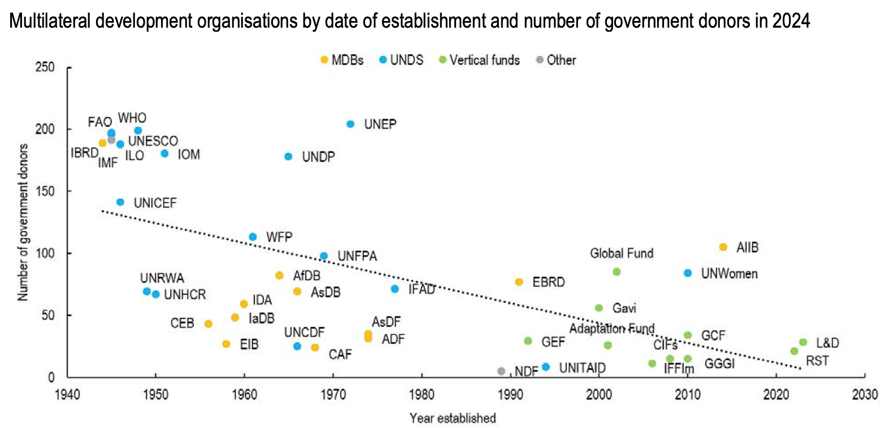 Source: OECD-DAC (2026), p. 48.
 In 2013 Gartner and Kharas characterized vertical funds as follows: “Vertical funds are global programs for allocating official development assistance that focus specifically on an issue or theme. According to the World Bank’s definition, they are ‘partnerships and related initiatives whose benefits are intended to cut across more than one region of the world and in which the partners: (a) reach explicit agreement on objectives; (b) agree to establish a new (formal or informal) organization; (c) generate new products or services; and (d) contribute dedicated resources to the program.’ They contrast with more traditional channels for development assistance, which focus on the needs of each partner country through country-based, horizontal, funding allocations. Although vertical funds have a long history, only since the late 1990s have they become the international community’s funding vehicle of choice.”[1]
More recently, OECD-DAC noted that “[v]ertical funds typically occupy the catalytic segment of the spectrum to support global public goods and collective action. Their strong investment in global public goods, such as health, education, climate and biodiversity, reflects their mandate to address specific issues where markets fail and collective action is required. They often play a de-risking role, piloting new approaches, absorbing early-stage risk and demonstrating viability, with the expectation that successful approaches can be scaled through concessional or non-concessional MDB [multilateral development banks] financing, often in collaboration with UNDS [United Nations Development System] entities and other partners for implementation at country level.”[2]
Vertical funds have been set up and attracted financing from official funders and foundations across a wide range of sectors and thematic areas, as demonstrated by the sample of five vertical funds in the Mainstreaming Initiative, which covers agriculture, climate adaptation, health, meteorology and trade facilitation. These funds have greater flexibility in their membership (governments and private organizations) and they allow narrow targeting of finance by sector, theme, or country income to match the priorities of particular funders and their domestic stakeholder groups (ministries, NGOs, private business). Many of these funds are managed by or associated with particular MDBs (especially the World Bank) with the resulting expectation of leveraging the MDBs’ resources and efficiency in deployment. They are welcomed by recipient countries, because they provide their finance mostly in the form of grants (rather than loans or equity), closely align their financing with the interests of specific groups in the country (ministries, technical bodies, NGOs, etc.), and often offer recipient countries a stronger voice in their governing bodies than is the case for traditional multilateral funders.[3]
There is no clear picture on how many vertical funds currently exist. The OECD’s 2024 report on multilateral finance counts only 14 vertical funds for 2020 (Figure 2, next page). While this represents a doubling of the number of these funds over the previous 10 years, this number in fact is only a fraction of the total number of multilateral agencies (212) considered by OECD-DAC. However, the OECD-DAC count likely underestimates the true number of vertical funds. For example, Philippe Le Houérou identified 62 active multilateral green climate funds for 2021-2022 (as well as 19 bilateral vertical funds).[4] Similarly, in the area of health, a number of important vertical funds (e.g., the Global Financing Facility) are not included in the OECD-DAC count. At the same time, according to an AI search, many proposals for the establishment of new vertical funds are under consideration, including in the areas of digital public infrastructure, social protection, food systems transformation, health security, education, water security, environment and climate change.
| Figure 2: Growth in the number ODA-eligible multilateral funds
Source: OECD-DAC 2024, p. 44. https://www.oecd.org/content/dam/oecd/en/publications/reports/2024/09/multilateral-development-finance-2024_4d90da16/8f1e2b9b-en.pdf |
Whatever their numbers, there is general agreement that the rise of vertical funds has contributed to the increasing fragmentation of the development and climate finance architecture. A World Bank report of 2007 warned about the growing proliferation of vertical funds,[5] a view that was echoed in a 2023 World Bank report that focused on the fragmentation of the development finance architecture.[6] For the climate finance system, Le Houérou views the fragmentation caused by the large and rapidly growing number of vertical climate funds as a serious threat to effective delivery of climate action. He recommends that no more new funds be created and that, to the extent possible, existing funds be closed or consolidated.[7] Witter et al. recently assessed the performance of six global health initiatives (or GHIs), three vertical funds among them.[8] They conclude that while these initiatives respond effectively to funders’ needs for targeted interventions that are innovative, results-focused, flexible and transparent, they also give rise to a number of concerns relating to their siloed approach, their operational effectiveness, and the potential distortion of health sector spending that they create (Box 1).[9]
| Box 1: Challenges of Global Health Initiatives (GHI)
“[T]hese strengths are increasingly challenged, particularly when viewed from the country perspective, where funding by the larger GHIs has long been observed to distort national priorities and health systems, creating heavy costs in terms of preparation and implementation of grants, which do not use national systems, typically, or align with national plans, budgets, Public Financial Management (PFM) systems, human resource or information systems. Grant proposals developed by external consultants, away from the national context; siloed funding to elements and specific population groups within a system; support for unsustainable delivery strategies (in terms of cost); lack of focus on efficiency across the health system; lack of downward accountability of GHIs to countries, and failure to build national capacity to sustain gains in the long term (through system strengthening) are amongst the key concerns at national level. In addition, the results claimed by GHIs were always emergent from a wider set of investments, including by governments and other bilateral and multilateral funders. “The report analyses some of the political economy dynamics underlying the patterns found and the lessons from previous attempts to reform global health architecture. Where organisational mandates and incentives remain unaligned, efforts at coordination have been very frustrating. There is also considerable path dependency in the system, such as it is easier to create new structures than to reform old. The GHIs solved many funders’ problems by creating structures which converted funding into credible results, while at the national level, clients were created who gained resources and therefore power from the funding. The wider global health system has been distorted by the relative volume of funding passing through GHIs, compared to other players with substantial roles, such as WHO. Incentives have been primarily focused on grant disbursement, more than achieving stronger, more effective and more sustainable health systems. Transparency of what is being spent in which health area and through what channels, as well as its longer term impact on the health system, is still hard to achieve for some GHIs.” Source: Witter et al., op.cit., p. 12 |
In addition to these sector-specific concerns for climate and health funds, OECD-DAC flags a number general issues for vertical funds: their prevailing funding risk and volatility, given their typically narrow funder base (see Figure 1) and lack of capital endowment of vertical funds; their dependency on collaboration with MDBs and UN agencies as implementing agencies; and their potential for reducing funder support for the MDBs and United Nations agencies.[10]
However, there is also a view that vertical funds have some potential advantages in the delivery of development and climate assistance over traditional finance organizations, and in particular that they have internalized approaches to supporting impact at scale as a core element of their modus operandi. This view was first articulated by Gartner and Kharas (2013) in their nuanced assessment of major vertical funds in the health, education and agriculture sectors. They stress the fact that the more narrowly defined are the vertical funds in terms of their scope and results goals and the more they rely on participatory governance and approaches, the more effective are they likely to be in attracting donor funding and in establishing credibility at country level for sustained and scaled results. (Box 2, below)[11]
| Box 2. Success factors for vertical funds
“It is clear that vertical funds are not a panacea for all global challenges. Some challenges lend themselves more easily to a framing that catalyzes global action, particularly donor financing. Global issues are more successful in terms of verticalization and scaling up when they can be framed in terms of focused, simple, and compelling outcomes (such as lives saved) and when expanded resources can make a visible transformational change when closely linked to outcomes. Broad participation in the governance structures of these vertical funds can leverage key nonstate actors in donor countries to become champions for the fund and solidify the credibility with beneficiaries of the interventions at the country level. Further research is needed to evaluate the impact of vertical funds across a wider range of sectors, and this would be helped if there were an independent audit model for presenting results. Nonetheless, the important contribution of these funds to the challenge of scaling up is reflected both in their innovative approaches and in the rising share of development assistance that is channeled through these funds. While not all vertical funds have succeeded in scaling up, they may have done better than traditional approaches to development on some dimensions. Where they have not, the obstacles are often the result not of the vertical approach but of the barriers to participation and innovation that remain when funds are not truly independent. More independent, more participatory, and more results-focused vertical funds pose a challenge to traditional approaches to development, and a wide range of institutions is now seeking to adopt the best practices of many of these vertical funds.” Source: Gartner and Kharas in Chandy et al., op. cit. (p. 133-134) |
More recently, the World Resources Institute (WRI, 2017) explored how vertical climate funds can overcome fragmentation, duplication and one-off projects and focus more effectively on impact at scale. It recommends clearer demarcation of responsibilities, greater focus on system context, increased collaboration and eventual consolidation of selected funds.[12]
Similarly, a 2025 report by the Climate Policy Institute, Finance in Common, and African Development Bank notes the potential for the four large climate and environmental funds (GEF, GCF, Adaptation Fund and CIF) in supporting the impact at scale of climate finance through enhanced collaboration with MDBs and national development banks (NDBs) by building on their experience to date. The report recommends more cofinancing across agencies; harmonization of operational standards, metrics and practices; shared knowledge management, capacity building and monitoring and evaluation approaches; joint efforts to attract private finance; and alignment of support under nationally led country coordination platforms.
An independent evaluation of the Climate Investment Funds (CIF) confirms these conclusions. It finds that the four component funds of CIF (the Clean Technology Fund, the Pilot Program for Climate Resilience, the Forest Investment Program and the Scaling Up Renewable Energy in Low Income Countries Program) already pursue scalability and transformational change in their areas of engagement with their support for systemic change in the enabling environment, partnerships with other funders and the private sector, and learning and knowledge sharing, aligned with national priorities. The report recommends more intensive collaboration with MDBs for catalytic change; continuation of multi-stakeholder consultations; development of more detailed theories of change for transformational change; ensuring country-based alignment; strengthening the knowledge base for transformational scaling and promote understanding of transformational change; and further exploration of financial instruments in support of innovation and risk taking.
In sum, while much remains to be learned about multilateral vertical funds, we conclude from this review of the available evidence that
- the relatively recent growth of multilateral funds deserves more attention than it has received in the development and climate finance literature;
- they are attractive instruments for donor and recipient countries because of their sustained attention and relatively narrow focus on particular development and climate goals and results; this becomes especially important in the climate field at a time when more general funders move away from climate investments in spite of the accelerating climate crisis;
- their proliferation has contributed to the fragmentation of the development and climate finance system; and
- they have the potential for supporting the pursuit of long-term sustainable impact at scale, provided their operational approach is strengthened.[13]
After this brief review of what we know in general about multilateral vertical funds, we now turn in the next section to a summary of findings of the Initiative on Mainstreaming Scaling in Funder Organizations as they apply specifically to the Multilateral Development Funds.
C. What Are the Findings and Lessons of Scaling by Multilateral Vertical Funds?
We summarize the findings and lessons of scaling for multilateral vertical funds by drawing on the five case studies of such funds prepared under the Mainstreaming Initiative.[14] We complement the findings with reference to the broader assessment of the effectiveness of vertical funds in the literature (Section B) and to our experience of engagement with these funds as researchers and consultants. We first provide an overview of what the five vertical funds do and then consider their role in the overall development and climate finance architecture from a scaling perspective. We then explore how vertical funds have mainstreamed key aspects of a systematic scaling approach in their organizational agenda and practices. We close this section with a discussion of challenges and opportunities vertical funds face in mainstreaming scaling in their operational approach. In this assessment we draw on the approach and findings of the overall Mainstreaming Initiative, which are summarized in Annex 2.
1. What do the five multilateral vertical funds do?
The five funders included in our sample are diverse in terms of size and breadth of engagement (see Table 1 and Box 2). They range from a very narrow focus (SOFF on improving weather observations; STDF on strengthening phytosanitary cross border trade practices) to a much broader scope of engagement in agriculture (IFAD), climate adaptation (AF) and health (GFF). They also differ in terms of membership, eligibility for financing, governance and financing instruments. IFAD membership is global in membership, but restricted to governments. All member countries can contribute to IFAD’s replenishments and all developing member countries are in principle eligible for financing. Its governance and financing instruments (primarily loans) are similar to those of the multilateral development banks. The other four funds have fewer funder members, but some include private foundations as funders and as members of their governing boards. They mostly provide grants, and eligibility tends to be restricted to lower income developing countries. The five funds also differ significantly in terms of their resource endowments and the size of the projects that they fund, but all five are relatively small compared to the large multilateral and bilateral funders, and smaller than some of the large vertical funds, such as the Global Fund to Fight AIDS, Tuberculosis and Malaria and the Green Climate Fund.
Table 1. Foundations included in the mainstreaming initiative
| Funder | Area of engagement | Approximate Average Annual Commitments 2024-2045
(in US$ million) |
| Adaptation Fund (AF) | Climate adaptation | 275 |
| Global Financing Facility (GFF) | Health (with a focus on women, children, and adolescent health and nutrition) | 400 |
| International Fund for Agricultural Development (IFAD) | Agriculture, rural development and food security | 1,700 |
| Standards and Trade Development Facility (STDF) | Sanitary and phytosanitary trade in agriculture and food | 10 |
| Systematic Observations Financing Facility (SOFF) | Weather and climate observations | 18 |
| Box 2. What do the five multilateral vertical funds do?
AF: The Adaptation Fund has played a pioneering role in delivering community-focused, innovative, and direct-access climate adaptation finance to developing countries. In the context of rapidly increasing global adaptation needs and in response to the COP29 mandate to triple adaptation finance by 2030 it contributes by (a) focusing on upfront financing of concrete adaptation activities with the expectation that these will later be scaled by other actors, both national and international; (b) offering direct access to National Implementing Entities (NIEs), thus building a broad network of nationally-based implementing partners worldwide; (c) supporting accreditation and readiness; (d) prioritizing innovation in community-led resilience and nature-based solutions across sectors; and (e) emphasizing adaptation knowledge creation and dissemination. GFF: The Global Financing Facility (GFF) was set up in 2015 to support developing countries in addressing serious systemic constraints in the provision of basic health services, with a special focus on Reproductive Maternal Newborn Child and Adolescent Health and Nutrition (RMNCAH-N). In recognition of the fact that the achievement of the Sustainable Development Goals by 2030 will require the availability of sufficient, well-utilized and sustainable financing the GFF has been designed from its very beginning to pursue sustainable impact at scale in assisting countries with particularly weak health systems to achieve universal health coverage (UHC). IFAD: The International Fund for Agricultural Development (IFAD) is a midsize multilateral international finance institution established to support agricultural and rural development in low and middle income member countries, with a special focus on often neglected or difficult to reach smallholder farming communities. IFAD has actively pursued mainstreaming of a scaling agenda in its operations since 2002. STDF: The Standards and Trade Development Facility (STDF) is a global partnership that promotes improved food safety and animal and plant health in developing countries. STDF helps developing countries meet sanitary and phytosanitary (SPS) requirements for imports and exports, based on international standards. It acts through three interlinked workstreams — Global Platform, Knowledge Work, and the Grant Mechanism – to catalyze change by convening, innovating, and learning for effective SPS practices. SOFF: The Systematic Observations Financing Facility (SOFF) started operations in July 2022. It finances improved collection and sharing of the surface-based weather and climate observations in developing countries. These observations are critical for weather and climate analysis and prediction by the global weather centers, which in turn provide the foundation for regional and national weather and climate prediction. Accurate weather and climate prediction are essential for early warnings of natural disasters and have substantial benefits for agriculture, energy, transport, etc. Hence, global collection and sharing of weather data represents an important global public good. SOFF was established to provide investment and operating finance to Small Island Developing States (SIDS) Least Developed Countries (LDCs) so they can meet the global minimum standard of weather and climate observation and data sharing established by the World Meteorological Organization (WMO). |
2. What is the role of the multilateral vertical funds in supporting scaling pathways?
Multilateral vertical funds play potentially important roles in supporting various stages of the scaling pathway, as reflected by the five funds included in the case studies of the Mainstreaming Initiative. (Figure 3, next page) Adaptation Fund and STDF offer support from the proof of concept stage through transition to scale for the Adaptation Fund and to scaling for STDF. GFF and IFAD support mostly the transition to scale and scaling stages, but GFF also has some engagement in supporting the proof of concept stage. SOFF is unique among the vertical funds in our sample, and also across funder organizations more generally, for supporting not only the scaling phase but also the sustainable scale (or operating-at-scale) phase with its support for operations and maintenance of meteorological installations beyond the investment phase.
| Figure 3: Engagement of five vertical funds along the scaling pathway
Source: Mainstreaming Initiative Synthesis Report https://scalingcommunityofpractice.com/wp-content/uploads/2026/03/FINAL-Mainstreaming-Initiative-Synthesis-Report.pdf |
In their support for scaling pathways, vertical funds face a challenge of intertemporal and contemporaneous integration with other actors in the financial architecture of their respective engagement. The intertemporal integration challenge arises at the beginning and at the end of their support for scaling efforts, typically in the context of investment, capacity building and/or advisory projects that have a beginning and an end. At the beginning, project preparation has to include a search for scalable solutions, involving handoff of scalable interventions from other organizations involved in the preceding stages of the pathway. At the end of their engagement in a particular project or program, the vertical funds need to have prepared their initiative for continued scaling or operation at scale by appropriate handoff to other partners, which usually involves other domestic or external funders and implementers. As an example, IFAD should in principle have a systematic process of identifying innovations developed and promoted as scalable by other partners, such as CGIAR, the agricultural research consortium.[15] It also should systematically prepare for handoff to other partners during project implementation. In both regards, IFAD has had some success stories, but would have benefitted from a more systematic focus on the intertemporal integration challenge. . The Adaptation Fund has been working in partnership especially with the GCF in order to hand off projects for scale-up and is seeking to strengthen this aspect of their scaling ambition.
The contemporaneous integration challenge is related to the problem of fragmentation flagged in Section B above. Multiple funders generally operate in the area of a vertical fund’s engagement in a complementary and/or competitive manner. Taking again the case of IFAD, it operates in parallel with the other Rome-based agricultural UN organizations (FAO and WFP), with the MDBs, bilateral funders, foundations, and other agricultural vertical funds (e.g., GAFSP[16]). Effective coordination, division of labor and/or collaboration at country level among the various external funders and actors is essential for effective support of a scaling strategy.[17] Another aspect of the contemporaneous integration process relates to the need for narrowly focused vertical funds to place their interventions into the wider systemic context, sectorally and intersectorally, where there are important linkages, as is often the case. This has been an issue with the narrowly focused vertical funds in the health sector. Their success in attracting and deploying large amounts of foreign and domestic resources for relatively narrow purposes has tended to distort health sector interventions. GFF has assumed a lead role in supporting an integrating approach in support of transformational scaling with its support for the development of longer-term health strategies and investment plans, for country coordination platforms, and for integrated monitoring and evaluation approaches.
SOFF is the vertical fund that has most explicitly addressed both the intertemporal and contemporaneous integration challenge: Intertemporally, it uses a well-understood process at entry to identify the appropriate investment (the “Readiness Phase”), while also offering support for operation and maintenance expenses during the “Compliance Phase” after investments are completed. Contemporaneously, SOFF has developed a comprehensive partnership approach with other funder partners (MDBs and UN agencies), with meteorological centers serving as peer advisers, and with other vertical funds and agencies that support the effective utilization of weather and climate observations in agriculture, transport, early warning, etc.
Rather than serving as loners or passive partners in the scaling process, vertical funds are well positioned in principle to serve as intermediaries in supporting scaling pathways, by actively engaging the intertemporal and contemporaneous integration processes. They are well placed to support the establishment and functioning of country platforms that address both the intertemporal and contemporaneous integration challenge.[18] We will further explore these opportunities and related challenges in the next subsection, as we discuss the importance of creating effective incentives for the implementation of partnerships and intermediary roles in mainstreaming.
3. What are the key elements of a mainstreaming strategy for multilateral vertical funds?
We now turn to assess how far and in what ways vertical funds have mainstreamed scaling into their operational practices. We use the standard framework developed by the Mainstreaming Initiative in assessing the key elements of a mainstreaming strategy, as reflected in Figure 4. The framework focuses on eight factors that together determine the extent of mainstreaming of scaling: (i) leadership; (ii) vision, goals and strategy; (iii) instruments, policies and processes; (iv) decentralization and localization; (v) analytical frameworks, tools, and knowledge; (vi) monitoring, evaluation and learning (MEL); (vii) internal resources; and (viii) planning and sequencing of mainstreaming. Action in all areas is critical if funders, vertical funds included, are to move from a transactional approach to scaling to a fully transformational approach.[19]
Figure 4 (next page) presents the findings of an AI-based analysis of all the 28 funder case studies, assessing mainstreaming progress in the principal eight elements of the mainstreaming framework.[20] It allows a comparison of mainstreaming across types of funders. It shows that foundations, innovation funders, and vertical funders are farthest along in mainstreaming scaling, followed by INGOs, while MDBs and bilateral official funders lag behind. In the remainder of this section we look how vertical funds fare with regard to each of the main elements.[21]
| Figure 4. Mainstreaming score by funder type and factor
Source: Mainstreaming Initiative Synthesis Report https://scalingcommunityofpractice.com/wp-content/uploads/2026/03/FINAL-Mainstreaming-Initiative-Synthesis-Report.pdf |
A. Leadership, vision, goals and strategy
We are considering the elements of leadership and vision, goals and strategy together, since they are closely related in the case of vertical funds. The leadership of these funds generally is represented by their governance bodies (governing board, steering committee, etc.) and the heads of the secretariats. Together they determine the mandate of the fund and how it is translated into organizational vision, goals and strategy.
From their establishment, vertical funds are generally characterized by a focus on scale in their mandate, vision, goals and strategies. The narrower is the mandate of a fund, the easier is it to identify and pursue impact at scale. However, in all cases much depends on how effective the leadership of a vertical fund is in translating its mandate into actual sustainable impact at scale.
This is reflected in our sample of five vertical funds: SOFF has the narrowest of mandates and the clearest focus on its pursuit of sustainable impact at scale, with its steering committee and secretariat leadership squarely oriented towards the achievement of a well-defined long-term scale target, i.e., the collection and sharing of weather and climate observations by LDCs and SIDS at the minimum levels required by WMO agreements. On the other hand, for IFAD with its relatively broad mandate, the governing board and top management have struggled over the last 20 years to maintain a clear and sustained scaling vision and goals – at times the scaling focus was strong, at other times board’s and management’s attention was directed at other institutional priorities to the detriment of the scaling agenda. In the case of GFF, which also has a relatively broad mandate in the health sector, strong leadership from its steering committee and especially its secretariat has led to a clear and sustained focus on its scaling vision, goals and strategy. In the case of the Adaptation Fund and the STDF, our case studies conclude that their leaderships have scaling within their sight but need to strengthen their attention to whether and how scaling is pursued by their organizations.
B. Instruments, internal resources, policies and processes for aligning internal incentives
Funders’ effective support for scaling doesn’t happen just because the organization’s leadership wants it to happen. Funder managers and program teams need to have the operational instruments and resources to implement scaling strategies. They have to be supported by appropriate instruments, resources, policies, and processes that enable, enjoin, empower and thus incentivize them to implement a scaling approach in their operational practice.
Of the five vertical funds in our case studies, GFF has the strongest combination of instruments, resources, policies and process that enable its managers and staff to deliver on the scaling vision and strategy. Over the years of its existence, GFF systematically developed and deployed a comprehensive and mutually reinforcing set of operational instruments – support for investment and domestic resource mobilization plans, country analyses and coordination platforms, capacity building, grant cofinancing with the World Bank’s IDA, and scale-oriented results frameworks and evaluation practices. GFF generally also provided to its front-line teams and to those of IDA the resources and incentives to deliver on its scaling mandate. SOFF likewise since its recent launch has established the necessary instruments, policies and processes to empower and incentivize its staff to implement its scaling vision. Unfortunately, the pace of SOFF’s overall resource mobilization has lagged behind its targets, which has slowed the implementation of its ambitious 10-year scaling strategy.
IFAD developed a comprehensive scaling framework, guidelines and operational policies in the initial phase of its mainstreaming effort over a decade ago, but its middle management and staff saw a lack of adequate internal resources to support and incentivize an effective implementation of the scaling approach.[22] The Adaptation Fund and STDF have important elements of scaling incorporated into their current policies and processes, but for both our case studies recommend strengthening their application and the deployment of internal resources.
C. Decentralization, localization and partnerships
Many development and climate funders have recognized that the effectiveness and sustainability of development and climate programs depend on their being anchored in the specific conditions of a country; that they must be owned by the key stakeholders, including governments, civil society and the private sector; and that external funders coordinate and collaborate in their financial and technical assistance.[23] Some funder organizations, especially the larger multilateral and bilateral official funders, therefore have decentralized their staff to locations in or close to the countries of their operations. They have pursued “localization,” i.e., stressed ownership, leadership and staffing of programs by country stakeholders. And they engaged in partnerships with other international funders in support of specific sectoral or thematic programs at country level. Smaller funders have found it more difficult to decentralize their staff, but have increasingly aimed to channel their funds directly to national and local recipients, rather than through external, international organizations. Some funders have supported country coordination platforms with the goal of achieving greater alignment of program goals and implementation across national and international stakeholders.
IFAD – the largest among our sample of five vertical funds – has decentralized a substantial number of its frontline staff in recent years and has stressed local ownership of programs that it supports. It also encourages and tracks cofinancing of programs with international and national partners; indeed, its definition of scaling is built on the notion of leveraging its own financial resources through co-financing. GFF has local representatives in its program countries and has relied on World Bank country office staff to engage with national and international partners in the projects that it cofinances with IDA. It has strongly supported the development on locally owned and led country platforms.
The Adaptation Fund, SOFF and STDF are too small to warrant decentralization. They have aimed to strengthen the country ownership of their programs through representation of recipient countries in their governing bodies, through direct access of local implementers (AF and STDF), through close interaction with national technical bodies (SOFF and STDF), and through strong global and regional networks (GFF and STDF). SOFF has intensively pursued partnerships with international partners (MDBs and UN agencies, meteorological centers, business organizations, etc.). The Adaptation Fund’s ability to leverage its financial resources has been hampered by lack of encouragement to cofinance with loans or credits from other international funders and more generally the case study concluded that its partnership approach needs to be strengthened.
D. Analytical frameworks, tools and knowledge
All funders need definitions of what scaling means for them, they need frameworks, guidance documents and practical tools for their frontline managers and staff, and they need to develop and share knowledge assets through training to help their staff and their clients in the pursuit of impact at scale. This is also the case for vertical funds. Their relatively narrow mandates should in principle make it easier, but for our five case study organizations the extent to which they do, varied considerably.
IFAD has developed a clear definition of scaling and guidance documents on scaling for its staff. It also had developed a useful set of knowledge products that summarized scaling experience in particular areas of agricultural and rural development financing, and had put in place a training module on scaling for its general staff training program. However, these knowledge assets and training activities were not sustained in recent years. GFF has a well-developed scaling approach, tools and knowledge base, as has SOFF, despite its relatively recent establishment and limited resource base. For the Adaptation Fund and STDF our case studies concluded that scaling definitions, frameworks, guidance and knowledge work could be strengthened.
E. Monitoring, evaluation and learning
Monitoring, evaluation and learning (MEL) are an essential element of mainstreaming scaling in funder organizations in two regards: First, projects and programs supported by funders need to be monitored and evaluated for their impact and whether they pursue an effective scaling approach, leading to learning appropriate lessons and adaptation in the way programs are supported. Second, the process of mainstreaming scaling in funder organizations – like any change management process – has to be monitored, evaluated and adapted in the light of lessons learned.
IFAD incorporated scaling in its project monitoring and evaluation criteria. It also has carried out an evaluation of how and how far scaling has been mainstreamed in its activities. There has been feedback from this experience into IFAD’s scaling guidance documents. GFF also has developed strong monitoring and evaluation approaches that focus on impact at scale, with sustained learning and adaptation since its establishment. Its most recent evaluation (2025) of its own performance, however, did not specifically focus on the scaling dimension. SOFF relies on project evaluations of its implementing entities, but has sponsored evaluations of its overall approach and incorporated the results in its operational practices. The Adaptation Fund commissioned an evaluation of its scalability concepts and practices, but our case study concluded that AF could strengthen is tracking of scaling with clear metrics. STDF includes relevant scaling criteria in its current MEL practices, but its evaluation approach could focus more on scaling design and impact and tracking long-term results. It is notable that all five organizations participated in the SCoP’s Mainstreaming Initiative which is a sign that their managements had a serious interest in assessing and adapting their scaling approach.
F. Planning and sequencing of mainstreaming
Mainstreaming is a change management effort that requires comprehensive institutional strengthening, changes in incentives and mindsets across the funder organization. Like all major change management efforts, this requires time, persistence, as well as effective planning and sequencing. Short-lived initiatives will not likely lead to sustained change. The SCoP developed a Mainstreaming Tracker for funder organizations; it helps with identifying the main bottlenecks and prioritizing and sequencing institutional change efforts, as well as tracking progress.[24]
IFAD had a well-designed and managed planning and implementation approach to mainstream scaling during the early years of it efforts. A renewed effort was underway during our case study. GFF and SOFF have consistently given attention to their mainstreaming agenda focusing attention on the key aspects that they identified as bottlenecks and hence priority areas for strengthening their approach. Our case studies suggested that the Adaptation Fund and STDF develop effective mainstreaming plans. All five organizations could benefit from regular use of the Mainstreaming Tracker to assess progress with mainstreaming and help prioritize further action.
4. Strengths and challenges in scaling by vertical funds
Vertical funds have potential strengths in regard to their readiness and ability to support scaling pathways. But they also face challenges, often directly related to their strengths. Building on the strengths and recognizing, and creatively and transparently addressing these challenges is an important part of the leadership task faced by the boards and secretariats of these funds.
A. Strengths
Vertical funds stand out in their explicit focus on scaling. Vertical funds by design focus explicitly on long-term targets of impact at scale in their areas of thematic and sectoral responsibility and monitor and evaluate progress in relation to these targets. They differ, however, in the depth and sophistication of their strategies for achieving stated global targets, including the extent of their focus on results following the investment phase, on local ownership and engagement by stakeholders, on policy reform and capacity building, on partnerships and country platforms, and on long-term persistence in the face of political and policy uncertainty.
Vertical funds tend to have a clear value proposition. The focus on scaling is linked to the vertical funds’ need to demonstrate their value proposition to the funders they attract in support of their mission. The governing boards of vertical funds are usually made up of a combination of their financiers and of recipient countries. Their members tend to come from a sectoral or thematic background and condition their support on a clear articulation of the value proposition of the vertical fund in achieving sustainable impact in the mandated areas. The managements and staff of the funds in turn are usually sectoral and thematic experts and frequently articulate a clearer vision for impact at scale than their counterparts in the large official funder organizations, where the focus tends to be on multisectoral country programs and portfolios organized by generalist country teams.
Vertical funds can serve as intermediaries in supporting replication of successful innovations across countries and in connecting experts and practitioners across borders and within countries. As noted, vertical funds arise from and are embedded in the technical, professional and advocacy ecosystem of their mandated area of engagement and are generally led by boards and managers with technical focus and expertise. This makes them natural intermediaries for supporting replication of proven technical solutions across countries. Their networks of experts and practitioners can share knowledge and experience on a sustained basis, as in the case of STDF.
Vertical funds generally provide grant finance. Grant finance is attractive for recipient countries and for cofinancing partners since it does not add to existing debts. It can be used to create incentives by implementers and cofinanciers alike to focus on scaling pathways, as demonstrated by GFF and SOFF.
Vertical funds pursue financial innovation. Vertical funds have developed innovative financing mechanisms to raise funds for their causes. This includes the UNFCCC Article 6 funding mechanism of the Adaptation Fund and the efforts by SOFF to develop an impact bond, modelled on the experience of IFFIm, the financing arm of Gavi, the Vaccine Alliance.[25] [26]
The governance of vertical funds tends to be more inclusive of recipient countries and nongovernmental funders. Vertical funds are more open in their governance to participation by recipient countries and nongovernmental funders than all other types of funders. This offers greater influence for the interests of developing countries and gives greater opportunities for resource mobilization from non-traditional sources (especially foundations) and for a two-way flow of experience from a larger array of partners.
B. Challenges
The strengths of vertical funds also carry with them challenges and tradeoffs that need to be weighed in their creation and managed in their implementation. It is worth noting that many of these challenges also arise for other funders that intentionally or inadvertently mimic the stove piping of vertical funds in their internal structure and funding operations. Large official funders have experimented with vertical structures or programs (e.g., the World Bank’s current global programs), and some of the large private foundations, e.g., the Gates Foundation, have long been structured around vertical program areas. And many of the private foundations, innovation funders, private foundations and INGOs focus on funding specific sectoral or thematic areas.
The narrow focus of vertical funds creates fragmentation and stove piping and the attendant integration challenges. The narrow mandates and a single-minded focus on impact and results at scale in limited sectoral or thematic areas of engagement creates the challenges of contemporaneous integration that we explored in Section B of this paper, such as duplication of functions and interventions, lack of attention to dependence on wider system change and to the systemic impacts of investments, distortion of national budget and investment priorities, etc. GFF and SOFF have paid special attention to these aspects in their scaling approaches: GFF by supporting country platforms and alignment of national stakeholders around a common long-term investment and financing plan and by cofinancing with IDA; SOFF by implementing its elaborate horizontal partnership structure of implementing entities, peer advisers and downstream partners in the hydromet value chain. The Adaptation Fund now explicitly seeks alignment with countries’ national adaptation goals. The experience of the GFF demonstrates that achieving alignment across national and international stakeholders involves a difficult, time and resource intensive effort which does not always succeed. SOFF has so far been largely successful in its partnership approach. The main challenge for vertical funds, as for other funders, is that key actors and their frontline teams, often do not have the incentives to collaborate and align themselves around a common scaling pathway. The grant resources offered by GFF and SOFF to partners to cover the cost of their engagement act as an incentive, but such incentives are not always sufficient to overcome conflicting interests and institutional inertia.
The focus on replication of solutions across countries must be matched by country-relevant adaptation and respect for locally generated solutions. Replication of successful innovations and interventions is a valid scaling strategy, whether locally, nationally or across borders. But simple replication is often not successful in generating impact at the scale of the problem. Three reasons stand out: First, replication without taking into account and adapting the intervention to local economic, social, and political conditions will often lead to unsatisfactory outcomes. Second, externally sourced solutions need not be better than those based on national or local initiative, and external funders’ push to have their interventions adopted can be seen as a “neocolonial” approach. Third, replication of external solutions in one-off projects that do not consider sustainability and scalability beyond project end will not address the scale of the problem at country level. The five vertical funds in our 28 case studies have all endeavored to go beyond simple replication, even as their scaling approaches can be strengthened in various ways to ensure they are effectively focused on transformational scaling at country level.
Grant financing limits leverage. As noted, most vertical funds provide their financing in the form of non-repayable grants and hence do not generate reflows that can be reinvested. IFAD is an exception, since it provides financing predominantly in the form of loans and concessional credits. The repayment flows provide a recurrent source of sustainable financing, recently amplified by the fact that IFAD has been borrowing against future reflows in the international capital markets. In the case of MDBs, their ability to leverage funding is further enhanced by the fact that they have callable capital in addition to paid-in capital, which allows them to borrow and disburse multiples of their paid-in capital.
Dependence on recurrent funding by a limited funder base creates financial resource mobilization challenges.[27] The creation of vertical funds is often justified by noting that they mobilize coalitions of donors that offer incremental financing over and above what they would otherwise have contributed. This may well be the case, but at the same time the experience of many vertical funds, our five cases included, demonstrates that they often face significant resource mobilization challenges in addressing the scale of the problem in line with their mandate and ambition. Whether vertical funds raise their resources on a continuous basis (e.g., SOFF and STDF) or through intermittent replenishments (AF, GFF, IFAD), they always struggle to raise the financial resources they aim to attract for their programs. They face difficulties especially now as Official Development Assistance (ODA) has been drastically reduced since 2023.[28] Since many of the vertical funds in effect provide finance for global public goods, the financing challenge will ultimately only be satisfactorily addressed if and when a global public goods financing mechanism is established.[29] The chances for this happening are remote at this time.[30]
Vertical funds, like other funders, have yet to fully overcome the traditional weakness of the stand alone, one-off project model of development assistance. Our case studies of the five vertical funds show that while their mandates, vision and goals are in principle aligned with a scaling approach, their operational practices for some (esp. Adaptation Fund, IFAD and STDF) will benefit from further strengthening to move beyond the transactional, one-off project approach that is deeply embedded in traditional development assistance practice. Vertical funds, like other funders, need to focus on the key elements of a mainstreaming approach explored earlier in this section if they are to make the most of their resources in contributing to transformational impact at scale in the areas of their mandate. In particular, they need to provide their front line team with the capacity, resources, instruments, and incentives to look beyond project end in planning, implementing and evaluating they projects that they fund to establish sustainability and scalability.
D. Conclusion
We close this paper with a brief summary of the main conclusions of our analysis of multilateral vertical funds and their approach to mainstreaming scaling:
- Vertical funds are a growing component of the international development and climate finance architecture.
- We found surprisingly little analysis of the growth and contribution of these vertical funds, although they have been critiqued as contributing importantly to its increasing fragmentation.
- At the same time these funds have proven to be attractive financing vehicles for donors and recipients alike, principally because of their narrow sectoral and thematic focus, results focus and their demonstrated focus on long-term results.
- Based on the five case studies of vertical funds as part of the Mainstreaming Initiative, buttressed by a review of the (scant) literature and our personal experience, we concluded that vertical funds have been relatively successful in mainstreaming scaling into their vision, operational design, implementation, and monitoring and evaluation approaches.
- However, we also conclude that if vertical funds are to move beyond transactional scaling to consistently support transformational scaling, their leadership (boards and secretariats) needs to focus consistently on further strengthening the scaling practices of their organizations, with a particular emphasis on ensuring that their staffs have the capacity, resources and incentives to support transformational scaling approaches in program design, implementation, monitoring and evaluation.
- Of particular importance are intertemporal and contemporaneous integration of vertical funds’ activities at country level, which will help minimize the costs of fragmentation in the development and climate finance architecture:
- sourcing interventions explicitly for their scalability and supporting longer-term scaling pathways beyond the end of projects;
- ensuring that the interventions are integrated into the broader institutional and financial ecosystem at country level with close attention to assuring alignment with country-owned investment priorities and effective hand-off to national funders and implementors; and
- pursuing division of labor, coordination and partnerships with other funders operating in the same or closely connected area, by supporting transformational country platforms wherever possible.
- Since vertical funds generally do not have own capital (in contrast to MDBs) or endowments (as do foundations), and since they predominantly provide grant finance, they face difficult resource mobilization challenges that potentially limit their ability to support impact at scale on a sustained basis; therefore they need to demonstrate continuously their value proposition to their current funders and search for new funders as well as financial innovations that allow them to sustain and grow their activities and impact.
If other funder organizations, especially the large bilateral and multilateral funders, were to successfully mainstream scaling into their operations, including by learning the lessons from the experience of multilateral vertical funds, there would be less need and pressure for new vertical funds to be created and thus less tendency of further fragmentation of the international finance architecture.