Scaling built into delivery models

Table of Contents

Description

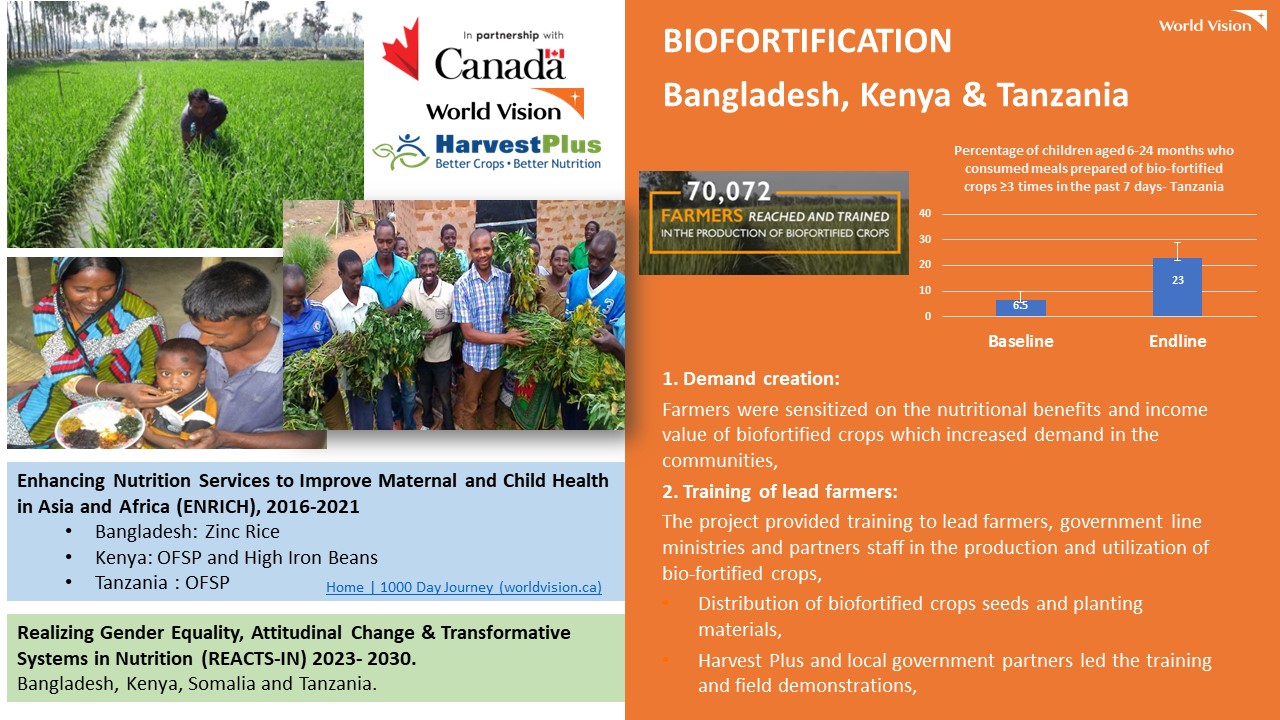
This webinar focuses on the experience and lessons learned in mainstreaming scaling from HarvestPlus. The HarvestPlus program works across CGIAR as part of the International Food Policy Research Institute (IFPRI). HarvestPlus fights hunger worldwide by scaling new, climate smart, high yielding, competitive varieties of staple crops that are nutrient enriched, making food systems more nutritious and inclusive.

The session focuses on how HarvestPlus built a delivery model with the intention to scale from its inception, working through both commercial and non-commercial pathways. It has reached 100 million consumers as of 2023. The program includes a presentation by HarvestPlus and in-country private and NGO partners.

Moderator: Dr. Richard Kohl, Scaling and Strategy, LLC and co-chair of the CoP’s Mainstreaming Working Group

Jenny Walton,  HarvestPlus

Dr. Katharina Diehl,  HarvestPlus

Atinuke Lebile,  Cato Foods

Dr. Asrat Dibaba Tolossa,  World Vision Canada

Lawrence Kent,  The Bill & Melinda Gates Foundation

Dr. Julie Howard,  The Center for Strategic and International Studies
Related Posts

A Framework and Key Elements for Mainstreaming Scaling in Funder Organizations

As part of a comprehensive action-research initiative on mainstreaming scaling in funder organizations, the Scaling Community of Practice developed a framework for assessing the nature and extent of integration of transformational scaling practices in funder organizations operational approach. The framework was distilled in a “Mainstreaming Tracker Tool” (MTT), which allows funder organizations to plan, track and adapt their mainstreaming efforts. The framework consisted of 13 elements, of which 6 are elements that enable the mainstreaming process, and 7 are elements that relate to the operationalization of mainstreaming scaling.

Read More »

RHNS Program Brochure

Food and nutrition security is under unprecedented threat worldwide. Despite decades of international commitments, over 300 million people are living with extreme hunger. Projections show that we’ve stopped making progress on the problem – that we’ll have the same proportion of food insecure people in 2030 as
we did in 2015.

Read More »

SUBSCRIBE

Don’t miss a thing. Become a member by joining our mailing list and get fresh updates, insights, and upcoming opportunities delivered straight to your inbox for free!