

For decades the global community has set out ambitious – though many would argue insufficient – goals for tackling climate change. Countries around the world have adopted thousands of climate policies, but implementation gaps, fragmented efforts, and uneven results continue to limit climate outcomes. In parallel, many locally-led climate efforts are seeking to innovate from the ground up. Yet overall, the sum of these efforts is still not reaching impact at sufficient scale for climate change mitigation, resilience or ecosystem protection.
Many of the barriers to effective climate outcomes are not primarily technical or financial: they are rooted in political economy dynamics, weak governance, unequal power relations and limited accountability. As a result, climate finance and programmes often fail to reach or respond to the needs of vulnerable communities, while ambitious climate commitments struggle in implementation due to misaligned incentives.
National level efforts to strengthen climate change mitigation and resilience need to understand, navigate and shift the political economy and governance dynamics that are required for inclusive, effective and sustainable outcomes.
One opportunity for these changes is through climate-focused Country Platforms (CPs): nationally led coordination mechanisms intended to align finance, policy reform, technical support and implementation around shared climate goals. Initiatives such as the Just Energy Transition Partnerships (JETPs) in Senegal (as well as South Africa, Indonesia, and Vietnam) illustrate efforts to coordinate governments, donors and other actors around large-scale climate transitions. CPs are intended to improve coherence across climate finance and programming while creating stronger pathways towards transformational change.
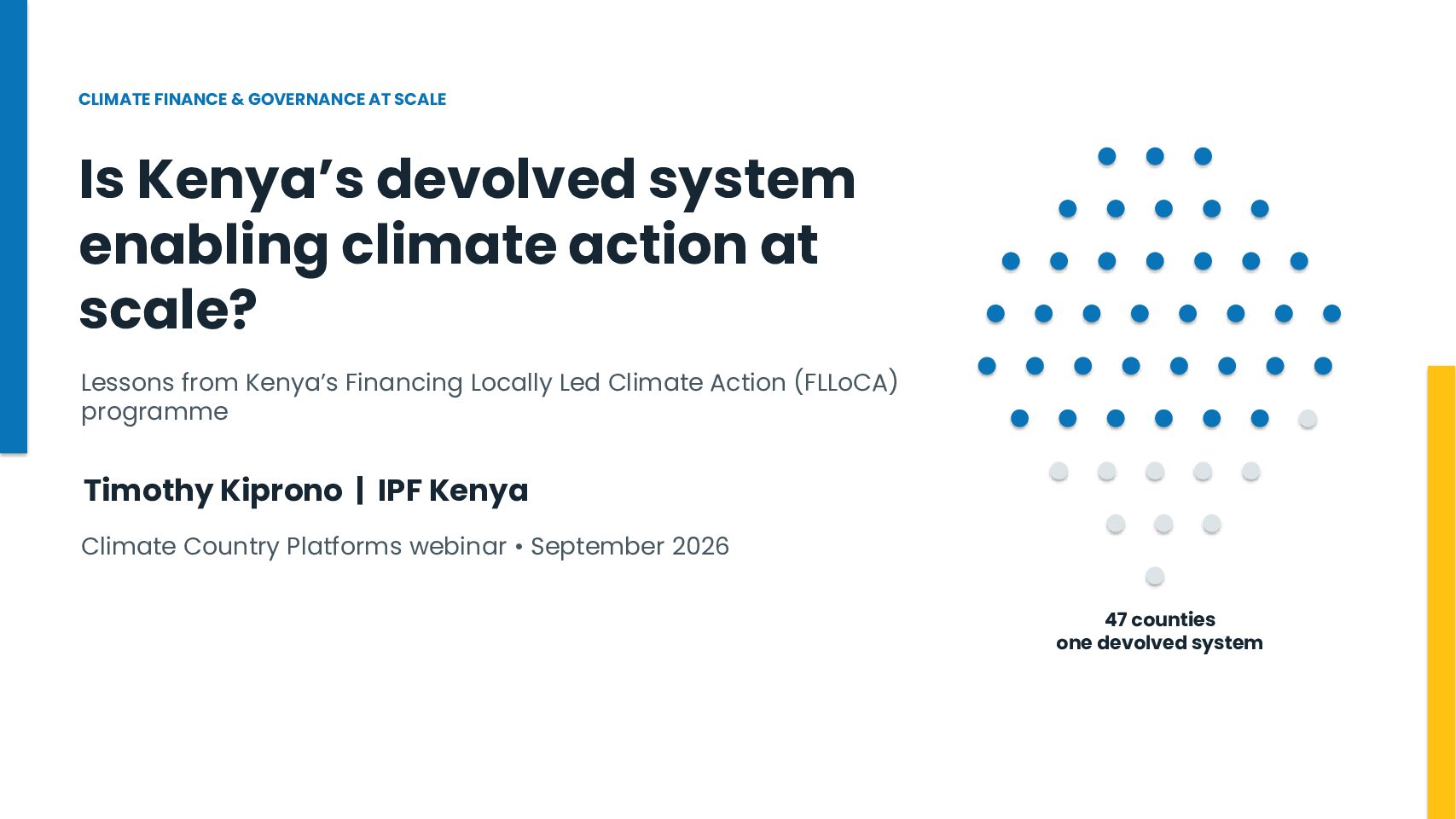
Other approaches to effective climate finance and action at scale are more bottom up, such Kenya’s County Climate Change Funds. These too face political economy and governance challenges that must be understood and addressed to ensure effectiveness at national scale.
This webinar will explore experience and approaches to shifting governance of climate finance and programming in ways that support more inclusive, effective and sustainable outcomes at national scale.
Brendan Halloran
Consultant
Bio
Daouda Diene
Senior Economic Analyst
Natural Resource Governance Institute
Bio
Papa Daouda DIENE is a Senior Economic Analyst for Francophone Africa at the Natural Resource Governance Institute (NRGI), based in Dakar. He leads research and policy analysis across Francophone Africa and contributes to the implementation of NRGI’s broader Africa strategy, working across country, regional and thematic initiatives.
An economist and statistician by training, Daouda has more than a decade of experience working at the intersection of government, civil society, industry and international development partners. His work focuses on natural resource governance and the economic transformation of resource-rich countries, with expertise spanning extractive-sector fiscal regimes and revenue management, economic and financial modelling, energy transition policy and finance, domestic energy utilization, critical minerals, and mineral value addition and industrialization.
Daouda co-leads NRGI’s organization-wide Transition Finance Working Group, which brings together expertise across the institute to advance research, policy thinking and engagement on financing pathways for resource-rich countries navigating the global energy transition. His work in this area covers Just Energy Transition Partnerships (JETPs), climate and transition finance, gas-to-power and domestic gas utilization, fossil-fuel transition pathways, and the governance and political economy of large-scale energy transitions.
He also leads NRGI’s work on financing mineral value addition and industrialization in Africa, examining the policy, institutional and financing conditions required for mineral-rich countries to capture greater domestic and regional value from their resources.
His work focuses particularly on critical minerals, regional mineral value chains, project development and financing, industrial policy, and the opportunities and trade-offs associated with efforts to use mineral wealth to support broader economic transformation.
Across these areas, Daouda combines quantitative economic analysis with policy, institutional and political-economy analysis. He has also designed and delivered training and capacity-development activities for government officials, civil society organizations, journalists and other stakeholders, and regularly contributes to international conferences, policy forums and expert discussions.
Before joining NRGI, Daouda worked with the African Development Bank-supported Institutional Support Project for Resource Mobilization and Investment Attractiveness (PAIMRAI) in Senegal. He previously served as a research officer at the French National Research Institute for Sustainable Development (IRD), worked with Senegal’s Directorate General of Taxes and Domains, and undertook strategy consulting assignments, including work supporting strategic planning in the financial and energy sectors.
Timothy Kiprono
Project Officer
Institute of Public Finance
Bio
Timothy Kiprono is a Kenyan governance and public finance practitioner with over ten years of experience in public financial management, participatory governance, accountability, and institutional reform. At the Institute of Public Finance (IPF), he contributes to work examining how climate finance is governed, financed, and implemented through Kenya’s national and devolved systems. He previously founded and led the Open Governance Institute Kenya.
His work explores the political economy of public finance, with particular interest in how institutional arrangements, public participation, and accountability shape the allocation and delivery of climate finance at the county level. He has collaborated with governments, civil society organisations, research institutions, and international networks on research, policy development, learning, and governance reforms.
Timothy serves on the Research Board of People Powered and is a member of the Open Government Partnership’s Dialogue and Deliberation Practice Group. He is particularly interested in how locally grounded governance innovations can move beyond short-term projects and become sustainable practices embedded within public institutions.
Johannes Linn
Co-Founder & Senior Advisor
Scaling Community of Practice
Bio
Johannes F. Linn is a Non-resident Senior Fellow at the Brookings Institution, a Distinguished Resident Scholar at the Emerging Markets Forum in Washington, D.C., a Senior Fellow at the Results for Development Institute and a Senior Research Fellow at the International Initiative for Impact Evaluation. He is co-founder and Senior Advisor of the international Scaling Community of Practice. He currently serves as Global Facilitator for the Systematic Observation Financing Facility (SOFF) of the World Meteorological Organization (WMO). From 2005-2010 he was Director of the Wolfensohn Center for Development at the Brookings Institution in Washington, DC. Before that, he worked for three decades at the World Bank, including as Vice President for Financial Policy and Resource Mobilization and as Vice President for Europe and Central Asia. He holds a bachelor degree from Oxford University and a doctorate in economics from Cornell University.
Karin Kemper
Senior Advisor
The Scaling Community of Practice
Bio
Over more than 30 years, Karin Kemper has worked across development finance, biodiversity, climate, water, and the blue economy to help design and scale solutions that deliver impact at the level required. Her focus is on bridging finance, policy, and implementation, mobilizing capital, structuring investment approaches, and building partnerships that enable systemic change across emerging and developing economies.
Karin Kemper’s experience includes leading multi-million-dollar portfolios at the World Bank and contributing to institutional strategy and innovation in development finance and environmental governance. Today, she serves as Board Director and Senior Advisor, including to the Scaling Community of Practice, and as a member of international expert groups on sustainable and sovereign finance.
An institutional economist by training, she has authored numerous publications on natural resource economics and managed comprehensive studies on environmental management globally. Karin Kemper, a German national, possesses an educational background from Linkӧping University in Sweden holding a Ph.D. in Water and Environmental Studies. In her free time her interests include nutrition and natural medicine. She holds M.Sc. degrees in Nutrition and Integrative Health and Herbal Medicine from Maryland University for Integrative Health (now NDMU).