Since the Scaling Community of Practice was established in 2015 years ago, the global context has shifted radically.
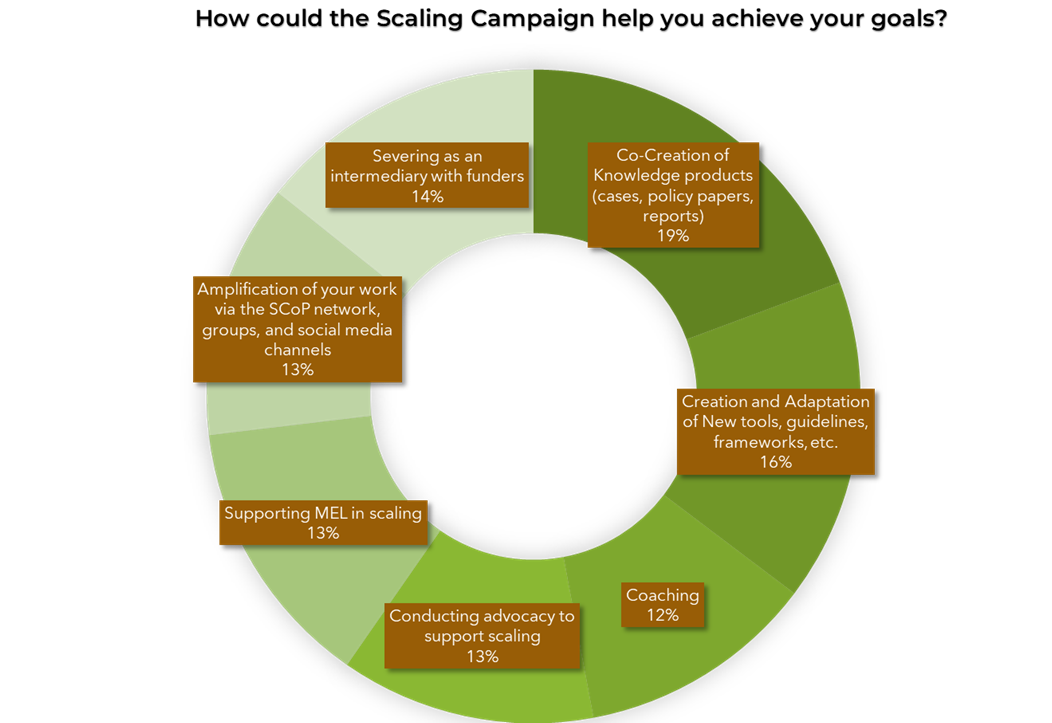
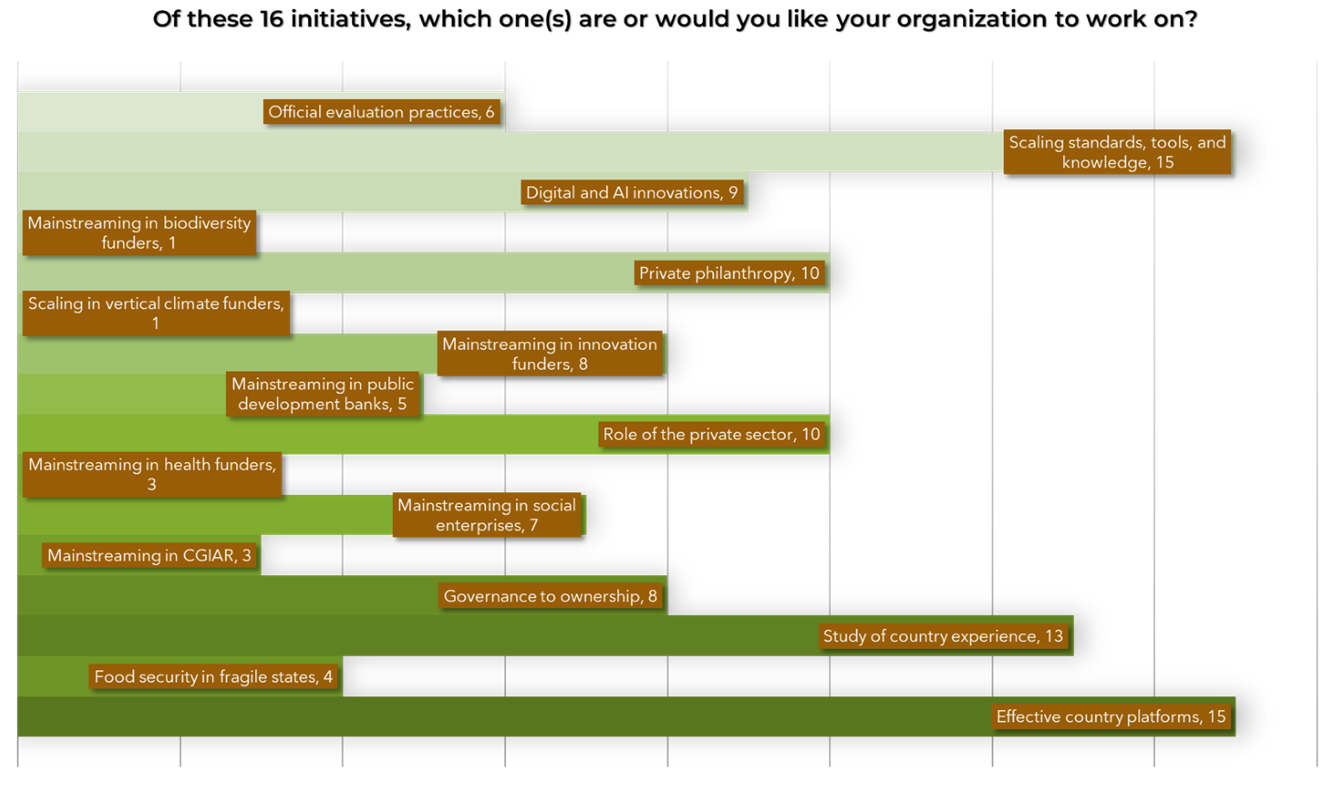
It’s time now to turn our attention urgently to influencing current thinking about the way forward. Building on the experience of a three-year action research program, the SCoP has decided to turn its attention to a 5-year action agenda to align the practices, policies and priorities of governments, funders, innovators and implementers to align with the lessons we have learned about producing sustainable outcomes that match the scale of the development and climate problems they address.
Part 1 of the session will introduce the Scaling Campaign 2026 – 2030 and its key elements. Part 2 will be a panel discussion among global leaders about the relationship of the Campaign to some of today’s most pressing issues. And Part 3 will provide a deep dive to one of the Campaign’s early initiatives in Somalia.

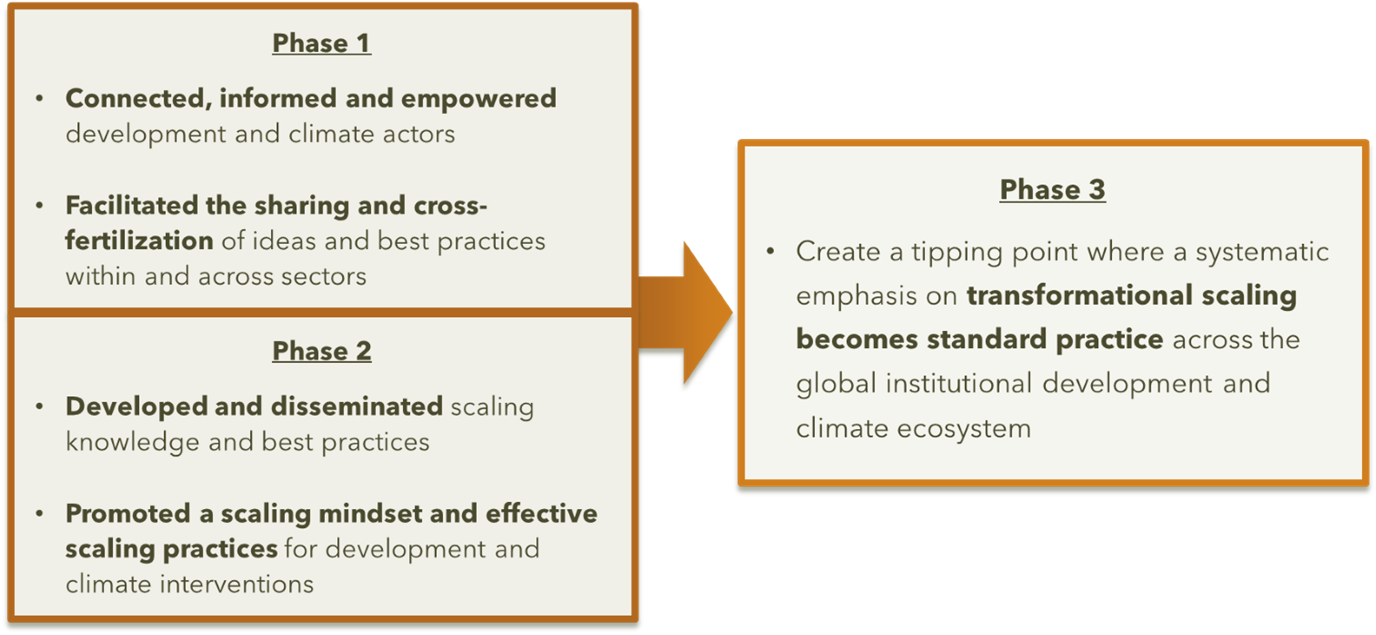
The second plenary marked the formal launch of the Scaling Campaign 2026–2030, which represents the SCoP’s move from a peer-learning network to a movement.
A network has loosely connected nodes that facilitate communication and learning while a movement shapes narratives and builds collective action through leaders, without any one organization “owning” the agenda. The session made the case for members to start pushing for systemic change across the institutions, governments, and funders that shape development and climate action at scale.
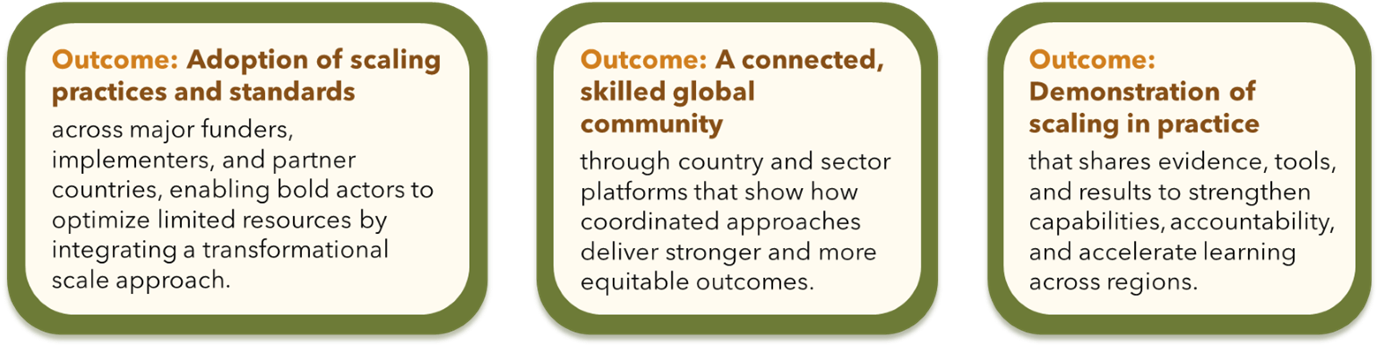
The Campaign’s three outcomes — adoption of scaling practices and standards, a connected and skilled global community, and demonstration of scaling in practice — were presented not as an organizational to-do list, but as a theory of change for reaching a tipping point where transformational scaling becomes the norm rather than the exception.
The panel, led by Alan Robbins of Devex and featuring Jordan Fabyanske (Dalberg Catalyst), Poonam Muttreja (Population Foundation of India), and Ndidi Okonkwo Nwuneli (the One Campaign), picked up on the “knowing-doing gap” from the first plenary and asked: if we know what needs to change, why hasn’t it? Jordan Fabyanske reframed the challenge as “belief work.” The problem is not ignorance of what transformational scaling requires. The problem is that funders want to believe they can achieve their objectives without the hard, slow work of true co-creation with governments and communities. The current rupture in ODA has stripped away that convenient assumption. Poonam Muttreja brought in the ground-level view from India, arguing that the only way to make scaling stick is to build it into the delivery structure from day one. Scaling needs to be in performance metrics and incentives. Her example of a 180-episode television campaign that reached 150 million viewers, credited to the Government of India and not the donors, illustrated a clear scaling pathway with true local ownership. Ndidi Okonkwo Nwuneli offered a sharp criticism, “I’ve literally had people, … ask me, ‘If Africa gets its act together, I’m not going to have a job.’” People resist transformational scaling because they do not see themselves in the future it describes. Therefore, the advocacy and communications of the Scaling Campaign cannot be afterthoughts, but must be strategic imperatives.
The session closed with Larry Cooley presenting three organizational paths for the Campaign’s Secretariat: a dedicated secretariat, a dispersed model across partner organizations, or a fully organic and voluntary structure. He asked the audience to get involved however they could: join the movement, advocate within their organizations, work with the SCoP, provide core funding, or engage in other creative activities to support the scaling agenda.

Larry Cooley
Co-founder & Co-chair
Scaling Community of Practice
Bio
LARRY COOLEY
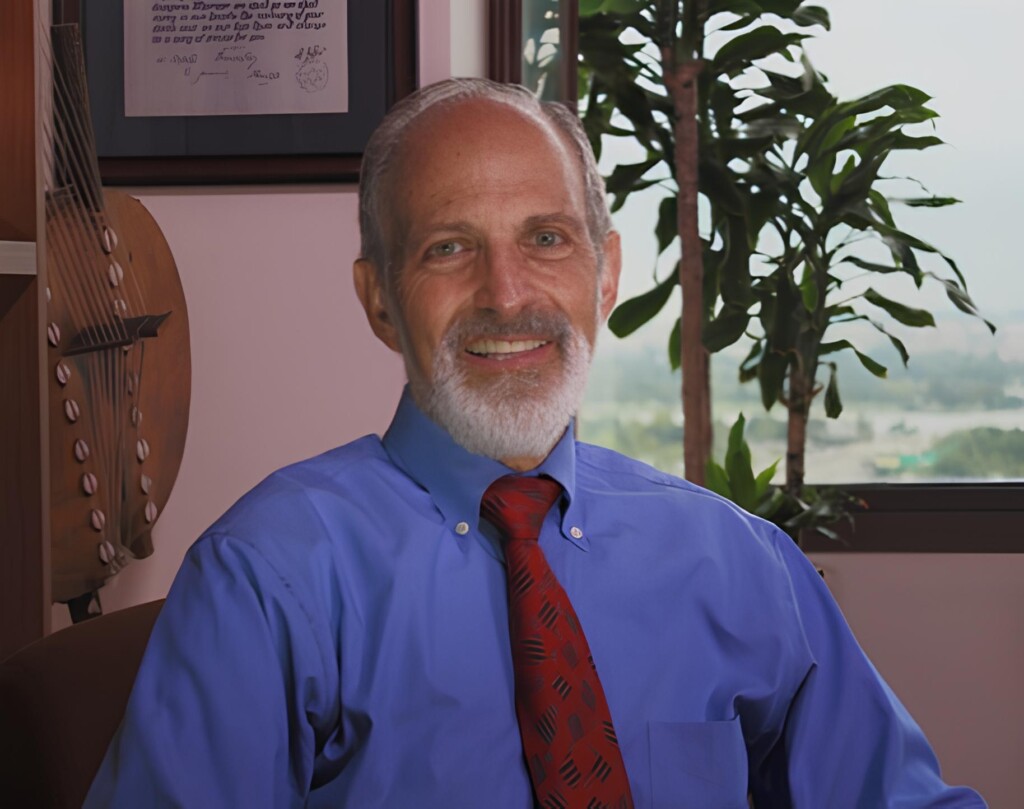
Larry Cooley is Founder and President Emeritus of Management Systems International and a specialist in managing large system change. He currently serves as Chair of the Governing Council of the Society for International Development and is the author of widely used methodologies for managing policy change, scaling innovation, entrepreneurship development, and results-based management. Larry is an elected Fellow of the U.S. National Academy of Public Administration and a non-resident senior fellow at the Brookings Institution; a Trustee of Elma Philanthropies; founder and co-curator of the Global Community of Practice on Scaling Development Outcomes, and Co-Chair of its Working Group on Monitoring and Evaluation
Alan Robbins
Executive Vice President
Devex
Bio
Alan has played a key role in Devex’s journey from a small start- up to the leading media platform covering global development, health and humanitarian issues. Along with a talented group of editors, reporters, and communicators, he is driving growth and engagement through partnerships with organizations working on the SDGs and social good – aid agencies, major corporations, leading NGOs and everyone in-between. Through events, visual stories, content series, special reports and more, Devex’s award-winning partnerships help drive the development agenda and create awareness on key global issues, from disability inclusive development, to health worker safety, to inclusive food systems and much, much more.
Alan has a graduate degree in international affairs from George Washington University and an undergraduate degree in history and political science from Rutgers University. In his spare time, you can find him reading historical biographies, coaching his sons’ sports teams and adjusting to no longer being the tallest in the family.
Ndidi Okonkwo Nwuneli
President/CEO
ONE Campaign
Bio
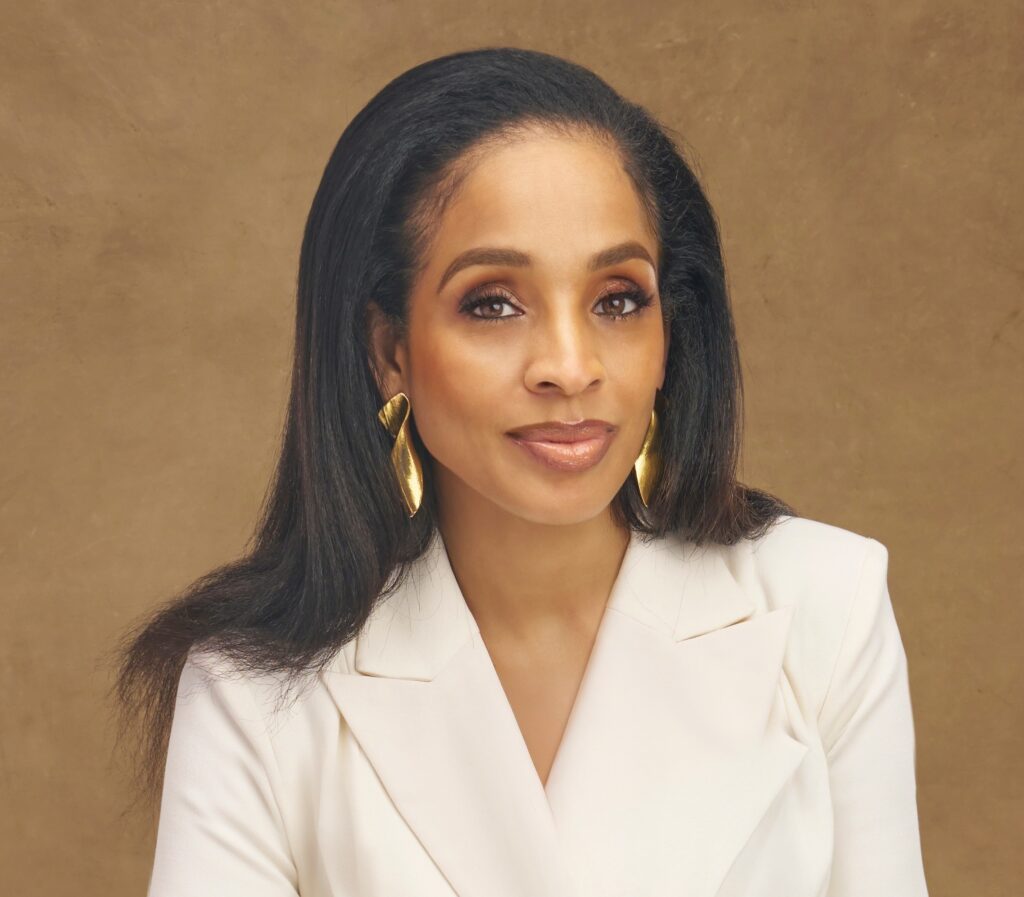
Ndidi Okonkwo Nwuneli is the President/CEO of the ONE Campaign. Ndidi started her career at McKinsey & Company’s Chicago office and returned to Nigeria in 2000 to serve as the pioneer Executive Director of the FATE Foundation. She is the founder of LEAP Africa, a non-profit committed to developing dynamic, innovative and principled African leaders and African Food Changemakers, which provides support for African entrepreneurs to start and scale resilient and sustainable agribusinesses. She is also the co-founder of Sahel Consulting Agriculture & Nutrition Ltd. and AACE Foods Processing & Distribution Ltd.
Ndidi serves on the boards of the Rockefeller Foundation, Chanel Foundation, Stanbic IBTC Group, the Young Global Leaders of the World Economic Forum, the Bridgespan Group, and the Global Partnership for Sustainable Development Data. She has also joined the International Finance Corporation’s Women LEAD Africa Alliance. Ndidi holds an M.B.A. from the Harvard Business School and an undergraduate degree with honors from the Wharton School of the University of Pennsylvania. She was a Senior Fellow at the Mossavar-Rahmani Center for Business & Government at the Harvard Kennedy School, a visiting Scholar at Max Bell School of Public Policy at McGill University, an Aspen Institute New Voices Fellow, and an Eisenhower Fellow.
Poonam Muttreja
Executive Director
Population Foundation of India
Bio
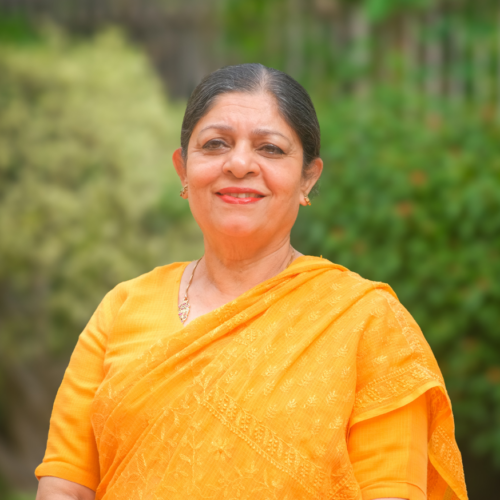
Poonam Muttreja is the Executive Director of the Population Foundation of India and has championed women’s health and rights for over 40 years. She co-conceived the transmedia initiative, “Main Kuch Bhi Kar Sakti Hoon.” Previously, she was the India Country Director at the John D and Catherine T MacArthur Foundation in India for 15 years and co-founded organizations like Ashoka Foundation and Dastkar. Poonam is also affiliated with ActionAid International, The National Academies of Sciences, Engineering, and Medicine, Washington DC, and is an alumna of Delhi University and Harvard’s Kennedy School of Government. She is a regular commentator for prominent media organisations in India and globally.
Jordan Fabyanske
CEO
Integral
Bio
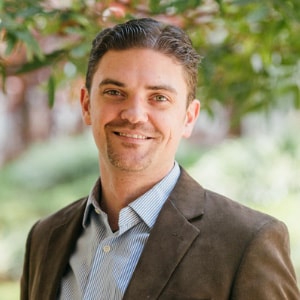
Jordan Fabyanske is a senior executive and entrepreneurial leader in the field of social change. As CEO of Integral, Jorden stewards global programming in co-creation and stewardship with global initiative heads.
Previously, Jordan was Chief Program Officer of Dalberg Catalyst and, prior to that, a Partner at Dalberg Advisors and head of the Dalberg Group’s operations globally. At Dalberg, Jordan co-led the firm’s Inclusive Economic Growth service line and Systems Change community of practice, advising leading actors in global development—including foundations, governments, multilateral organizations, NGOs and corporations—on matters of policy, strategy, organizational effectiveness, multi-stakeholder initiatives, and scaling social impact.
An alum of Booz Allen Hamilton and Booz&Co (now PwC – Strategy&), Jordan holds a Master’s degree in international business from The Fletcher School at Tufts University and a Bachelor of Science degree in applied mathematics from MIT. When he is not nudging his friends and colleagues to think in terms of systemic, visionary change, Jordan can be found hiking or canoeing with his wife and two children in Minnesota.
Abdihakim Ainte
Director of Food Security and Climate Change
Office of the Prime Minister of Somalia
Bio
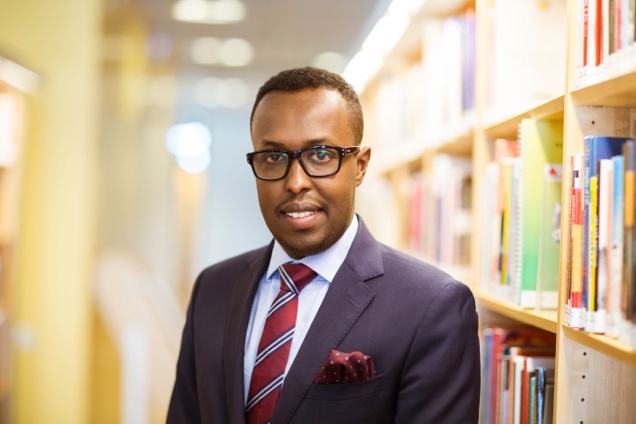
Abdihakim Ainte is prolific writer and social entrepreneur with strong track record in working with both public and private sector. Before he was appointed to Director of Food Security and Climate Change by Prime Minister of Somalia in April 2024, he was leading and co-founded the first innovation, entrepreneurship and technology Hub called iRise Hub in Somalia with aim of leveraging to unlock social and private capital for economic growth. The Hub raised over 20 million dollars from private, philanthropist and development partners in less than 4 years.
Since assuming his current role, Mr. Ainte has steered Somalia’s climate and food security agenda on the global stage, including leading the country’s participation in COP28 and COP29, where he played a key role in high-level negotiations. His work has focused on building resilience through Country Platforms.
Mr. Ainte previously served as an advisor to the Government of Somalia, UN agencies, international organizations, and think tanks. He holds a BA in Peace and Development Studies from Linnaeus University in Sweden and an MSc in Public Policy from the University of Bristol, UK.
Simon Winter
VP, Reimagining Humanitarian Nutrition Security
RF Catalytic Capital
Bio
Simon started with RF Catalytic Capital (a public charity supported by Rockefeller Foundation) in August 2025 to lead a new initiative that looks to develop next generation integrated models to deliver resilient food and nutrition security in fragile regions. At the end of 2024, he founded Sustainable Agriculture Foundations’ International Association, to support the legacy Asia and African country organizations spun out of the Syngenta Foundation for Sustainable Agriculture (SFSA). He was SFSA Executive Director from 2017 to 2024, during which time SFSA saw a 5-fold increase in pre-commercial smallholder farmers supported. He joined from TechnoServe, where he had been SVP, Development, and led operations in sub-Saharan Africa. From 2015-2017, Simon was a Senior Fellow of the Mossavar-Rahmani Center at the Harvard Kennedy School. He serves on a range of boards including chair of the Dalberg Trust, the Scaling Community of Practice, and Griffith Foods Sustainability Advisory Council and is an Associate Director of Morphosis (an organization boosting investment in climate adaptation). His earlier career included positions at McKinsey & Co, a Ministry in Botswana, and Barclays Bank. A UK and German citizen, Simon holds a PhD in Economics from SOAS, London.