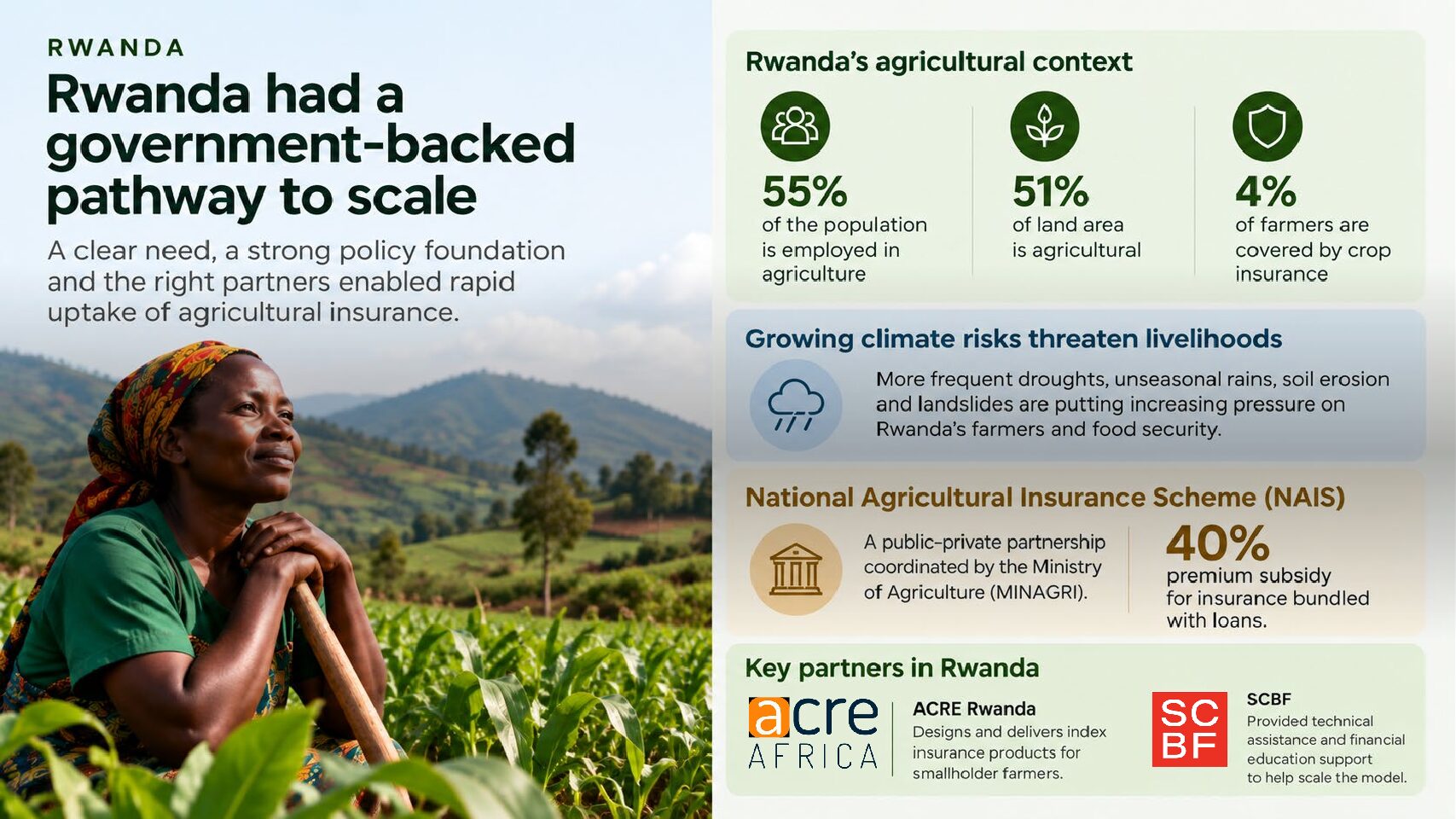

| Climate and weather index-based insurance can help smallholder farmers, businesses and vulnerable communities manage increasingly severe climate shocks. Yet many promising solutions remain small pilots. Even where a product shows early potential, reaching wider and more sustainable scale requires more than additional funding. It depends on adapting the product, building trust, generating credible evidence, strengthening local capacity and bringing together insurers, governments, funders, distributors and technical partners at the right stages. This webinar will examine what it takes to move a climate insurance solution from early innovation towards institutional or market scale. It is designed for development practitioners, funders, policymakers, researchers and other members of the scaling community, including those without specialist insurance knowledge. The discussion begins with the recurring challenges that prevent climate insurance solutions from scaling. Two practical cases are then show how these challenges were addressed in different contexts. Rather than focusing primarily on what each project delivered, the speakers examine the decisions made, how the approach changed over time, which partnerships proved essential and how financing needs evolved from initial testing to wider implementation. Participants leave with a practical framework for assessing whether a climate insurance innovation is ready to scale, the obstacles that need to be addressed and the different roles that funders and implementation partners can play along the way. What we cover
|
Sitara Merchant Carter
CEO
Swiss Capacity Building Facility (SCBF)
Bio
Sitara Merchant Carter, is a multicultural professional with over 30 years of experience in international management and development across Asia, Africa, the Middle East and North America. Sitara is the CEO at Swiss Capacity Building Facility (SCBF), a membership-based organisation that brings together public and private entities to advance responsible financial inclusion. SCBF provides catalytic funding to support Financial Sector Partners (FSPs), impact-driven organisations and social enterprises to test, develop and scale financial solutions that address the needs of low-income households, smallholder farmers, and micro, small, and medium enterprises (MSMEs).
Claire Harbron
CEO
Howden Foundation
Bio
Claire joined as CEO of Howden Foundation in May 2025, bringing with her 15 years’ experience in international corporate and climate philanthropy.
Prior to joining Howden Foundation, Claire was Chief Investment Officer at the BHP Foundation, where she oversaw development and execution of the Foundation’s strategy, and led an international team to maximise the outcomes and impact of the Foundation’s grant-making, overseeing a portfolio of over $50 million per year.
Claire began her philanthropic career at one of the world’s largest global climate funders, Children’s Investment Fund Foundation, where she led programme, portfolio and grant-making work before moving into the role of the Chief of Staff to the CEO.
Claire began her career at Ernst and Young where she worked with clients in both the public and private sector in Assurance and Advisory. She has a Master of Arts in Natural Sciences from the University of Cambridge and is a Chartered Accountant with the Institute of Chartered Accountants of Scotland. Claire is also a Trustee and Chair of the Audit Committee for the UK-based charity, Integrity Action.
Reinhard Marcellino
Head, Southeast Asia
Blue Marble
Bio
Reinhard leads Blue Marble’s portfolio of projects across Southeast Asia. He brings over 10 years of experience in business development and project management, with a focus on financial inclusion and microinsurance in emerging markets. He has a strong track record in developing public-private partnerships and working with government, private-sector, and development partners to scale inclusive insurance solutions.
Koray Alus
Senior Development Finance Expert
InsuResilience Solutions Fund
Bio
Koray Alus is a Senior Banking Expert and Project Manager at the Frankfurt School of Finance & Management, with more than 18 years of experience in development finance, financial inclusion and innovative financing mechanisms. He currently supports the management and implementation of KfW’s InsuResilience Solutions Fund, including the assessment, structuring and monitoring of climate risk insurance projects. Previously, he worked at the EBRD and Garanti Bank, where he managed development finance programmes involving blended finance, guarantees and risk-sharing mechanisms across SME, agricultural, gender and sustainable energy finance.
Matthew Eldridge
Senior Program Officer
The Gates Foundation
Bio
Matthew Eldridge is a climate and development finance advisor at the Gates Foundation, where he focuses on building finance partnerships to scale investment in climate-resilient food system solutions. Previously, he served as a Senior Program Officer at Gates, leading a portfolio on climate finance policy and macroeconomics. Prior to joining the Foundation, he led research on innovative finance and public financial management at the Urban Institute, consulted on banking and asset management policy, and worked at the World Bank on aid effectiveness and supporting the Central Asia portfolio.
Karin Kemper
Senior Advisor
The Scaling Community of Practice
Bio
Over more than 30 years, Karin Kemper has worked across development finance, biodiversity, climate, water, and the blue economy to help design and scale solutions that deliver impact at the level required. Her focus is on bridging finance, policy, and implementation, mobilizing capital, structuring investment approaches, and building partnerships that enable systemic change across emerging and developing economies.
Karin Kemper’s experience includes leading multi-million-dollar portfolios at the World Bank and contributing to institutional strategy and innovation in development finance and environmental governance. Today, she serves as Board Director and Senior Advisor, including to the Scaling Community of Practice, and as a member of international expert groups on sustainable and sovereign finance.
An institutional economist by training, she has authored numerous publications on natural resource economics and managed comprehensive studies on environmental management globally. Karin Kemper, a German national, possesses an educational background from Linkӧping University in Sweden holding a Ph.D. in Water and Environmental Studies. In her free time her interests include nutrition and natural medicine. She holds M.Sc. degrees in Nutrition and Integrative Health and Herbal Medicine from Maryland University for Integrative Health (now NDMU).