

Larry Cooley is Founder and President Emeritus of Management Systems International and a specialist in managing large system change. He currently serves as Chair of the Governing Council of the Society for International Development and is the author of widely used methodologies for managing policy change, scaling innovation, entrepreneurship development, and results-based management. Larry is an elected Fellow of the U.S. National Academy of Public Administration and a non-resident senior fellow at the Brookings Institution; a Trustee of Elma Philanthropies; founder and co-curator of the Global Community of Practice on Scaling Development Outcomes, and Co-Chair of its Working Group on Monitoring and Evaluation.

Digital technology and African smallholder agriculture: Implications for public policy
COVID-19 has exacerbated challenges to Africa’s food and agriculture sector and to its millions of smallholder farmers. At the same time, the pandemic has accelerated innovative efforts to develop and deploy the transformative power of digital technology to address these…

Designing for scale: A worksheet for developing a scaling strategy in education
Suddenly, talk of scaling and systems change in education seems to be popping up everywhere—and for good reason. Progress toward key educational goals has stalled or even regressed, and education systems have been slow to adopt and integrate disruptive change.…
Education Scalability Checklist
Produced in collaboration with VVOB – education for development, the Brookings Center for Universal Education, Educate!, Pratham and STiR Education, the Education Scalability Checklist (ESC) and associated user’s guide adapts MSI’s Scalability Checklist to address the specific needs for scaling…

Scaling Up Impact – the Key Challenge for the Development Community Takeaways from a Workshop of the Scaling Community of Practice
By: Lawrence Cooley, Richard Kohl, and Johannes Linn “Scaling up impact” is the new watchword in development. Cynics might be inclined to dismiss it as the newest fad in the merry-go-round of fads in development theory and practice. But this…
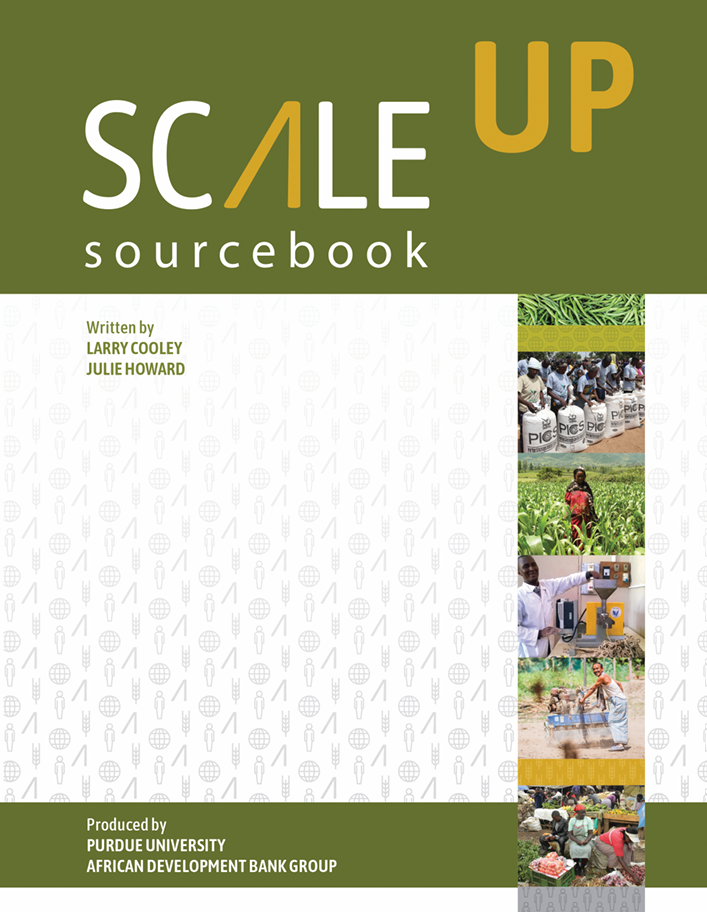
Sourcebook for Scaling Agricultural Innovation
The Scale Up Sourcebook is informed and inspired by the September 2018 conference, Innovations in Agriculture: Scaling Up to Reach Millions, organized by Purdue University, in partnership with the African Development Bank. The Sourcebook consolidates, extends, and disseminates some of the scaling insights presented at the Purdue conference. It is intended as an easy-to-use guidebook targeted to a broad and diverse audience of stakeholders associated with scaling agricultural technologies and innovations to meet the needs of the world’s poor. The Sourcebook has nine chapters: designing with scale in mind; assessing scalability; using commercial markets to drive scaling; financing the transition to scale; creating an enabling environment for scale; tailoring metrics, monitoring, and evaluation to support sustainable outcomes at scale; and the critical role of intermediary and donor organizations. The Sourcebook provides guidance, tips, and examples, along with links and references to additional resources on scale up.