

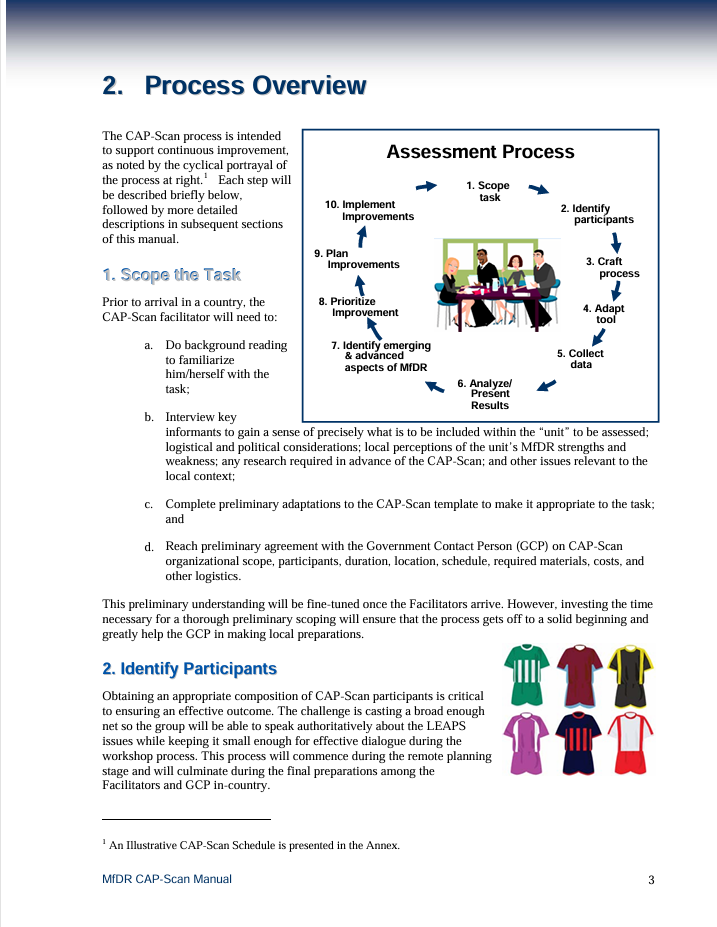
Managing for Development Results Capacity Self-Assessment Toolkit
The Management for Development Results Capacity Self-Assessment Toolkit (CAP-Scan) is a practical, self-guided methodology designed to help governments assess and strengthen their capacity to manage for development results (MfDR) at both national and sectoral levels. Developed by MSI in collaboration with a World Bank-led donor consortium, the toolkit is built around a tested maturity model that enables stakeholders to identify strengths, diagnose gaps, and prioritize actions for improvement. CAP-Scan supports capacity development across key areas including leadership, planning and budgeting, monitoring and evaluation, mutual accountability, and statistical systems. The methodology has been applied in 34 countries and has also been adapted for use in the agriculture and power sectors.
The Education Scaling-Up Education Working Group: Report on a Meeting
The Education Working Group hosted a webinar on April 9, 2020, to discuss how members are continuing (or exploring how to continue) learning opportunities in the midst of the global COVID- 19 pandemic, and more specifically to: Discuss immediate and…


Toolkit for Scaling Maternal and Child Health Interventions
The Coordinators Guide and Toolkit are intended for those supporting a Ministry of Health-led systematic process of scale-up of one or more high-impact reproductive, maternal, newborn, child and adolescent health interventions, geared towards a scale-up coordinator or scale-up manager role.…


A New Book by IDRC Explores Scaling Approaches and Experience in Depth
The world is changing rapidly, and persistent problems like environmental degradation or accelerating inequality impact the entire global community and press us to do better for each other and our environment. For organizations and individuals working to tackle big social…
Update on J-PAL’s New Evidence to Policy Initiative and its Focus on Scaling
By The E2P team at E2P@povertyactionlab.org Well-designed randomized evaluations test theories and provide general insights about how programs designed to address poverty work. These insights, when combined with descriptive data and a deep understanding of the local context and institutions,…