A. Introduction
The world faces enormous development, humanitarian, and climate challenges at the very time when traditional sources of international financial support are suffering major cutbacks. Likewise, governments in the Global South, the private sector and civil society are under stress, while communities face major challenges to their cohesion and traditions of civic culture. This puts a premium on ensuring that the available financing shifts its focus from funding innovative, standalone projects to increasing the capacity of governments, social enterprises, and the private sector to deliver long-term impacts that address global problems sustainably and at the scale of the problem.
A recent report by the Scaling Community of Practice (SCoP) assesses to what extent and how 28 public and private funders (see the Annex for a full list of case studies) have mainstreamed consistent approaches to scale and scaling into their policies, multi practices and priorities and synthesizes lessons from their experience. Case studies for this mainstreaming initiative were purposively selected to examine a wide range of funder organizations known to be making serious efforts to mainstream scaling into their core operations. Following an “action research” approach, funder staff wrote or supported the writing of all 28 case studies. The Synthesis Report also draws selectively on the related experience of the three authors with a range of other funders.
This note focuses specifically on the implications of the mainstreaming initiative for funders that support research and innovation related to international development and climate change. These organizations potentially play key roles in supporting the pursuit of sustainable impact at scale. The paper concludes that they have made progress in their quest to play a catalytic role, but that they have potential to go much further in their pursuit of supporting transformational change in the countries and sectors where they provide support.
The note first summarizes, in Section B, the findings and lessons for funder organizations in general that also apply to research and innovation funders. It then presents, in Section C, findings and lessons that apply specifically to research and innovation funders. Section D presents summary conclusions.
CLICK HERE TO READ MORE
B. General Findings and Lessons
The main findings and lessons of the mainstreaming initiative can be summarized as responses to the key questions addressed. These findings apply to funders in general, including research and innovation funders working in developing countries.
1. To what extent have funder organizations mainstreamed a systematic focus on scaling?
- Scaling is a topic of rapidly growing and now widespread interest in the funder community.
- Overall, funders have made the most progress in incorporating a scaling focus in statements by agency leadership and embodying it in mission statements. There is frequently a gap between high-level aspirations and implementation of the needed internal changes to incentives, systems and metrics.
- Trade-offs, such as scale and equity, scale, quality, etc., do not get the attention they merit.
- Insufficient attention is paid to funder collaboration, to handoffs among funders, and to engaging institutions with the ability and incentive to fund and provide services over time.
- The distinction between transactional and transformational scaling is of central importance but not widely recognized. Transactional scaling focuses on one-off increases in impact, measured against a base line rather than a long-term goal. Transformational scaling requires a long-term vision of scale and scalability from the beginning and measures progress in terms of impact and change relative to the long-term goal. It has an explicit and sustained focus on systemic change, persistence in engagement, a focus on localization and partnerships, and frequent adaptation in response to lessons learned.
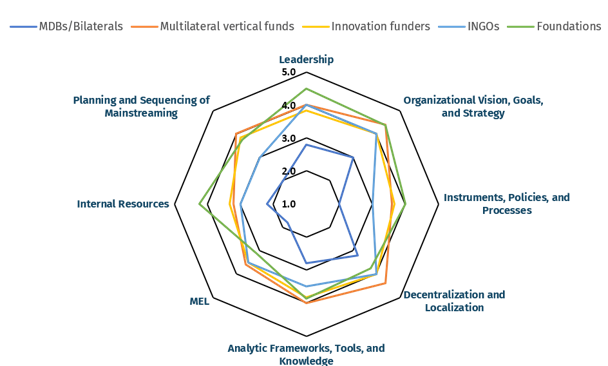
An AI-based analysis of the case studies, drawing on key elements of the Mainstreaming Initiative’s Tracker Tool,[2] provides a comparison of mainstreaming across types of funders, by rating them according to eight criteria of mainstreaming drivers (see Section B.4 above). Figure 1 below summarizes the results of the AI analysis. It shows that foundations, innovation funders and vertical funders are farthest along in mainstreaming scaling, followed by INGOs in the middle, while Multilateral Development Banks and bilateral official funders lag behind. For research and innovation funders, performance is generally relatively strong, but internal resources and monitoring, evaluation and learning (MEL) are relatively weak. The remainder of this section provides a detailed assessment of the mainstreaming experience across all funder categories.
|
Figure 1. Mainstreaming score by funder type and factor |
2. What funder practices are most critical in supporting transformational scaling?
Initiate scaling from the beginning (“start with the end in mind”): It is not sufficient for funders to focus on scaling at the end of an innovation process or when exiting a project. There needs to be a clear vision from the outset of what successful scaling looks like. The conditions that allow scaling to happen – primarily alignment with domestic priorities and resource and implementation realities at scale – have to be addressed from the beginning of the scaling pathway.
Incorporate scalability assessment: A systematic assessment of scalability helps guide, monitor, and evaluate the design and implementation of the scaling process by assessing the enabling conditions of scaling – demand, costs, incentives, financing, capacity, political support, etc. – and drawing attention to issues such as complexity; potential opposition; ease of production and delivery by suppliers; ease of adoption by end users; unit cost; and availability of a “funder at scale.”
Integrate systems change with scaling support: Achieving impact at scale requires funders to systematically identify and address institutional, policy and political constraints alongside scaling investments to increase the probability of successful scaling and impact.
Consider equity and inclusion explicitly: Scaling efforts can unintentionally reinforce inequality or create other unintended consequences such as adverse environmental impacts. Increased inequality is driven by the fact that reaching marginalized and vulnerable groups often requires greater time, effort and unit cost. Funders should make equity tradeoffs explicit and target optimal — not maximum — scale.
Double down on country ownership and localization: Transformational scaling depends on domestic actors — government, business and civil society — owning the vision of impact at scale, championing the solutions and the scaling pathways, and having the capacity and resources to sustain them. Localization too often continues to be interpreted as consultation rather than genuine changes in historical power dynamics.[1]
Invest in partnerships with other funders: Because no single funder spans the full scaling pathway nor is best placed to undertake all the tasks needed at a given scaling stage, effective scaling requires partnerships — often through country platforms, collaborative financing mechanisms, and coordinated handoffs across scaling stages. All funders are challenged by the often-unanticipated costs of developing and maintaining partnerships, which take time, resources and a willingness to harmonize processes, to share control and to co-brand.
Build support for scaling into monitoring, evaluation and learning: Effective scaling requires monitoring not only outputs but also impacts, enabling conditions and the scaling process itself. Learning from experience has to be used to revise and update objectives and scaling strategies; support adaptive, flexible management; and ensure accountability.
Elevate the role of intermediaries: The lack of effective intermediation across the scaling pathway contributes to the stubborn persistence of unscaled pilots and the “Valley of Death” for promising innovations and interventions. Funders can be of great assistance when they go beyond traditional project financing and support local intermediaries – or use their own good offices – to broker handoffs across scaling stages, convene partners and strengthen coordination structures.
3. What are the principal obstacles to mainstreaming scaling that funders have encountered?[2]
The project mindset: timebound funding delivers outputs, not sustainable impact. Funders typically support time-bound (2-5 year), one-off projects that focus on delivering outputs, or at best outcomes, but not necessarily development impact. Moreover, they typically focus on outputs that can be achieved during the project’s duration, but not beyond project closeout.
Misaligned incentives and metrics. Funder middle management and staff feel overburdened with unfunded mandates and resist additional priorities that are added on top of existing mandates. Moreover, they are often rewarded for presenting new projects to their management and boards, for disbursement, on-time delivery, and achieving their output objectives by project end. Staff receive less recognition, if any, for supporting ambitious longer-term goals of scale and sustainability. Similarly, the design and implementation of projects typically do not measure sustainability and scalability by others beyond project end. Follow-up to previous projects is often less valued by management than starting new ones. These incentive structures are often reinforced by governance and board-level expectations.
Lack of alignment with local and national priorities. Funders often fail to align adequately with local and national priorities and ownership.
Institutional strengthening and capacity building are missing, inadequate, or not targeting sustainable scaling. While many funders do some institutional strengthening and capacity building during the project lifetime, often these are incomplete given short project duration. More importantly, they frequently fail to address critical constraints on financial resources that stand in the way of long-term, sustainable scaling.
Poor donor coordination, duplication, and burdensome, siloed reporting instead of mutually reinforcing activities. Despite decades of efforts at and exhortations for coordination and collaboration, funders operating in the same development space (geography, sector, thematic area, etc.) continue to evidence poor coordination, siloed reporting systems, duplicative efforts, etc. While partnerships are always necessary for successful scaling, international development and climate funders continue to struggle to overcome systemic obstacles to successful collaboration, especially a lack of internal organizational incentives that support and reward effective cooperation with others.
Monitoring and evaluation methodologies and practice track outputs and outcomes against baseline, not impact against long-term targets and not enabling conditions for scaling. Project monitoring and evaluations focus on delivery against project plans, timely disbursement of funds, and narrow results targets. Monitoring and evaluation processes usually fail to generate data on scalability to support future scaling efforts and rarely examine whether projects put in place conditions for sustainability and scaling impact beyond project end.[3] More specifically, these systems and metrics typically do not distinguish between need and demand; evaluate the impact and cost effectiveness of competing approaches; assess the extent of changes from existing behaviors and practices required by adopters and implementers; measure unit costs and evaluate potential for economies of scale; identify the role of context, social issues, and the political economy across relevant stakeholders; or assess constraints to scaling in the policy enabling environment or relevant market systems.
4. What factors drive the mainstreaming of transformational scaling within funder organizations?
Leadership must drive support for scaling. Embedding scaling across a funder organization requires leadership at all levels, but sustained change must be led from the top. Governing bodies and chief executives need to set a long-term vision for transformational impact, ensure continuity through leadership transitions, and translate commitments to scale into operational practice. The emphasis on impact at scale should not remain aspirational or merely transactional, but must be matched by changes in incentives, resources, and management systems. Clear direction, accountability, and support are essential to move from rhetoric on scaling to action.
Corporate mission, vision, goals and definitions have to focus on transformational impact at scale. This requires funders to define what they mean by scale and transformational scaling and to establish clear, measurable long-term impact goals. Broad mandates make this more challenging, but evidence shows that the clearer and more specific the institutional commitment to achieving specific sustainable outcomes at scale, the more effectively these commitments are reflected in operational practice.
Financial and operational instruments, policies and practices have to support a scaling approach. Funders’ financial and capacity building instruments, operational policies, appraisal criteria, monitoring and evaluation systems must explicitly incorporate scaling considerations and preconditions, shifting the focus beyond short-term project outputs toward long-term, sustainable, and scalable outcomes supported by the needed enabling conditions.
Dedicated organizational, staff and budget resources have to be committed to scaling. Funders that have most effectively mainstreamed scaling have invested in dedicated units, staff, and budgets to build capacity, incentives, and a culture that supports transformational scaling. While centralized support and focused accountability are often necessary initially, scaling must ultimately be owned by front-line operational staff and their managers.
Decentralization can support scaling but is not a panacea for localization. Many funders have realized the importance of localization and especially the larger ones have decentralized their operations by placing staff in country or in regional hubs. This closeness to the client helps with consultation and coordination, but it does not guarantee that funder staff pursue scaling and localization effectively, especially when institutional priorities, resources and incentives are not aligned with national priorities and locally defined needs. Clear institutional direction, aligned incentives, delegated authorities, and resources are needed to ensure decentralized teams support nationally driven, locally defined scaling pathways.
Analytical tools, learning and knowledge are important for mainstreaming scaling. While more remains to be done, several of the funders we studied have adopted or developed analytical tools, training and advisory support to enable scaling. Experience shows that these tools and learning capacities make an important difference if, but only if, scaling is firmly embedded in performance expectations, resourcing and decision-making.
Monitoring and evaluation must support the mainstreaming process. Monitoring and evaluating should be used to assess, guide and drive funders’ internal mainstreaming processes by analyzing the extent to which strategies for organizational change are having the desired effect of institutionalizing a systematic focus on transformational scale[4].
Mainstreaming ideally follows a planned, phased approach, beginning with leadership commitment followed by clear definitions, alignment of mission, development of policies, allocation of resources, and adoption of tools. In practice, organizations advance through iterative learning and adaptation rather than fixed blueprints.
C. Mainstreaming Scaling in Research and Innovation Funders
Findings and lessons for innovation funders are summarized in this section. These findings should be interpreted as indicative rather than conclusive. The universe of research and innovation funders included in our sample of 8 (see below) is deliberately diverse in terms of size and breadth (multi-sector vs single sector funders in health, agriculture and nutrition) and focused on publicly funded organizations. The sample also includes research funders in addition to innovation funders narrowly defined. Although we also draw on the innovation funding experience of several of the foundations and vertical funds we profiled in the Mainstreaming case studies and supplemented those case studies with secondary-source analysis of five other research and innovation funders, the sample remains limited and potentially biased.
Table 1. Research and Innovations funders included as cases in the mainstreaming initiative
| Funder | Area of engagement |
| Grand Challenges Canada (GCC) | Health |
| Consultative Group in International Agricultural Research (CGIAR) | Agriculture, food security, climate change, nutrition and environmental sustainability |
| HarvestPlus | Agriculture and nutrition |
| IDB Lab | Multi-sectoral; Latin America and the Caribbean |
| USAID-Feed the Future (Research) | Agriculture, food security and nutrition |
| Swiss Agency for Development and Cooperation (SDC-Research and Innovation) | Multi-sectoral |
| Lincoln Institute of Land Policy[5] | Land policy |
| Adaptation Fund[6] | Climate adaptation |
Our findings validate anecdotally-reported observations that, with limited but notable exceptions, innovation and research funders typically support the early stages of the scaling pathway and that limited resources, misaligned incentives and narrow funding guidelines continue to constrain their ability to support broader systems change or sustain handoffs to governments, private sector actors, or large multilateral and vertical funders.
As it became evident that the results of their investments did not automatically result in sustainable impact at scale, the evidence suggests that innovation funders have incorporated some or all of the following eight strategies in an effort to close the gap:
- Greater use of scalability criteria;
- More focused funding pathways;
- Transition to scale grants;
- Coaching and training;
- Brokering next-stage financing and providing other intermediation support;
- Emphasized attention to system change;
- Doubling down on localization; and
- Incorporating attention to equity considerations.
1. Greater Use of Scalability Criteria
Funders have recognized that researchers and innovators, even when located in the Global South, generally do not integrate scaling considerations into their research efforts nor do they have incentives to do so. Some funders have taken direct action to change this and report promising initial results. Specifically cited were the use of product profiles upfront to ensure alignment with real demand, and the use of stage-gate, product life-cycle models to narrow the number of innovations supported as they move through the innovation to scaling phases.
Innovation generates potential and possibility, not impact. The case studies suggested that there is still limited evidence in the agendas and practices of research and innovation funders that innovation and scaling are fundamentally different activities requiring different capabilities, incentives, partners, time horizons and funding instruments. Likewise, there is limited apparent attention to strong evidence about what it actually scales that:
- Simplicity is essential;
- Robustness is typically more important than absolute fidelity;
- Implementation capacity frequently trumps technical elegance;
- Nothing scales without a viable business model or reliable funding source; and
- Innovations are much more likely to scale when they align with the existing norms, practices and incentives of implementers, beneficiaries and funders.
As a promising first step, many research and innovation funders increased their use of scaling criteria or made them more explicit even for initial grants, and especially for mid-stage grants. The funders we studied had introduced checklists to assess relevance, demand, impact evidence, unit economics, scaling pathway plausibility, political buy-in and innovator capacity. Some additionally require that grant proposals analyze the enabling environment and clearly identify the problem and its importance, target population, intended scaling pathway (who pays, who delivers) and cost effectiveness compared with other solutions. Some expand this analysis to require assessment of affordability at population scale, concrete adoption commitments (e.g., ministry memorandums of understanding, payer contracts, distributor agreements), delivery capacity and implementation readiness, financing model and expected timeline to reach meaningful coverage.
The key distinction is shifting the conversation from “does it work?” to include “can it realistically scale?”
Many research and innovation funders cite their limited local presence as a challenge to conducting due diligence in terms of enhanced scaling criteria.
1. More Focused Funding Pathways
Many research and innovation funders have begun to focus their funding on proposals that involve certain scaling pathways. One funder, for example, has moved towards funding only Social Enterprise models that have clear business models and earned income potential. Another funder decided to focus on funding digital innovations and/or digital scaling pathways based on an expressed view that digital solutions allow scaling to occur without confronting many of the challenges of political economy, governance, public fiscal and budgetary limitations, and weak delivery and implementation capacity.
2 . Transition to Scale grants
Many research and innovation funders have adopted a multi-stage approach to scaling, offering USD $1-4 million Transition to Scale grants to successful innovators after initial innovation grants. Funders use various terms to characterize this stage and to describe this support. Early-stage Transition to Scale grants have been deployed for many different purposes, including generating better evidence, conducting market surveys, developing a scaling strategy, and internal capacity development, especially in areas like marketing and/or advocacy. Funders increasingly require and/or help innovators to: (i) extend credible impact evidence to include the contexts and delivery systems intended for scale; (ii) develop unit-cost and cost-trajectory analyses (including one-off institutionalization costs); and (iii) enhance fidelity/quality metrics that are practical to maintain at scale.
3. Coaching and Training to Build Capacity
Transition to Scale grants are often also used for capacity building, supplemented by other types of support. This training and technical assistance support is sometimes divided into two phases based on the observation that many innovative NGOs and social enterprises need first to invest in developing a scaling strategy, internal capacity building, or both before effectively mobilizing for scale. First stage support provides training in areas such as leadership development, advocacy, marketing and communications, fundraising and pitch development, monitoring and evaluation, partnerships and collaboration, governance, social inclusion, and professionalizing core functions like human resources. Related efforts sometimes involve technical support in areas related to legal status and data/intellectual property rights. The training and capacity building offered by funders sometimes includes the establishment of peer networking and learning opportunities.
4. Brokering Next Stage Financing and Other Intermediation Support
While initially most innovation funders practiced a “build it and they will come” approach to their funding of promising innovations, many have discovered that a more proactive approach is required to promote dissemination, adoption and commercialization of the innovations they support. These funders now fill or fund a wide range of intermediary roles: convening coalitions, matchmaking, strengthening implementing systems, and stewarding hand-offs. In several cases, staff also actively promote grantees’ proposals to potentially-interested funders through direct introductions, supplemented by donor events, curated lists and fact sheets organized around specific issue areas and sectors. On rare occasions, innovation funders also co-fund or help to syndicate next-stage investment to help mobilize and de-risk future funding.
5. Enhanced Emphasis on Systems Change
As recognition grows that most innovations fail to scale, not because the innovation itself is weak, but because system constraints remain unaddressed, some research and innovation funders are also trying, despite very limited resources, to support systems change. Where it does exist, this support typically involves small grants or advocacy efforts that target specific policy change/reform, regulatory changes or related capacity building. The case studies include examples where this effort unlocked or catalyzed broader changes, but these remain rare. Attention to political economy constraints is uncommon. In some limited cases, these efforts also include support for “field building” – i.e., supporting networks of organizations working to improve or advance key elements of policy or practice.
6. Doubling Down on Localization
Importantly, the cases clearly demonstrate the importance and centrality of leadership by host country governments. Absent that, prospects for successful and durable scaling of the results of research and innovation investments, however successful, are likely to be minimal.
Most research and innovation funders have doubled down on localization describing it as both a strategy for enhancing scaling prospects and as part of their commitment to decolonization and addressing historical power imbalances. Some now require that their funding flow to or through local professionals and local organizations, moving away from funding through research institutions in the global north, or requiring grantees to have a prominent local partner.
7. Incorporating Equity Considerations
Many research and innovation funders have adopted the concepts of optimal or responsible scaling with strong emphasis on targeting gender and social integration, incorporating attention to marginalized and vulnerable groups and promoting “alternative” solutions to problems more attentive to these groups’ needs, constraints, and preferences. In contrast to those innovation funders that have moved towards only funding innovations and social enterprises with high prospects for commercial sustainability, these models often face challenges in scaling through conventional pathways. This is particularly the case where standard public/private pathways are weak or unviable, such as in conflict, fragile or humanitarian contexts.
Despite these important efforts, the Valley of Death remains a problem for many innovation and research funders. Most of them implicitly rely on other funders, international or national, to provide the necessary support to move beyond their modest transition to scale support efforts. While efforts at brokering and facilitating handoffs are, as noted, increasing, such efforts at effective handoff remain limited, especially as larger funders have few incentives and make little effort to systematically connect with innovation and research funders even when they are part of the same official organization.
Also, as suggested above, several conceptual gaps continue to limit the impact research and innovation funders can – and sometimes do – have. Specifically, we noted persistent failures to:
- Make the distinction between what is needed for promising innovation and what is needed for successful scaling;
- Make a clear distinction between the requirements of transformational vs transactional scaling; and
- Make the distinction between financial sustainability and political, institutional and implementation sustainability.
On the upside, the case studies and our own experience suggest that research and innovation funders often create impacts that cannot be captured through investee-level metrics. More frequently than not, this appears to have been unintentional, for example, by creating new standards or models that had the result of reducing investor risk, crowding in competitors, and legitimatizing new sectors or subsectors.
D. Some Concluding Thoughts
The Mainstreaming Initiative and its 28 case studies began in 2023, prior to the implosion of bilateral development assistance and the attendant challenges to development and climate action. In ways large and small, the period saw each of the organizations we analyzed pivot in response. But even before these changes, many shortcomings in the architecture of assistance and action were evident. In our view, the case for change has not fundamentally changed, but the receptivity to making the needed changes is greater than we have seen in recent decades. History demonstrates that opportunities to make fundamental shifts in deep-seated institutional practices occur rarely. It is our sincere hope that the current soul-searching takes us all in a direction that is long overdue: working together in truly collaborative ways to advance important development and climate outcomes at scale.
The major evolution in mainstreaming of research and innovation funding over the last fifteen years has not been better innovation. It has been growing recognition that innovation alone is insufficient. The most advanced innovation funders are increasingly becoming scaling funders, ecosystem builders, intermediaries and systems-change actors.
Their comparative advantage lies not simply in identifying promising innovations but in helping innovators navigate the difficult transition from proof of concept to sustainable impact at scale, whether through greater emphasis on transition to scale funding, brokering and networking the next round of funding, or adopting a portfolio approach that accepts that a few big wins offset several investments that do not pan out. Perhaps most importantly, it is not whether their specific grantee or innovation are the ones that scale, but that they create a market or legitimize a solution or approach that ends-up crowding in others that solve the problem at scale.
In addition to a new narrative, this implies more effectively linking research and innovation funders with other investors – public and private, domestic and external – willing to support the scaling process and sustainable operation at scale.
[1] See Mainstreaming Scaling in Funder Organizations: A Synthesis Report and Mainstreaming Initiative Synthesis Policy Brief The case studies included 3 multilateral development banks, 3 bilateral official development finance agencies, 6 official vertical official funds, 8 innovation and research funders, 2 large international non-governmental organizations (INGOs), and 8 private foundations.
[2] See https://scalingcommunityofpractice.com/wp-content/uploads/2025/03/Final-MTT-Abridged-1.pdf
[1] Country-led cooperation mechanisms for national and international stakeholders, sometimes referred to as “country platforms,” can help align interests and plans, coordinate resources, and support long-term scaling with system change. However, they require institutional support structures, sustained resourcing, strong incentives, and staff mandates aligned with transformational impact, all of which mandate that the platform participants, including the funders, focus systematically on scaling approaches.
[2] In addition to the case studies and synthesis reports, there is also evidence for these obstacles in expert interviews conducted in lead up to the mainstreaming initiative (see https://scalingcommunityofpractice.com/wp-content/uploads/2022/11/Exploratory-Study-of-Mainstreaming-Scaling.pdf) and in the review of recipient perspectives carried out under the mainstreaming initiative (see https://scalingcommunityofpractice.com/wp-content/uploads/2024/12/Recipient-perspective-FINAL-2025.06.19.pdf).
[3] See the review of evaluation methodologies and practices of official funders carried out under the mainstreaming initiative: https://scalingcommunityofpractice.com/wp-content/uploads/2025/04/FINAL-Evaluation-Guidelines-of-Official-International-Development-Funders.pdf
[4] The Mainstreaming Tracker Tool referenced in footnote 3 is a methodology for assessing progress by funders in institutionalized the internal changes needed to support transformational scaling.
[5] Also categorized as a Foundation.
[6] Also categorized as a Multilateral Vertical Fund.