Preface: A High-Level Summary of Findings
This report presents a synthesis of findings from a three-year action research initiative undertaken by the Scaling Community of Practice. The main findings of the report are also summarized in a Policy Brief.
The world faces enormous development, humanitarian, and climate challenges at the very time when traditional sources of support are suffering major cutbacks. This puts a premium on ensuring that the available financing shifts its focus from funding innovative standalone projects to increasing the capacity of governments, social enterprises, and the private sector to deliver long-term impacts that address global problems sustainably and at scale.
International development and climate funder organizations play a key role in supporting the pursuit of sustainable impact at scale, but in the past they have in general not focused adequately on the scaling agenda. Recognizing this, funders are increasingly focusing on impact at scale. This report assesses to what extent and how 28 funders organizations have mainstreamed consistent approaches to scale and scaling into their operational practice and what lessons can be learned from their experience. In this context, “mainstreaming scaling” means systematically integrating scaling into funders’ organizational objectives, strategies, business models, operations, resource allocation, managerial and staff mindsets and incentives with a focus on impact and results, not disbursements and short-term outcomes achieved.
Case studies for this study were purposively selected to examine a wide range of funder organizations known to be making serious efforts to mainstream scaling into their policies, programs and priorities. Following an “action research” approach, funder staff wrote or supported the writing of all 28 case studies.
The main findings of the report can be summarized as responses to the key questions addressed:
To what extent have funder organizations mainstreamed a systematic focus on scaling?
- Scaling is a topic of growing interest in the funder community.
- Across the 28 organizations, there is progress with mainstreaming, but unevenly so.
- The needle is moving in the right direction, but too slowly.
Which key dimensions of scaling should funders prioritize and support?
- The distinction between transactional and transformational scaling is of central importance.
- Transformational scaling requires a long-term vision of scale and scalability from the beginning, an explicit and sustained focus on systemic change, persistence in engagement, a focus on equity and inclusion and on localization and partnerships, and frequent adaptation in response to lessons learned.
- A focus on support for transformational scaling is easier for some categories of funder than for others, with large official funders most challenged.
What factors enable or drive the mainstreaming of scaling within funder organizations?
- Specific drivers, as detailed in the case studies, relate to leadership, vision and goals, operational policies, internal resources and incentives, knowledge and monitoring, evaluation, accountability and learning.
In which areas have funders made greater progress, and where has progress been more limited?
- Overall, funders have made the most progress in incorporating a scaling focus in statements by agency leadership and embodying it in mission statements, though this focus often fails to distinguish between transformational and transactional scaling.
- There is frequently a gap between high-level aspirations and implementation of the needed internal changes in incentives, systems and metrics.
- The ability and readiness to stay engaged and persistent over time in scaling support is most evident in vertical funds, INGOs, and some foundations.
- Trade-offs do not get the attention they merit.
What are the principal challenges encountered?
- The traditional project model is a pervasive problem because of its focus on one-off results, its failure to consider the needed enabling conditions for sustainability and scalability, and its lack of consideration of what happens beyond project end.
- Reluctance to engage in strategic partnerships and ineffective handoff from one funder to the next remain serious challenges.
- “Unfunded mandates” for midlevel management and staff and the resulting disincentives for them are a hidden hazard.
What lessons emerge for funders seeking to mainstream scaling?
- The main lessons for funders considering mainstreaming are summarized in the table below:
| Support key transformational scaling practices
· Initiate scaling from the beginning · Incorporate scalability criteria and assessment into all stages of scaling · Integrate support for systems change with scaling · Explicitly address equity and inclusion and anticipate unintended consequences · Double down on country ownership and localization · Invest in partnerships with other funders · Embed scaling into MEAL · Elevate and strengthen intermediary roles |
Put in place key enablers of mainstreaming transformational scaling
· Drive scaling through leadership · Focus vision, goals, and targets on transformational impact at scale · Align operational policies and practices and time horizons with scaling · Dedicate organizational resources and capacity to scaling · Develop analytical tools and knowledge and esp. an incentive and culture for scaling · Go beyond decentralizing operations in supporting localization and scaling. · Use M&E to drive effective mainstreaming · Plan for appropriate sequencing and adapting the mainstreaming process · Manage tradeoffs and tensions transparently |
CLICK HERE TO READ MORE
I. Introduction: Background, Motivation and Scope of this Report
A. The Background of This Report
The pursuit of sustainable development and climate impact at scale – or scaling, for short – has been receiving growing attention in the international development community over the last few years. The exponential growth of the Scaling Community of Practice (SCoP) membership from some 40 participants at its founding in 2015 to more than 5,000 in 2025 is one indicator of this interest. There are many others, including statements by leaders of major development finance institutions, such as the World Bank’s President in his speech at the International Monetary Fund (IMF)/World Bank Annual Meeting in October 2023, and the inclusion of achieving impact at scale now found in many mission statements of international and national development agencies.
This is largely due to recognition that traditional approaches to development and climate finance are not having the needed impact relative to the size of the problems, as evidenced by the fact that the world is significantly off track to achieve the Sustainable Development Goals (SDGs) and Paris Agreement objectives by 2030. In addition, there is general acknowledgement that despite their tremendous promise, investments in innovation have not realized their potential. That underperformance reflects not only the scale of resources, but also how financing is structured, sequenced, and governed.
Following years of increases, official development assistance (ODA) peaked in 2023, declined by 9% in 2024, and is projected to decline by a further 9-17% in 2025.While donors, national governments and the private sector could and should allocate more financial resources to meet the development and climate challenge, that is an unrealistic expectation given current political realities. Even if the political situation were to improve, it is unlikely that the quantity of funding will ever meet the need given the size of the financing gap. Experience also suggests that money alone will not do the trick.
Two additional considerations add weight to the urgency for reform. There is strong evidence regarding the need for larger, longer, and more flexible funding. Despite this, fragmentation and multiplication of the sources of external funding paired with reduction in the duration and size of funding packages have increased rather than diminished the prominence of small, short, single-donor, one-time projects.
The second major development is the increasing demand for local ownership (“localization”) to replace local concurrence as the foundation for effective development. Rooted in considerations of development effectiveness as well as power redistribution, the groundswell of support for localization now comes from voices across the political spectrum. In that regard, it is of particular concern that three out of every four projects funded by official development assistance continue to be implemented by third parties rather than by host governments.
For these reasons and more, the scaling agenda has merged with the movement to maximize the catalytic and value-added impact of whatever external financing is available.
In this understanding, scaling is not simply spending more or doing more, though the term is often used that way. Similarly, while grounded in the concept of increased development effectiveness, it goes beyond merely ensuring positive or growing returns on investment. It involves achieving economies of scale, scope, continuity, and cooperation so that greater impact (breadth and depth) can be achieved with whatever financing can be mobilized. For funders, this means that implementation is sustainable and that scaling by domestic actors continues after funder efforts end and reaches most, if not all, of the people and places needed to address development and climate challenges. While some organizations have made this kind of distinction rhetorically, they often blur or fail to maintain them in practice, particularly in large organizations.
Despite this heightened buzz around scaling and many examples of successful scaling, there is a growing consensus among development observers that not enough is being done by the principal development actors – governments, private investors, civil society, and development funders – to pursue scaling systematically. Documented cases of effective scaling continue to be linked mostly to specific interventions, individual initiatives, or fortuitous circumstances rather than the result of deliberate organization-wide strategies and their implementation. The issue is not a lack of examples, but a lack of institutionalization and repeatability.
Against this backdrop, the SCoP launched the “Mainstreaming Initiative” in early 2023 as a three-year “action-research” effort to study mainstreaming of systematic approaches to scaling in a cross-section of organizations that are funding international development and climate action. This followed a year-long preparation process that included a background paper and intensive discussion among the SCoP’s members in two SCoP Annual Forums and a number of webinars. The purpose of this initiative was to (i) assess progress to date, (ii) develop lessons learned, and (iii) disseminate those lessons to encourage and inform further mainstreaming by interested organizations. To facilitate learning, the Initiative focused on funders interested in partnering with the SCoP and known to have made some progress in mainstreaming scaling. This paper reports on the results of the three-year Mainstreaming Initiative.
At the core of the Mainstreaming initiative lies the evidence collected in 28 case studies of official multilateral and bilateral donors, vertical funds, innovation funders, research institutions, private foundations, and INGOs, all of which fund development and/or climate action. In addition, the Initiative carried out a number of studies to underpin and extend its overall findings:
- An Interim Synthesis Report prepared in June 2024, halfway into the Initiative;
- Deep dives on scaling lessons for funders in Education and Agri-Food, and for Foundations;
- Supporting analyses on: (1) a survey of recipient perspectives; (2) evaluation policies and practices of official funders; (3) promising practices by innovation funders; (4) the role of big bets and open call competitions; (5) the relationship between scaling and country platforms; and (6) the relationship between scaling and localization;
- A Mainstreaming Tracking Tool for monitoring and guiding funder policies and practices related to scaling;
- A publication on Scaling Fundamentals;
- A publication on why scaling is essential for the achievement of the SDGs:
- SCoP Scaling Principles and Lessons and support for the preparation of a Scaling Guide published by OECD-DAC; and
- A series of blogs, convenings, and webinars on these topics.
The remainder of this introductory section explains why the SCoP and we as project leaders and authors have focused our on funders as a first step and what is the nature of the action-research approach that we have chosen. It is the long-term aim of the SCoP to support mainstreaming of scaling in the wider ecosystem of development and climate action. Section II present a bird’s eye view of funder roles and progress with mainstreaming support for scaling in their operational practice. Section III responds to the question of what are the scaling practices that funder organizations should support as they consider mainstreaming scaling in their funding practices – the focus here is on how to support transformational scaling. Section IV assess in detail how transformational scaling practices can be effectively mainstreamed into funder operations – by considering key enabling factors that can drive and support funder’s systematic approach to supporting scaling on the ground. Section V takes a look at the mainstreaming experience to date by broad categories of funder organizations – large official funders, vertical funds, innovation and research funders, international non-governmental organizations (INGOs), foundations, and funders of big bet and open call competitions. The report closes with a summary of findings and lessons, recommendations for the funder community, and a call to action.
B. Focus on External Funders and Their Challenges in Providing Support for Scaling
Why the primary focus on external funders? Funders generally do not directly implement development programs, projects or policy changes. And, the aggregate resources they provide represent a small proportion of the funds needed to achieve key development and climate results. Those resources they do provide, however, often represent the lion’s share of the discretionary resources available to develop and scale new strategies and interventions, especially in the least developed countries. This creates a tension between funders’ limited financial share and their disproportionate influence over design, incentives, and accountability.
Experience suggests that external funders exercise outsized influence on program goals, strategies, results, and deliverables of the organizations and projects that they fund. Indeed, one of the motivations for this initiative was that many INGO members of the SCoP wanted to integrate scaling into their projects but were unable to obtain funding from donors. As such, funders can potentially serve as champions for scaling, and at the least can ensure that their funding practices and technical support facilitate, rather than impede.
Unfortunately, our analysis suggests that in many cases funders inadvertently create obstacles to scaling, obstacles that are systematic rather than idiosyncratic. The funder practices most frequently cited as compromising scaling efforts include:
- The project mindset – timebound funding delivers outputs, not sustainable impact. Funders typically support time-bound (2-5 year), one-off projects that focus on delivering outputs or at best outcomes, but not necessarily development impact. Moreover, they typically focus on outputs that can be achieved during the project’s duration, but not beyond project closeout.
- Misaligned incentives and metrics. Funder staff are often rewarded for presenting projects to their management and boards, and for disbursement, on-time delivery, and achieving their output objectives by project end. Staff receive less recognition, if any, for supporting ambitious longer-term goals of scale and sustainability. Similarly, the design and implementation of projects do not look to ensure, or measure, sustainability and scalability by others beyond project end. Follow-up to previous projects is often less valued by management than starting new ones. These incentive structures are often reinforced by governance and board-level expectations, not just staff behavior.
- Lack of alignment with domestic priorities. Funders often fail to align adequately with national priorities and ownership.
- Institutional strengthening and capacity building are missing, inadequate, or not targeting sustainable scaling. While many funders do some institutional strengthening and capacity building during the project lifetime, often these are incomplete given short project duration. More importantly, they frequently fail to address critical constraints on financial resources that stand in the way of long-term, sustainable scaling.
- Poor donor coordination, duplication, and burdensome siloed reporting versus mutually reinforcing activities. Despite decades of efforts at and exhortations for coordination and collaboration, funders operating in the same development space (geography, sector, thematic area, etc.) continue to evidence poor coordination, siloed reporting systems, duplicative efforts, etc. While partnerships are almost always necessary for successful scaling, international development and climate funders continue to struggle to overcome systemic obstacles to successful collaboration.
- Innovation funding has not been combined with sufficient support for scaling. Supporting “innovation” has become increasingly popular in the past fifteen years, as demonstrated by the proliferation of innovation and challenge funds, incubators, and accelerators. In too many cases, however, such approaches have not been accompanied by efforts to address the shortcomings of local systems and enabling environments that limit scaling and perpetuate development problems. Many innovation funders now provide funding for Transition to Scale as well as non-financial support like coaching, and more institutions work with innovators to connect to the next stage of funding. Still, too many continue to indulge in “magical thinking,” presuming that scaling will happen spontaneously or is the responsibility of unspecified “other institutions.” Innovation funding generally has not created institutions akin to the role venture capitalists play in taking their investments to market (“catalytic intermediaries”), resulting in the loss of enormous potential.
- Monitoring and Evaluation tracks outputs and outcomes, not impact. Project monitoring and evaluations focus on delivery against project plans, timely disbursement of funds, narrow results targets and impact. Monitoring and evaluation processes usually fail to generate data on scalability to support future scaling efforts and rarely examine whether projects put in place conditions for sustainability and scaling impact beyond project end. More specifically, these systems and metrics typically do not distinguish between need and demand; evaluate the impact and cost effectiveness of competing approaches; assess complexity and the extent of changes from existing behaviors and practices required by adopters and implementers; measure unit costs and evaluate potential for economies of scale; identify the role of context, social issues, and the political economy across relevant stakeholders; or assess constraints to scaling in the policy enabling environment or relevant market systems.
These concerns were confirmed by recipients of external development funding who were consulted as part of the Mainstreaming Initiative (see Box 1).
| Box 1: The recipient perspective of funder support for scaling
“This report examines recipients’ perspectives on how funders’ actions and requirements affect their capacity to scale development interventions effectively and sustainably. Drawing on key informant interviews, written stories, and a focus group, this report provides insight into recurring challenges and identifies actionable opportunities to improve funder-recipient dynamics.” “The report finds that, according to recipients, funders vary widely in their understanding and support for scaling. Recipients often lack the longer-term, flexible, and adaptive funding necessary to scale. Proposal processes are cumbersome and often misaligned with scaling goals, emphasizing compliance and immediate outputs over the adaptive learning and flexible approaches necessary for sustainable impact. Reporting frameworks are largely focused on short-term metrics rather than iterative progress, limiting their utility in scaling efforts. However, monitoring and evaluation provide opportunities for adaptive program management, if flexibility is allowed. Relationships with funders emerge as a central factor, with trust-based, collaborative engagements enabling more effective scaling. Foundations, while providing greater flexibility and relational support, typically offer smaller grants that limit their overall impact.” Source: Charlotte Coogan (2025) https://scalingcommunityofpractice.com/wp-content/uploads/2024/12/Recipient-perspective-FINAL-2025.06.19.pdf |
C. The Case Studies of Funder Mainstreaming Experience
The Mainstreaming Initiative organized case studies of international development and climate funder organizations that explored six main questions:
- To what extent have funder organizations mainstreamed a systematic focus on scaling?
- Which key dimensions of scaling should funders prioritize and support?
- What factors enable or drive the mainstreaming of scaling within funder organizations?
- In which areas have funders made greater progress, and where has progress been more limited?
- What are the principal challenges encountered?
- What lessons emerge for funders seeking to mainstream scaling?
Underpinning the case studies are the definitions, principles, and lessons that have emerged from research on good practice in scaling, as found in the Principles and Lessons of Scaling compiled by the Scaling Community of Practice and in the SCoP paper on Scaling Fundamentals. Box 2 summarizes the definitions we use in this report.
In the spirit of a highly collaborative “action research” undertaking, the case studies were either prepared by experts from within the funder organizations with support from the Scaling Community of Practice or written by Community of Practice members with cooperation from the organizations. The case studies were guided by a broad set of questions identified in the Concept Note for the Mainstreaming Initiative (see Annex 1) and adapted in each case to the specific conditions of the funder organization under review. Funding for the case studies was provided by the Scaling Community of Practice (including a grant by the Agence Française de Développement), by financing and in-kind contributions from the case study organizations, and by pro bono contributions of the case study authors.
| Box 2. Definitions
· Scale: sustainable impact at large scale, where large is defined as a significant share of the problem. · Scaling: actions taken over time in pursuit of sustainable impact at scale. · Transactional scaling: doing more with one-off interventions – more resources, larger projects, more co-financiers – and measuring success in terms of the scale of funding and results against baseline achieved by a project’s or program’s end. · Transformational scaling: delivering long-term sustainable impact at a large scale beyond a project’s lifetime and emphasizing a viable business or funding model, usually accompanied by a significant effort at sustainable systems change – and measuring success in terms of impact relative to the size of the problem, not against the baseline. · Mainstreaming scaling: integrating support for sustainable impact at scale into the operational mission, goals, policies, resource allocation decisions, managerial and staff incentives, and monitoring and evaluation methodologies. · Doer: a domestic implementing, delivery, or producing organization that continues to provide the product or service and has the capacity, infrastructure, incentive, and organizational resources to do so. · Payer: a financing mechanism or business model that sustainably funds the activity from recurring domestic or other resources. · Funder: a third-party, often international, payer organization. · Systems change: policy, legal, or regulatory reforms to the public sector enabling environment; action to strengthen public sector institutions and market systems; or changes to social norms and beliefs. · Sustainable: impact endures over time in the following regards: (i) political: government, champions, or stakeholders provide ongoing support; (ii) institutional: implementing organizations have the capacity and other resources needed; (iii) financial: there is a viable source of ongoing funding, either public, private or mixed; and (iv) effectiveness: impact on beneficiaries or end-users suffers minimal decline or degradation. |
The mix of organizations covered is purposely diverse (see Table 1, next page). It includes: (i) large bilateral and multilateral funders that finance development projects across a broad range of sectoral and thematic areas; (ii) multilateral vertical funds that focus more narrowly on specific sectors, subsectors, or thematic development or climate topics; (iii) innovation funders and research organizations; (iv) large INGOs that provide grants and implement donor projects; and (v) private foundations that provide grants and other support for innovation and/or scaling.
| Table 1. Case study organizations by funder category | ||
| Type of organization | Name | Focus Areas |
| Multilateral Development Banks | Inter-American Development Bank (IDB) | Multi-sectoral; Latin America |
| African Development Bank (AfDB)* | Multi-sectoral; Africa | |
| World Bank* | Multi-sectoral | |
| Bilateral Official Funders | Agence Française de Développement (AFD) | Multi-sectoral |
| Deutsche Gesellschaft für Internationale Zusammenarbeit (GIZ) | Multi-sectoral | |
| USAID Feed the Future (USAID-FtF) (2 studies on agricultural funding) | Agriculture, food security and nutrition | |
| Multilateral Vertical Funds/UN Agencies | Global Financing Facility (GFF) | Health |
| International Fund for Agricultural Development (IFAD) | Agriculture, rural development and food security | |
| Systematic Observations Financing Facility (SOFF) | Weather and climate observations | |
| Adaptation Fund (AF) | Climate adaptation | |
| Standards and Trade Development Facility (STDF) | Sanitary and phytosanitary trade in agriculture and food | |
| Food and Agriculture Organization (FAO)* | Agriculture, rural development and food security | |
| Innovation and Research Funders (official) | Grand Challenges Canada (GCC) | Health |
| Consultative Group in International Agricultural Research (CGIAR) | Agriculture, food security, climate change, nutrition and environmental sustainability | |
| HarvestPlus (Research) and HarvestPlus Solutions (Commercial Delivery) | Agriculture and nutrition | |
| IDB Lab | Latin America | |
| USAID-FtF (Research) | Agriculture, food security and nutrition | |
| Swiss Agency for Development and Cooperation (SDC-Research and Innovation) | Multi-sectoral | |
| INGOs | CARE | Multi-sectoral |
| Catholic Relief Services (CRS) | Multi-sectoral | |
| Foundations | Syngenta Foundation for Sustainable Agriculture[37] | Agriculture and food security for smallholder farmers |
| Echidna Giving | Girls’ education; India, Kenya, Uganda, Tanzania | |
| DG Murray Trust (DGMT) | Combatting inequality; South Africa | |
| Gates Foundation | Multi-sectoral | |
| Lincoln Institute of Land Policy | Land policy | |
| Lever for Change (LFC) | Multi-sectoral | |
| Co-Impact | Health, education, economic opportunity, gender equality | |
| Fundación Corona | Education, employment, citizen engagement; Colombia | |
|
It is important to note a few caveats. First, the case studies are neither a random nor a representative sample. As noted above, cases were drawn from organizations that were known to have made some efforts at mainstreaming. Second, selection required cooperation from the organization. Third, the case studies do not represent nor were they meant to be formal, in-depth, independent evaluations. Rather they are joint learning efforts undertaken by the funder organizations and the SCoP with limited resources and time. In the interest of bringing to bear as much relevant evidence as possible, the SCoP team selectively augmented evidence from the case studies drawing upon the team’s decades of experience with funder practices and scaling beyond the case studies. Finally, the Mainstreaming Initiative in general and most of the individual case studies did not assess whether greater mainstreaming of good scaling practices led to organizations doing more scaling, nor whether it led eventually to increased sustainable impact at scale commensurate with the size of the problem. The SCoP fundamental theory of change – greater mainstreaming à more scaling à increased impact at scale – is at the core of the Community’s decade-long work and has found substantial empirical evidence to support it as reflected in many of its studies and events.
II. Funder Roles and Progress on Mainstreaming: Setting the Stage
A. Funder Roles
Using the six International Development Innovation Alliance (IDIA) innovation and scaling stages, we characterize funder roles according to where they operate along the innovation-scaling spectrum, from ideation, research and development, proof of concept to transition to scale, scaling, and operating at scale. As demonstrated in Figure 1 (next page), different types of funders support different stages along the scaling pathway, with research and innovation funders focusing on the early stages, foundations and INGOs the middle stages, and official funders, including vertical funds, the latter stages.
Figure 1: Six scaling stages at which funders could support scaling, within their mandates and resources
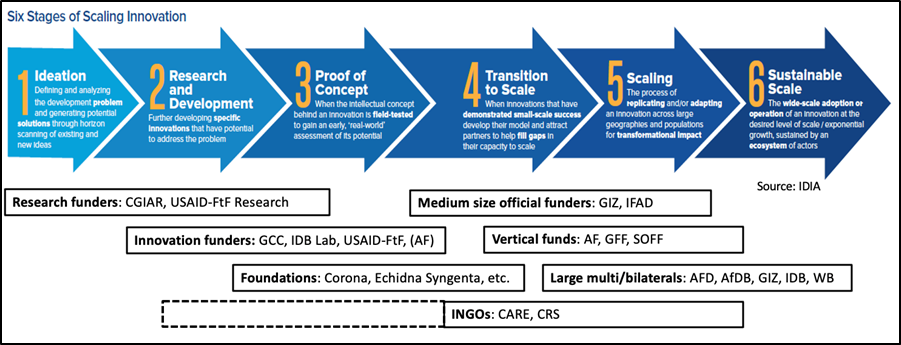
There are funders across each of the six IDIA stages and many funders overlap two or more stages. In principle, this suggests that the entire scaling pathway is potentially populated with relevant funders and that effective hand-offs from one funder to another are possible. However, the case studies and other evidence demonstrate that, in practice, there are significant gaps in funding support along the scaling pathway. Only some innovation and research funders anticipate and plan for the needed handoffs. Funders who could support scaling and institutionalization do not systematically integrate innovations developed by other funders and instead implement one-off projects at a limited scale. The tendency to go it alone is often reinforced by accountability, branding, and procurement systems rather than by lack of awareness. Thus, overlap alone does not ensure effective handoffs, which depend on incentives, mandates, and deliberate coordination rather than proximity along the pathway.
This predisposition to “go it alone” limits funders’ ability to scale their own projects or to support scaling of innovations that may have developed elsewhere. In particular, research and innovation funders (operating at stages 1-3) report very limited success in handing off proven initiatives to project funders (stages 4-6). By way of example, there has been no systematic process of integrating agri-food innovations developed by the CGIAR with large funder agri-food projects, such as those of IFAD. However, CGIAR is now focused more explicitly on scaling.
The capacity to integrate innovations into large-scale operations is limited even when both functions occur within the same organization. For example, while the incorporation of interventions developed by USAID’s Feed the Future Innovation Laboratories into its projects did sometimes happen, examples are few and opportunistic rather than systematic. The same holds true for IDB-Lab and IDB. This limited coordination between research and innovation funders and project funders contributes to the well-known “valley-of-death” between innovation and scaling. In this regard, it is encouraging that a growing number of research and innovation funders are now funding stage 4 (‘Transition to Scale’), helping ensure that innovations are scale-ready and supporting partnerships
Similarly, evidence from the case studies suggests that few funders and implementers systematically plan for hand-offs to government, private business, and/or other funders for sustainable operation at scale, i.e., stage 6. As a consequence, innovations and project interventions often neglect to align with prevailing implementation modalities and capacity, budgetary resources, or viable business models.
A final important consideration regarding funder roles is the extent to which funders serve as facilitators or intermediary institutions in support of systems change by providing or funding policy advice, capacity building, coordination and investment mobilization. The case studies contain noteworthy examples of funder organizations that extend their roles beyond funding to support field building and systems change in these ways. But this support remains the exception rather than the rule. Intermediary roles require sustained capability and legitimacy, and cannot be treated as short-term or ancillary function. A related challenge for those funders functioning as intermediaries is to ensure that these intermediary functions transition to other, preferably national, institutions after their engagement ends. The potential role of funders as catalytic intermediaries, and case study examples of funder efforts designed to fill this role, are addressed in Section III.I.
B. The State of Mainstreaming Scaling
The case studies provide insight into the current state of mainstreaming scaling in funder organizations. At the simplest level, we use a graphical framework for describing the state of mainstreaming within funder organizations as shown in Figure 2 (next page). The framework employs five categories of progress in mainstreaming: (i) scaling is outside the organization; (ii) scaling is on the periphery of the organization; (iii) scaling is prominent somewhere in the organization; (iv) scaling is located at the center of the organization as a key corporate goal, but not implemented throughout; and (v) scaling is intrinsic to the organization. The broad criteria for placement of a funder organization along this spectrum are shown in Table 3.
Figure 2: Funders placement on the mainstreaming spectrum
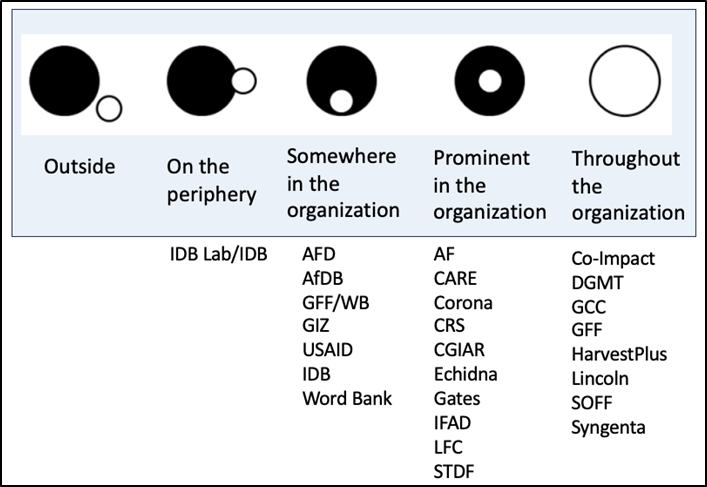
Table 3: Criteria for categorizing funders by state of mainstreaming
| Incorporated into corporate-level vision, goals | Toolkits and Frameworks developed | Integrated into Strategy, Operations and Procedures | Adoption or Utilization Level | |
| Outside | Not | Not | Not | Not |
| On the periphery | May be mentioned | Not for the organization |
Not
|
Ad hoc |
| Somewhere in the organization | May be mentioned | Developed or relatively advanced for parts of the organizations | Not systematically yet, or still being operationalized | Ad hoc, low levels, not required |
| Prominent in the organization | Central to the organizations’ core goals | Developed or well advanced | Relatively advanced | Started, still a small percentage |
| Throughout the organization | Central
|
Developed
|
Largely integrated
|
Throughout most of the organization |
Source: Authors
Note that the placement of funders in Figure 2 is only indicative and a snapshot at a particular time and also doesn’t reflect whether the organization is on the continuum from one stage to the next. For example, the World Bank and the IDB are now beginning to focus more systematically on scaling from the top down. And the CGIAR is moving rapidly towards mainstreaming the scaling agenda throughout its member organizations and hence could soon be categorized as falling into the “intrinsic” group. Furthermore, while in general it would be desirable for funders to move from left to right in Figure 2 (or from top to bottom in Table 3), not all funder organizations should necessarily aim for the “throughout” outcome in their mainstreaming efforts. For example, organizations that fund emergency humanitarian assistance may choose to be somewhere toward the center.
Overall, the case studies support the conclusion that funders are paying more attention to scaling than they have in the past. All the funders in the case studies are at least doing some scaling within their organization (Figure 2). Moreover, the case studies confirm that many funders are making efforts to move from left to right across the mainstreaming spectrum.
The following cases exemplify the status of mainstreaming in the case studies compiled for this Initiative:
- Eight funders (GCC, GFF, HarvestPlus, Lincoln Institute, SOFF, Co-Impact, DGMT, and Syngenta Foundation) stand out with intrinsic scaling for their organization. These funders made significant efforts and progress over the last 5-10 years, if not longer, in mainstreaming scaling throughout their organizations with strong leadership from the top. They have systematically oriented their funding (and delivery) practices to support that decision. For each of them, the case study extracted lessons and suggestions for further strengthening their scaling efforts. For many of these funders the principal driver and form of mainstreaming was the adoption of scaling as an “whole-of-the organization” mandate in terms of culture and purpose, and less about putting in place specific scaling tools, frameworks, incentives, and instruments.
- Ten funders (Adaptation Fund, IFAD, CARE, CRS, CGIAR, IDB-Lab, Echidna Giving, Gates, Fundación Corona, and LFC) have placed scaling centrally in their organizational vision, mission, and goals with strong leadership from the top. In most cases, scaling is prominent in some, but not all, of these organizations’ areas of activity. It is not clear in some of these cases if there is an organizational consensus to move further on mainstreaming (making it “intrinsic”) or whether they have decided that “centrally” is what is appropriate for their organization. However, all these organizations are still in the process of rolling out scaling throughout their organizations and with continued efforts some of them at least can be expected to move into the last column in due course (such as CGIAR).
- Six funders (AFD, AfDB, GIZ, IDB, USAID-FtF, and World Bank) are shown in the middle column, indicating that scaling has been pursued somewhere (and possibly in multiple locations) in the organization, but it is neither at the core of the funder’s mission and vision nor systematically mainstreamed into the overall funding practices of the organizations. As noted earlier, the World Bank may currently be moving to the right, as is the IDB, since their leadership is now focused on pursuing impact at scale. However, what approach to scaling, and where that falls on the spectrum from transactional to transformational (see Section III below), remains to be seen.
- Figure 2 also identifies two funder pairs. The GFF/World Bank pair is placed in the middle column, since the GFF is a trust fund housed at the World Bank, and GFF and the World Bank collaborate and cofinance in support of impact at scale. The IDB-Lab/IDB pair is in the second column from the left, since the IDB-Lab case study notes that there are as yet few effective links with IDB programs. Therefore, the pair is considered to have mainstreaming “on the periphery”, while IDB Lab itself has mainstreaming “at the center of the organization.”
Three additional findings emerge from the overall mainstreaming experience of funders included among our case studies:
- It appears that funders with narrower mandates and/or less reliance on appropriated funds have made more progress in mainstreaming scaling than official funders with broad, multi-sector mandates. The latter – official bilateral funders or multi-lateral development banks – face greater internal bureaucratic obstacles, disincentives and inertia, and find it difficult to adjust their traditional one-off project funding approach. Key informant interviews suggest that this may be due, in significant measure, to the following factors: (i) these funders are accountable to national legislatures or boards of directors that are hyper-focused on limiting the potential misuse of appropriated funds and have little tolerance for failure and high risk-aversion in terms of any perceived waste of taxpayers’ money; (ii) monitoring, evaluation, accountability, and incentive systems that focus on disbursements, short-term outputs, and direct beneficiaries, with little consideration of collective impact and indirect attribution; and (iii) a lack of explicit or implicit guidelines that allow for longer time horizons, multiple rounds of funding, and strategic pivots.
- In response to increased pressure to realize the promise of their investments in innovation, research and innovation funders are pushing further downstream into funding stage 4 (“Transition to Scale”) along the scaling pathway in Figure 1, helping to ensure that innovations are scale-ready, and are doing more to support partnerships and to broker follow-up funding.
- Mainstreaming is a long-term process. IFAD has been working to elevate the scaling agenda for twenty years and it remains a work in progress. For other funders (GIZ, CRS, CARE, Harvest-Plus, etc.), it has been 10 or more years of progressive efforts to mainstream scaling. The CGIAR began serious mainstreaming efforts around 2020 and launched its Scaling for Impact (S4I) program only at the beginning of 2026; it expects S4I to continue until the end of the decade. While the Standards and Trade Development Facility (STDF) has been taking some actions that support scaling since its inception in 2006, scaling was only formally integrated into its strategy in 2025.
The remaining sections of this report dig more deeply into the scaling experience of the case study funders. We begin with the next section by addressing what scaling practices funders should and do support, and in the subsequent section how funders can and do mainstream the support for these scaling practices into their operational approach.
III. Transformational Scaling Practices
Funders need to focus on transformational scaling, not merely transactional scaling. This is a foundational aspect of good scaling and a major new insight generated by the Mainstreaming Initiative. As defined by the SCoP, transformational scaling emphasizes sustainable, long-term outcomes at scale in contrast to transactional scaling which focuses on mobilizing more money to undertake more and larger projects with larger impact by the end of the project (Box 3). Support for transformational scaling prioritizes continued post-project scaling by permanent, preferably domestic, actors funded by permanent, preferably domestic, resources to achieve a well-defined, long-term goal. Among the case studies included in this study, there are examples of funder organizations that incorporate an explicit focus on support for transformational scaling. However, a transactional approach remains more typical.
| Box 3: Distinguishing between transformational scaling and transactional scaling
There is a continuum from purely transactional to fully transformational scaling. We describe the end points of that continuum, understanding that many projects and interventions fall somewhere in between. Transformational scaling takes place when initiatives, innovations, or projects are pursued with full attention to long-term, sustainable, scale goals and potential pathways to achieve these goals. Transformational scaling is demand driven and grounded in local ownership and sustainable funding. Initiatives, innovations, or programs are designed, implemented, and evaluated as steppingstones to achieve goals with explicit reference to addressing systemic barriers and ensuring enabling conditions exist for sustainable scaling. Sustainability occurs by identifying, and strengthening where necessary, local actors with the necessary mandates, incentives, resources, and implementation capacity, whether public or private, and persuading them to take on the roles of ongoing financing and implementation. This often implies that scaling is combined with systems changes and policy reform. Impact is measured in relation to the long-term target such as: “The number of women of reproductive age using basic reproductive health services moves from current levels of 30% to 75% over the next decade.” Or: “Carbon dioxide emissions reduce by five percent of the long-term emissions reduction target.” Transactional scaling focuses on larger projects and additional project financing, and frames results in terms of the direct impact specific projects are expected to achieve – or have achieved – at completion. Transactional scaling does not typically include systematic plans for what happens beyond the project’s end; does not take significant steps to mobilize or facilitate ownership by local actors who could ensure sustainability and scalability; and is often supply-driven. Capacity building, systems strengthening, and addressing the enabling conditions are typically limited, if they occur at all, and largely focus on ensuring achievement of the project’s short-term objectives. Most often, transactional scaling impact is considered in absolute terms or in relation to a baseline, but not in relation to a long-term need or target. Examples include: “10,000 women will access reproductive health care through our project.” Or: “Carbon dioxide emissions will be reduced by five percent as a result of our project.” |
Source: Authors
The remainder of this section unpacks eight key elements of transformational scaling, drawing on the principles noted in relevant SCoP publications (Scaling Principles and Lessons and Scaling Fundamentals) and the scaling guidance published by OECD-DAC as well as the cumulative experience of our 28 case studies. For ease of reference, these eight practices are shown in Box 4.
| Box 4. Eight transformational scaling practices
A. Initiate scaling from the beginning B. Incorporate scalability assessment C. Integrate systems change with scaling support D. Consider equity and inclusion explicitly E. Double down on country ownership and localization F. Invest in partnerships with other funders G. Build support for scaling into MEAL H. Elevate the role of intermediaries |
A. Initiate Scaling from the Beginning (“Start with the End in Mind”)
An early popular scaling framework suggests focusing first on effectiveness (or the depth of impact on individuals), then on efficiency, and finally on expansion (see Figure 3).
Figure 3. Scaling at the end rather than the beginning: A discarded approach
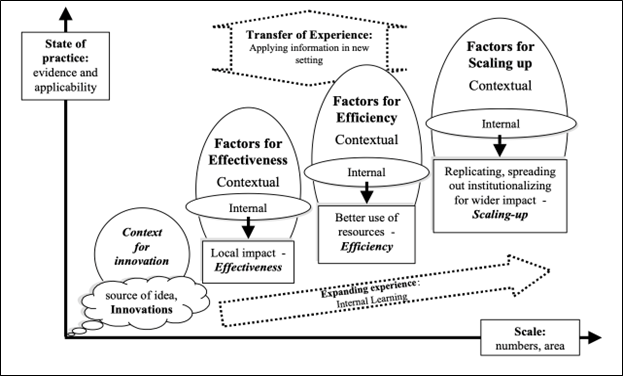
The scaling literature and the SCoP’s scaling experience reject this formulation as likely to result in interventions that maximize a project’s immediate impact (per location, end user, or beneficiary) at the expense of scalability and breadth or reach (as well as equity, social inclusion, and sustainability) by including elements that later prove to be difficult or impossible to deliver at scale. Instead, it is critical to focus from the beginning of an innovation process, a pilot project, or any intervention on likely scaling challenges, and, as discussed below, explicitly confront the fact that scaling faces multiple objectives necessitating tradeoffs between them. This implies working to establish the foundations for scaling even before knowing that an innovation or intervention merits broader application – what has been called proceeding with “one foot on the accelerator and the other on the brake”. Designing for scale early does not imply lowering standards of effectiveness, but rather redefining effectiveness in ways that remain feasible at scale.
Here the story emerging from the SCoP case studies is somewhat encouraging. The case studies suggest that a growing array of funders focus on scaling early in the innovation or project preparation process (e.g., CARE, CGIAR, CRS, GCC, IFAD, Lincoln Institute, SOFF, Syngenta Foundation, and HarvestPlus). However, for many funders, especially the larger ones, getting project teams, managers, and quality assurance units to focus adequate attention on scalability and the scaling agenda during project preparation remains a challenge. Middle managers note the pressure of having too many other corporate priorities and external critics observe that funders with larger projects and greater funding sometimes mistakenly conflate project scale and transformational scaling.
B. Incorporate Scalability Criteria and Assessment
Good practice suggests the practical utility of incorporating early use of “scalability assessments” to establish whether an innovation or intervention is scalable and under what conditions. While multiple scalability assessment tools have been developed for different sectors and by different organizations, the tools that we reviewed share many common elements and serve more or less the same functions: (i) to help determine whether an innovation or project is suitable for scaling; (ii) to assess what may have to be adjusted in the design of the intervention in the face of systemic constraints; and (iii) to identify accompanying system changes needed to address constraints. They also support a shared definition within the organization of what scale means and understanding of scalability that facilitates internal cohesion around that goal. Perhaps most importantly, the value of early scalability assessments lies less in the application of the tool itself than in how rigorously the findings influence go/no-go investment decisions and design revisions as innovations advance towards scaling.
Among the case studies we prepared and reviewed, we found several cases of organizations that recognize the need for an explicit scalability assessment and that have developed and used tools to conduct such an assessment. Particularly noteworthy were versions developed by CGIAR, GCC, IDB-Lab, CRS, and CARE. CGIAR’s tool is particularly advanced and complex. It requires identifying all complementary innovations relative to a core innovation (the “Innovation Package”) and conducting context, stakeholder, and political economy analyses. These analyses are used to determine bottlenecks and to develop actions needed to address those bottlenecks. GCC includes scaling potential among its general grant making criteria, and scaling is at the core of its funding instruments that target transition to scale. Some funders pay special attention to the financing constraints to sustainable scaling (e.g., GFF), while others focus more on policy and institutional strengthening (e.g., GIZ and GCC). IFAD’s scalability assessment involves systematic consideration of enabling conditions (or “drivers and spaces”). USAID-FtF developed a detailed guidance document on scaling, the Agricultural Scalability Assessment Tool and a tool – “Innovation to Impact” (or i2i) – that applies criteria used by private agri-business to decide whether to invest in innovations as they move through the stages of research, development, and testing by establishing what they call “stage gates.”
C. Integrate Systems Change with Scaling Support
As noted above, systems change is typically a critical element of transformational scaling. At a small scale and for one-off projects, funders and their implementing partners and grantees frequently have sufficient financial and institutional resources to address or work around systemic obstacles. However, solutions that match the size of the problem, especially if that scale is national and regional, inevitably encounter additional systemic obstacles that can severely constrain or prevent scaling.
National public policy, legal, and regulatory environments are obvious examples of systemic constraints, along with the capacity of potential public or private sector implementers. Another common constraint is a lack fiscal space in cases where the public sector is expected to defray some or all of the costs associated with implementing or subsidizing changed practices at scale. The political economy of systems change also creates obstacles since systemic reforms do not only have winners, but also losers who will try to impede or reserve the reforms unless they are compensated or restrained through the political system. Surrounding these issues are an array of existing power dynamics, social norms, and beliefs, all of which become more apparent and constraining the more significant the change and the greater the scale of impact.
Most large official funders support systems change in some way. Among the bilateral official funders, GIZ, for example, supports activities that help build government capacity and change the public sector enabling environment. The MDBs routinely support system reform, as do vertical funds in their specific areas of engagement. However, very few of the larger organizations in our sample coordinate their investments in systems change with the needs of scaling. Their support for system reform tends to be one-off in nature, rather than sustained for lasting impact, and tends to be disconnected from their project funding in the countries concerned. GFF, IFAD, and SOFF are exceptions, incorporating into their projects’ short-time frames and output-oriented approach as much capacity building and systems change as possible given the time and resources available.
Integrating systems change is a challenge for smaller funders and those working on innovation, as their mandate is to focus on the innovation, not the system. Nonetheless, GCC, CGIAR, and a growing number of innovation funders have taken steps to integrate systems change, as far as possible with their limited resources. The same is true for many of the private foundations included in our sample. For example, CGIAR routinely strengthens national agricultural research and extension services and provides policy advice. Private foundations include notable cases of direct support to local ecosystem change in targeted countries and sectors by the Gates Foundation, Co-Impact, Echidna Giving, and Lincoln Institute. Notably, Co-Impact features an explicit and central focus on systems change in each of its grants. In regard to land policy, the Lincoln Institute is an example of a think tank that focuses systematically through research, training, advice, and communication on helping to create a policy environment for effective land policy and financing at a global scale.
The relationship between scaling and systems change reinforces the need for effective partnerships between organizations that invest in research and innovation, organizations that focus on project implementation, and organizations that focus explicitly on systems strengthening. A notable example among small funders is Syngenta Foundation’s investment in the Seeds to Be (SEEDS2B) program (co-funded with USAID’s Feed the Future program). SEEDS2B worked to strengthen seed systems, helping domestic companies with licensing of new varieties and commercialization; strengthening and streamlining national testing, licensing and registration systems; and harmonizing regional systems. This allowed for faster release and scaling of new, improved varieties, clear scaling (commercialization) pathways, and reliable, sustainable seed supply chains. However, this example also demonstrates the challenges for advocates of scaling within funders; USAID’s scaling team was not able to obtain funding to replicate this systems approach in other agri-food subsectors such as mechanization and machinery services.
There is also an inherent tension between scaling and systems change. Systems change takes time, energy, and focus that can compete for attention and resources from scaling in the narrow sense. In Ghana, Feed the Future worked with the Ministry of Food and Agriculture to restructure its institutional approach to National Performance Trials while concurrently collecting the data required by the trials. Keeping the reforms and the trials moving in lockstep required very deft management so that the reforms would not derail the trials.
D. Consider Equity and Inclusion Explicitly
It is necessary to consider not only absolute scale of impact but also the sustainability and distribution across different social groups as scaling can have an intrinsic tendency to increase inequities because there are almost always lower transaction and other costs to scaling to advantaged groups that benefit from better infrastructure or population density. This has given rise to the concept of “optimal scale,” i.e., the scale that best balances quantitative and distributional goals most effectively. Most funders specifically include gender and other equity and inclusion objectives in their efforts to support the pursuit of scaling, whether it is small-holder farmers (e.g., Syngenta), people who live in remote areas (e.g., IFAD), women and children (e.g., GFF), the distributional implications of land policy (Lincoln Institute), or other equity and inclusion targets. CARE puts gender and gender equity at the center of its work. One of CRS’s scaling principles is to “engage with systems actors, both traditionally underrepresented and existing decision-makers, to prioritize equitable scaling.” However, the explicit consideration of the potential tension between scale and equity/inclusion has received less attention in our sample. Optimal scale calls for explicit consideration of the variety of unintended consequences associated with scaling including compensation for those displaced or disadvantaged by the changes resulting from new policies and practices. Only a few funders, e.g., CGIAR, CRS, GCC and SDC, make explicit their commitment to optimal or responsible scale principles, and even for these implementation remains a work in progress.
E. Double Down on Country Ownership and Localization
The pursuit and achievement of sustainable impact at scale requires ownership and involvement in decision-making by host country stakeholders of the goals and interventions supported by funders, and especially scaling strategies and objectives. This is in marked contrast to the lower bar of host country “concurrence” and stakeholder consultation evident in many donor-funded projects and programs. Accordingly, what is now often referred to as “localization” provides an important underpinning for effective and sustainable scaling. This includes not just the national government or alignment with national strategy documents, but broad stakeholder engagement with civil society and the private sector. It also means a search for locally sourced innovations and ensuring that there is effective demand for the goods and services created in a scaling process. It implies support for and use of local capacity and systems, the incorporation of sustained sources of public or private finance, and preparing for effective hand-off at project or program end to national organizations.
Notably, this focus on scale is at odds with some forms of hyper-localization that focus interventions on a limited number of small, local, community-based actors with little regard for geographic spread, external validity, or business models at scale. Financial and especially commercial viability can be impossible to achieve without a certain minimum market size.
Several of the organizations featured in case studies make use of “country platforms” as a means to combine localization with a recognition of the multi-stakeholder collaboration needed for effective scaling. For example, GFF supports the development of inclusive country platforms for maternal and child health programs. These platforms bring together an array of national stakeholders, including concerned government ministries, representatives from the private sector and civil society, as well as external funders, to jointly develop a sector strategy, implementation modalities, a results-tracking approach, and MEAL activities. As explained in Box 5, country platforms and scaling are mutually reinforcing as long as they are designed to support transformational long-term development and climate action.
| Box 5. Country Platforms and Scaling
Country platforms are nationally led coordination mechanisms that align government, external funders (MDBs, bilateral donors, philanthropies), private actors, civil society, and technical agencies around a shared, long-term development or climate vision. In general, they serve four core functions: (i) strategic alignment with national plans and strategies; (ii) coordination of actors to reduce duplication and fragmentation; (iii) mobilization of domestic and international finance; and (iv) MEAL to adapt during implementation. Effective platforms require an institutional home (a secretariat) that convenes partners, manages inclusive consultation, curates a common evidence base, and runs MEAL. Multilateral facilities such as the GFF (health) illustrate how an external facility can help countries stand up and animate a platform, at least until national institutions can fully take over. Country platforms are well suited to tackle common scaling barriers by (i) mobilizing or brokering resources to cross the “Valley of Death” in scaling between small pilots and follow-on projects along a scaling pathway; (ii) support sustainable institutionalization by convening, coordinating, and aligning support by national stakeholders; (iii) help overcome fragmentation and short time horizons by aligning programs and funding behind long-term national scale goals and pathways rather than one-off projects; (iv) address weak enabling environments by creating a locus to sequence policy and institutional reforms needed for durable delivery at scale; (v) closing the evidence-to-action gap by encouraging MEAL and adaptive learning; (vi) closing the financing gaps by effective fiscal planning and risk-sharing through public-private financing instruments; and (vii) aligning incentives and accountabilities across government, donors, implementers, and investors. At the same time, if country platforms are to help achieve long-term development and climate goals, their participants need to have internalized a scaling focus in their own operations, ensuring that their front-line teams have the incentives and resources to align on a sustained basis around common goals and long-term scaling pathways and engaging in long-term partnerships and coordination efforts. And, common monitoring and evaluation approaches must be implemented with a transformational perspective, incorporating key scaling aspects. Finally, the costs of platform management, coordination, analytics, and incentive mechanisms are real and substantial, and must be transparently budgeted and financed, not treated as unfunded mandates. In short country platforms and scaling are mutually reinforcing. Platforms become effective when they embed transformational scaling logic; transformational scaling, in turn, generally requires a platform to align actors, policies, and finance over time. Source: Linn (2025), op. cit. |
While many funders preach the benefits of national ownership and localization, many also noted challenges in implementing their good intentions. Challenges are especially severe for official bilateral funders since their leadership, parliaments, and ultimately the taxpayers often find it difficult to forgo the pursuit of their national priorities.
Staff and managers in some funder organizations also noted that national ownership, while necessary for long-term sustainable scaling, is no guarantee of success. National priorities shift unpredictably with election cycles, government overhauls, and economic and social crises, disrupting the best-laid scaling plans. Evidence from the case studies demonstrates that support is needed from multi-stakeholder engagement and coalitions are needed to sustain scaling in the face of such changes, i.e., political sustainability needs to be assured. Mobilizing and sustaining such coalitions requires an ongoing country presence and long-term relationships that are difficult to create or maintain when work on the ground is project-by-project and supported from abroad with intermittent expert visits. This is reinforced by the fact that most donors’ MEAL systems are still optimized for accountability rather than for learning under uncertainty, which limits their usefulness for scaling.
Particularly notable examples of funders fully and patiently integrating themselves into local ecosystems were evident in the experience of national foundations like Fundación Corona in Colombia, DG Murray Trust in South Africa, the Nilekani Foundation in India, and the Lemann Foundation in Brazil. Fundación Corona is a particularly instructive example. Blending features of a traditional funder, community foundation, and operating foundation, the Fundación is intervention agnostic and works to form and support coalitions of local actors at a municipal level jointly committed to working constructively with government to solve a problem of national consequence. For every dollar the Foundation commits, it helps local actors mobilize another $7+ dollars and seeks national scale by replicating the same process in multiple municipalities. Other relevant features are its deep commitment to institutional strengthening of local actors and obsessive commitment to the use of performance data.
In a somewhat analogous way, DG Murray Trust maximizes the use of its credibility as a nationally funded, nationally focused, and highly respected actor in South Africa to provide a vehicle for an array of host-country actors to engage constructively with the government on a range of social issues.
INGOs such as CRS and CARE – and many of the international private foundations – make special efforts to engage with multiple stakeholders on the ground, especially market and civil society actors, to help ensure that support remains even when governments and their policies change. Among bilateral funders, an instructive example is the innovations funded by SDC’s TRANSFORM program which requires projects to include partnership with at least one local research organization and an implementing organization, usually a domestic NGO.
Finally, as elaborated in Section IV below, many international funders have pursued decentralization of their operational staff to national or regional offices, closer to their programs and clients. This should, in principle, help with generating local ownership, building partnerships on the ground, and monitoring progress and constraints to scaling innovations and projects. However, experience from the case studies suggests that decentralization alone does not necessarily mean stronger localization or better scaling. Ironically, some funders note that decentralization can actually make scaling more difficult organization-wide. In decentralized organization, when the imperative to scale comes down from headquarters without creating buy-in from staff members based in country offices, the latter have few incentives and capacity to support, systematically embrace, and implement those approaches. Feed the Future experienced this as USAID missions design and fund their agri-food (and other) projects from their own budgets.
F. Invest in Partnerships with Other Funders
As noted above, there is broad agreement and growing evidence that enhanced coordination, partnership and collaborative funding are needed to overcome problems inherent in the highly fragmented development assistance architecture.
This is especially important for scaling interventions where host governments play dominant roles. Here, the case studies demonstrate remarkable strategic change in many funders’ theories of change in the last decade. Where the problem used to be research and innovation funders and private philanthropists that failed to recognize the central role of governments in achieving and sustaining development and climate results, the problem now is the challenges and bottlenecks created by multiple organizations hoping to work with and through government to advance their preferred issues and initiatives. On the other hand, the cases also demonstrate that the rhetoric of partnership often outstrips the reality. Where platforms for partnerships, collaboration and pooled funding exist, they are too often single-purpose and transactional, prioritizing cofinancing over joint problem solving and limiting the scope for effective hand-offs from one partner to another. While these partnerships sometimes result in larger one-off projects, they frequently lack longer-term longitudinal strategies for sustainable scale.
At the same time, there are notable exceptions. The Adaptation Fund actively seeks to partner with others (so far primarily with the Green Climate Fund) to hand projects over for scale-up once its projects are finished. Similarly, the Gates Foundation regularly partners with multilateral co-financiers, especially MDBs like the World Bank, IFC, and African Development Bank, to co-finance both scaling efforts and complementary investments. In recent years, the CGIAR has been working actively and successfully to integrate its innovations into national agri-food strategies in Africa and into the projects of the African Development Bank and other donors.
More generally, few funders offer evidence of having focused explicitly on the challenges of effective collaboration and coordination. There are staff and budgetary costs to develop and maintain partnerships; there are disincentives for managers and front-line teams when speed of project preparation, number of projects delivered to the governing boards, and amounts of money disbursed are the key performance measures; there are issues of control and meeting specific fiduciary requirements; and many funders are loath to dilute their brand and forgo the ability to literally plant their national or institutional flag at project sites.
G. Build Support for Scaling into Monitoring, Evaluation, Accountability and Learning (MEAL)
Evidence from the case studies confirms what has become the conventional wisdom in the field of scaling: that successful scaling is normally a lengthy process – typically takes 10-15 years – and rarely unfolds in accordance with initial plans. The process requires a commitment to genuine adaptive management and MEAL systems geared to support the iterative nature of scaling, from initial design of interventions all the way to sustainable scale. MEAL can identify and engage viable “doers” and “payers” for delivering goods and services at scale to identify strategies and manage progress in implementing new practices, strengthening institutions, shifting social norms, and addressing potential losers from scaling.
To meet these needs, MEAL systems need to go well beyond assessing whether an intervention or innovation “works” (i.e., has been implemented in an efficient, effective, and timely manner according to plan and has a positive impact), but also whether it is sustainable, scalable, and ultimately whether it has been sustainably scaled. Prior to full implementation, that includes assessment of the factors and preconditions likely to affect scalability; and during scaling, it includes effectively monitoring the interim changes needed to ensure full implementation, maintain effectiveness, and guarantee sustainability over time. It is also important to track the spread of interventions beyond the direct beneficiaries of specific interventions.
Our work with funders has shown that their MEAL practices are relatively strong in determining direct impact of interventions (proof of concept), are much weaker in assessing scalability and generally do not focus on whether the interventions effectively support scaling.
In a survey of the members of the SCoP’s Monitoring and Evaluation Working Group, the consensus was that – in order to provide for these needs and to secure wide dissemination of the resulting information – budgets for MEAL and information dissemination for pilot projects should be closer to 20% than to the 5-10% more typically provided for typical implementation projects. The case studies did not include any example of a funder having yet embraced this view.
A key analytical challenge in monitoring progress on scaling is assessing the extent to which systems changes and other foundational pieces of scaling are in place and permit or facilitate scaling. The CGIAR, USAID’s Agricultural Innovation Laboratories (part of USAID-FtF), IFAD, Co-Impact, and the GFF are the funders in our case study sample that have most explicitly focused on these considerations. For example, GFF systematically includes specific metrics for system change as part of its monitoring process through its support for a “One Plan/One Budget/One Record” approach in all the countries where it is active.
For most funders, however, MEAL continues to emphasize accountability, planned outputs, benefits to direct project participants, and disbursements. The current OECD-DAC and MOPAN evaluation guidelines for bilateral and multilateral official funders do not focus on sustainable scale or progress towards scaling in their recommended MEAL guidelines. Similarly, the case studies suggest that, for most research and innovation funders, tracking scaling beyond their own engagements and direct beneficiaries continues to be the exception rather than the rule. One notable exception is CGIAR, which is now committed to tracking the progress of its innovations all the way to sustainable scale. Likewise, GCC, which traditionally proxied the scaling impact of the innovations it supports scaling by measuring the funding its grantees raise, has updated that approach to include data on actual longer-term scaling and conducted one-off assessments of the entire portfolio’s progress towards financial sustainability and scale.
To aid in efforts to support and monitor progress towards sustainable scaling, the SCoP developed the Mainstreaming Tracker Tool – a maturity model, tool, and guideline for tracking the extent to which needed changes are institutionalized in host governments.
H. Elevate the Role of Catalytic Intermediaries
Catalytic intermediary organizations (intermediaries for short) facilitate the transition from innovations and innovators to large public and private sector delivery systems. As illustrated in Figure 4 below, these functions include tasks such as finding and supporting champions; convening stakeholders and building consensus; packaging investments; providing scaling advice assistance; helping to identify policy and regulatory obstacles; etc. These are tasks typically played by venture capitalists and investment bankers in the private sector. Regrettably, few organizations exist to provide these functions for public goods, largely due to the absence of viable business models for the organizations involved. This gap has been referred to as the broken part of the business model for scaling.
Figure 4. The manifold functions of catalytic intermediaries
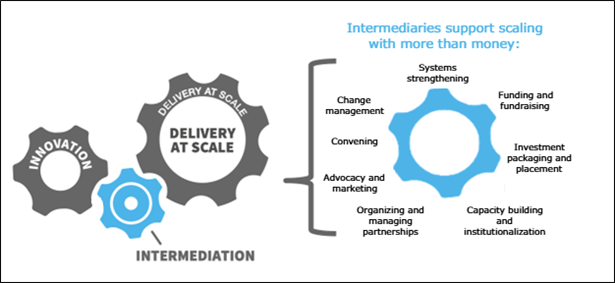
Absent a robust ecosystem of public, for-profit or not-for-profit organizations dedicated to intermediation, the responsibility falls on funders to provide or to fund these services. Among our case study partners, GFF, SOFF, CRS, Co-Impact, DG Murray Trust, and Fundación Corona are the organizations that have most comprehensively adopted an intermediary role; and the aforementioned newly initiated CGIAR S4I program is precisely intended to fill this function. Others, including HarvestPlus, IFAD, IDB-Lab, Gates, GCC, the Adaptation Fund, and the Syngenta Foundation provide intermediary support in a more limited fashion.
Many funders, especially innovation funders and foundations, are expanding their efforts to broker a next round of funding for the interventions they support and are providing capacity building to enable their grantees to better access funding and other forms of partnership. Some, like Fundación Corona and DG Murray Trust, provide direct support for capacity building to the implementation, advocacy, and intermediation partners they support. Others, using strategies modeled on Lever for Change’s (LFC) Open Competition model, provide several months of coaching to finalists to improve their proposals, often accompanied by substantial capacity building grants. All LFC finalists, for example, become eligible to participate in the Bold Solutions Network which provides opportunities for networking with other implementers and with potential funders along with a variety of individual and collective coaching and training opportunities. In this way, LFC has mobilized over $2.5 billion in total funding, well above the $1 billion in direct funding.
As more funders and implementers embrace the central role played by governments in achieving sustainable outcomes at scale, many have expanded their attention to working effectively with and through government. This sometimes leads to second-order intermediation problems as funders and implementers competing for government attention create a multiplicity of stakeholder forums and coordination mechanisms intended to ensure the needed buy-in for scaling specific interventions. The cases reviewed during this study also illustrate; however, emerging experience of donor collaboratives, multi-stakeholder country platforms, and other innovative mechanisms better suited to outcomes-oriented and government-led planning and coordination.
Rather than provide intermediation services themselves, some funders choose to fund local organizations to perform intermediation and field building activities. Examples from the pool of case studies include the Syngenta Foundation, GCC, Echidna Giving, and Lincoln Institute. But, such efforts remain small and nascent and, in our view, fostering more explicit consideration of funders’ roles in strengthening and financing intermediary organizations – and in developing viable business models for intermediaries – should be a priority topic for further research.
IV. Mainstreaming Support for Transformational Scaling in Funder Organizations
We now turn from what is to be mainstreamed – support for transformational scaling – to the how to mainstream transformational scaling. Prior published work by the SCoP, by many of its members, and by a host of others shows broad consensus regarding the enabling factors for mainstreaming of systematic support for scaling in funder organizations points to nine key factors that support or impede mainstreaming of transformational scaling practice into the operational work of development and climate funders. We examine the evidence regarding each of these factors in the 28 case studies and re-examine prior assumptions about each of these factors (Box 6).
| Box 6: Key enablers of mainstreaming transformational scaling
A. Leadership B. Vision, goals and targets, C. Operational policies and practices D. Resources and incentives E. Analytical tools and knowledge F. Decentralization G. M&E of mainstreaming H. Planning and sequencing I. Managing tradeoffs and tensions |
A. Leadership Must Drive Scaling
The most obvious enabling factor for mainstreaming scaling is leadership from the top of the funder organization explicitly and consistently focused on the need to integrate scaling into all aspects of the agency’s operational practice by squarely placing transformative impact at scale at the center of the organizational mission and vision; by systematically including attention to scale and scaling in operational instruments, policies and practices; by dedicating the necessary organizational, technical and budget resources to the scaling agenda; by developing analytical tools, learning and knowledge; by systematically monitoring and evaluating the mainstreaming process; and by planning and sequencing the interlocking incentives for management and staff in support of a scaling mindset and practice.
Leaders of many major funder organizations are now focusing on impact at scale, as exemplified by Ajay Banga, President of the World Bank; Mark Suzman, CEO of the Gates Foundation; and Rajiv Shah, President of the Rockefeller Foundation (Box 7, next page). Leadership was a major factor cited in a host of the other organizations included among the published case studies (see, for example, the case write ups on HarvestPlus, Lincoln Institute, Syngenta Foundation, GCC, CARE, Fundación Corona, DG Murray Trust, IFAD, LFC, and GIZ). For CARE, for example, the initiative came from senior management and included creating a Vice President for Impact and Innovation and a Director of an Impact at Scale. LFC was built on the model of the MacArthur Foundation’s 100&Change competition, with its Founding Director coming over from that program to offer similar services to the entire philanthropic community. IFAD, long a champion of scaling, illustrates the potential for discontinuity in the focus on mainstreaming scaling when leaders change.
| Box 7. Leaders of major funder organizations focus on scaling
Individual leaders and champions can and have had an important role focusing their organizations on the scaling agenda. Robert McNamara and Jim Wolfensohn as presidents of the World Bank stand out as prime examples. But there are others, including those that have moved across organizations during their careers. Raj Shah learned about taking big bets at Gates, got frustrated at USAID about his inability to move the ship significantly, and then refined the notion at Rockefeller with his recent book “Big Bets: How Large-Scale Change Really Happens”. Cecilia Conrad took her experience with the MacArthur Foundation’s 100&Change to found Lever for Change to bring the Big Bet Open Call model to the broader philanthropic community, especially ultra-high net worth individuals. Poonam Muttreja carried her experience funding scaling in India as the MacArthur Foundation country representative to take over the leadership of the Population Foundation of India and mainstream scaling. Santiago Levy scaled conditional cash transfers at ministerial level in Mexico and then throughout much of Latin America as Chief Economist of the Inter American Development Bank. Currently, Ajay Banga, President of the World Bank, is squarely focusing on the challenge of scale: “We need to be fixed on the horizon…Improving the lives of a few hundred thousands is not enough, if there are millions more that need us…We don’t suffer from lack of solutions — we need to scale them….We must scale and replicate…We must go for impact at scale.” (Statement at the 2023 Annual Meetings Penary). Mark Suzman, CEO of Gates Foundation, stated in an interview: “If there isn’t a way to make this at a price point and at a timeline that’s going to be useful and usable within low- and middle-income countries, I don’t care how good the idea is, we’re not going to be funding this.” Source: Devex Newsletter, 25 July 2025 |
Importantly, however, case study authors note the need to broaden leadership support beyond the C Suite. Specifically, they stress that middle management and senior staff need to have incentives to implement mainstreaming objectives; middle management is often where mainstreaming efforts stall, because of resistance to change but more often because of misaligned incentives and risk exposure. As discussed later in this Section, this alignment requires a clear articulation of operational goals, accountability, and rewards for achieving targets as well as resources that enable managers and frontline teams to deliver.
Support and, in some cases, pressure from the governing bodies of funder organizations (boards, ministries, etc.) can also drive mainstreaming as illustrated in the CARE, CRS, GFF, and Lincoln Institute cases. At the same time, in some cases, governing boards reinforce short-termism even while rhetorically supporting scale. The push to mainstream scaling in the CGIAR system was largely a response to donor pressure for greater impact at scale and accountability for that impact. In the case of IFAD, the fact that management had committed to a mainstreaming agenda and specific operational performance metrics under various resource replenishment negotiations facilitated some degree of continuity in the institutional focus on scaling achieved across leadership cycles. In the case of the Lincoln Institute, a focus on expanding the scale of impact was one of the selection criteria for a new president. However, the STDF case indicates that where consensus among governing bodies on scaling has yet to fully emerge, progress towards more systematic integration can be gradual, and the scaling agenda may continue to evolve in less formal ways unless there is concerted action for more systemic .
There are also cases where leadership on scaling originated at lower levels before being fully embraced at the top. In the CGIAR case, for example, the creation by staff and middle management of a scaling framework and tools helped advance scaling mainstreaming rapidly once senior management prioritized scaling in response to pressure from funders. In the case of the World Bank, a small team explored in depth the potential for scaling social enterprise innovations in the mid-2010s. Though that initiative eventually fizzled, it helped to lay a foundation for action at a later date. In partnerships like the STDF, where many organizations are engaged and decisions are taken by consensus, achieving scale depends on some of the stakeholders involved understanding and identifying opportunities for scaling to increase impact, and the ability to take steps and actions to achieve.
Government, stakeholder, or partner pressure in recipient countries is not widely cited in the case studies as a driver for mainstreaming. GFF is to some extent an exception. Senior government representatives from recipient countries play an active role in the GFF governance structure and have pushed for alignment of funder support with national priorities for long-term universal health objectives, i.e., a form of localization. More generally, though, it appears that relatively few recipient country governments have played leadership roles in negotiating with funders systematic approaches to defining and pursuing longer-term scaling pathways as part of their development strategy implementation. Exceptions cited by SCoP members and in the literature include China, Ethiopia (agriculture), India (health), Indonesia, Vietnam and Mexico where governments did push their external funder partners to support scaling programs.
B. Corporate Mission, Vision, Goals and Definitions Have to Focus on Transformational Impact at Scale
An obvious step in mainstreaming scaling is to incorporate scaling and explicit scale goals into funders’ corporate vision and mission statements. An increasing number of funder organizations have done so (Box 8). This is a relatively simple, but crucial, step to take and provides the foundation for other essential steps.
| Box 8: Examples of scaling mission statements
· CRS: “Catalyze Humanitarian and Development Outcomes at Scale” and “The synergy and opportunity that is created from direct services, to systems change, to catalyzing outcomes at scale.” · CARE Vision 2030: “CARE contributes to lasting impact at scale in poverty eradication and social justice, in support of the Sustainable Development Goals (SDGs).” · CGIAR Strategy and Results Framework 2016-2030: “350 million more farm households [in addition to 100 million reached by 2022] have adopted improved varieties, breeds or trees, and/or improved management practice; 100 million people, of which 50% are women, assisted to exit poverty.” · GCC: “A healthier, more equitable world through local, scalable, sustainable innovation.” · HarvestPlus: “By 2030, our strategic objective is to help partners worldwide sustainably reach 1 billion people by embedding biofortified crops and foods in food systems.” · Syngenta Foundation: “To strengthen smallholder farming and food systems, we catalyze market development and delivery of innovations, while building capacity across the public and private sectors.” · IFAD: “Scaling is mission critical.” · SOFF: “SOFF will ensure that SIDS [Small Island Developing States] and LDCs [Least Developed Countries] have the capacity and financing to deliver on their GBON [Global Basic Observing Network] commitments.” Source: Case studies |
The inclusion of quantitative long-term targets spells the difference between aspiration and meaningful goals. Said differently, from a transformational scaling perspective, it is important to express goals relative to a long-term target or in terms of the fraction of a needs gap to be filled, not merely as change against a baseline. While several funders framed their aspirations for impact at scale by links to the SDGs or Paris Climate Agreement, a few funders also announced other concrete and measurable medium or long-term goals for impact at scale. HarvestPlus, for example, has the goal of reaching one billion consumers with nutrient-enriched food by 2030. IFAD, in 2012, announced its goal to reach 90 million farmers and take 80 million people out of poverty. SOFF set an explicit, quantitative target to close the weather and climate observations gap in Small Island Developing States and Least Developed Countries over a ten-year period. In addition to its poverty goals, the CGIAR has concrete goals for improvements in food security (e.g., yields), nutrition (e.g., micronutrient consumption), and natural resources (e.g., deforestation and agricultural greenhouse gas emissions). CRS has six strategic platforms as part of its 2030 Strategic Vision, and each has quantitative targets. Lever for Change is looking to mobilize $10 billion in funding for high-impact solutions to by 2030. That said, it may be useful to note that targets can also distort behavior if they are not accompanied by credible delivery pathways. Some funders announce ambitious numbers that often appear to be aspirational or performative without specifying who delivers, who pays, and under what constraints.
It is important to note that some organizations set quantitative targets in terms of numbers reached or breadth alone, while others combine breadth and depth, i.e., the specific impact that will be had on the lives of those reached. A few, such as the CGIAR or GCC, even embrace broader, multi-component definitions of impact scale which include breadth, depth, equity, and other forms of impact i.e. responsible or optimal scaling. These positive examples notwithstanding, many of the funders represented among our case studies assess their results exclusively in terms of the extent to which their projects achieve specific short- to medium-term goals, often stated in terms of absolute numbers or changes relative to a baseline.
Closely related to setting scale targets and announcing scaling as a corporate objective is the need to define what is meant by scaling for the funder organization, including the distinction between transformational scaling and transactional scaling. When the SCoP began its work a decade ago, recognition of this distinction was rare. Although the use of the term “transformational scaling” remains relatively uncommon, the case studies included in this analysis suggest that a growing number of funders – among them CRS, HarvestPlus, IFAD, Co-Impact, Syngenta Foundation, the Gates Foundation, the Lincoln Institute, DG Murray Trust, and arguably LFC, Fundación Corona, GCC and GFF – are beginning to recognize the distinction and reflect it in aspects of their messaging and programming. However, definitions only matter if they shape investment decisions, portfolio composition, and exit strategies. Otherwise, calls for transformational scaling risk remaining rhetorical and without impact.
C. Financial and Operational Instruments, Policies and Practices Have to Support a Scaling Approach
The case studies emphasize the need for funders’ financial instruments, as well as their funding policies and processes, to be tailored to support recipients advancing along the targeted scaling pathway. Among the cases we reviewed, one interesting example is GCC’s use of Transition to Scale grants in combination with social enterprise coaching, establishment of communities of practice, and support for intermediary organizations that foster linkages to public sector actors. Several other innovation funders, such as France’s Fund for International Development, have adopted similar practices of providing various forms of non-financial assistance. Also instructive is the grant ladder used by Co-Impact which progresses from design phase grants to so-called anchor and domain grants. Co-Impact’s operating guidelines also include a provision for standalone ecosystem grants and financing, where appropriate, for technical accompaniment. Lever for Change provides extensive coaching for finalists before they submit their final, revised proposal and STDF supports project preparation grants. CGIAR’s strategy is to start with self-motivated early adopters and then apply coaching, financial support, and incentives to create a critical mass of adopters that will spread via example throughout the system. The Adaptation Fund provides Project Scale-Up Grants to support National Implementing Entities to scale up Adaptation Fund projects as well as Learning and Innovation Grants. It is important to note that layered instruments alone do not guarantee scale. Without downstream absorptive capacity or committed adopters, even well-designed ladders stall.
The larger multilateral and bilateral development agencies tend to be more constrained in their use of financing instruments, relying mostly on standard project loans or grants. Some of them, like IFAD and the World Bank, have the option of providing longer-term multi-stage investment project finance, but have made only limited use of it. Results-based funding instruments, where funding is provided for accomplished results, rather than delivery of inputs, can also support scaling since they allow greater flexibility for implementing entities to apply the tools of adaptive management in the scaling process. GFF and SOFF are among the organizations in our sample that employ results-based funding. SOFF, for example, will disburse grants in support of operations and maintenance expenditures by weather observation stations only if the collect weather date and share them with the World Meteorological Organization.
Funders’ operational policies and procedures also play central roles in advancing or impeding support for scaling. Most significant are criteria for the preparation, design, selection, and approval of projects; supervision of implementation, procurement, and contracting; and quality assurance, adaptive management, and risk management. Here, the case studies include evidence of selective inclusion of scaling in the standard operating procedures of some funders – e.g., IFAD’s project design and quality assurance criteria or CGIAR’s Innovation Package and Scaling Readiness framework and tools – but in general the special requirements associated with scaling are not systematically reflected in the standard practices and policies of most funders.
Human Resource systems can become the binding constraint on mainstreaming, even when leadership, tools, and financing are in place. In order to ensure managers and staff incentives are aligned with the scaling agenda, it is important to include scaling goals in job descriptions, performance evaluations, professional development, training requirements, salaries, and promotions. We found little evidence in the case studies that funders intent on scaling currently reflect this in their corporate Human Resources policies.
D. Dedicated Organizational, Staff and Budget Resources Have to Be Committed to Scaling
The case studies indicate that dedicated organizational, technical, and budget resources are required to ensure and incentivize effective and sustained mainstreaming of systematic approaches to scaling within the organization. Some of the case study funder organizations (e.g., CARE, CGIAR, CRS, GIZ, IFAD, Co-Impact, the Lincoln Institute, and USAID-FtF) deployed specialized technical, organizational, and budgetary resources to support and sustain the mainstreaming process. However, where they exist, these support units are generally quite small: for example, CARE’s scaling support units are composed of a few people and GIZ had one person playing that role. In contrast, CGIAR has a central support unit, has trained several hundred staff to act as local resource people, and has introduced a small scaling fund to support innovation teams working to achieve Scaling Readiness. IFAD for several years had staff within its central technical support unit with specialized expertise and mandate to support scaling but later disbanded it. In the case of CRS, a central unit of five staff members has supported the scaling agenda, funded by a long-term institutional strengthening grant by a private foundation – more of this kind of funding support is needed.
While a central unit that facilitates mainstreaming and supports operational units to integrate scaling is important, mainstreaming ultimately requires an “all-of-organization” effort. Central units risk becoming symbolic or ineffective if they are not paired with authority, resources, and demand from operations. In practice, this rarely happens, as many staff, especially in the larger official funder organizations, see themselves as already bearing a heavy burden in meeting cumulative “unfunded mandates” in the design, implementation, and evaluation of projects. These mandates – including issues such as gender and social inclusion, environment and climate change, community outreach, private sector engagement, and anti-corruption – have typically been added to staff workloads without additional staff or budget resources. As a result, even organizations like GIZ and CGIAR that are heavily committed to scaling have avoided mandates and tend to prefer encouragement and positive incentives, e.g., offering special scaling funds. In general, competing goals and incentives, and the lack of dedicated resources to support scaling, act as disincentives for midlevel managers and staff to pursue scaling, even if they believe it is, in principle, a worthy cause. In any case, funders’ project teams generally do not have scaling included in their annual workplans, Key Performance Indicators, or annual reviews.
Rather than mainstreaming scaling throughout the institution, some large funders apparently find it easier to focus on scaling of selected programs. This can be seen in initiatives such as the World Bank’s GFF and its new Global Challenge Program and Impact Programs. The GFF provides targeted resources to complement the financing of World Bank loans for maternal and child health. These resources allow scaling to be systematically supported in these loans through technical assistance for country-driven strategy formulation and implementation, institution building, policy reform, resource mobilization, and country platforms in support of a longer-term scaling pathway. The World Bank’s Global Challenges and Impact Programs respectively aim to support major global and regional investment initiatives, and to accelerate impact of proven solutions in selected countries committed to adopt reforms. These examples can arguably be seen initially as pragmatic workarounds, but also as potential transitional strategies. These examples are proof positive that mainstreaming is possible even in organizations as large and complex as the World Bank and invite the question of what would be required to institutionalize such practices throughout the organization.
E. Decentralization Can Support Scaling But Is Not a Panacea for Localization
Most funder organizations included among our case studies recognize that local context and ownership are critical for effective scaling (see also Section III.F: Country Ownership and Localization). This, in turn, requires that funder staff understand local context, needs, and the preferences of local stakeholders. While usually not driven by scaling considerations, many of the larger funder organizations have set up local offices in recipient countries and relocated staff to recipient countries (“decentralized”) or recruited locally for these offices.
The case studies suggest that this decentralization has had both positive and negative effects for mainstreaming scaling. On one hand, it facilitates stronger and better understanding of local context, political economy, and priorities; and enables funder organizations to establish long-term relations with key local stakeholders. It also allows staff to identify and take advantage of often transient windows of opportunity. On the other hand, greater independence of country offices can make pursuit of global goals and organization-wide adoption of a scaling approach more challenging, as was the case with USAID where country staff felt threatened by efforts to influence “their” flagship projects.
F. Analytical Tools, Learning, and Knowledge Are Important for Mainstreaming Scaling
Front-line staff need analytical tools, training, and knowledge management support for the systematic pursuit of scaling as part of project design, implementation, monitoring, and evaluation. Some of the case study funders (e.g., IDB-Lab, CARE, CRS, CGIAR, GFF, Co-Impact, Gates and USAID-FtF) developed specific conceptual frameworks combined with tools to integrate scaling into intervention designs, assess scalability, and monitor progress. Others used existing tools such as the Management Systems International (MSI) Scalability Assessment tool.
Some funders developed systematic knowledge management activities and products that help staff pursue scaling. For example, CRS published more than 50 case studies of scaling associated with its interventions; IFAD prepared reports on the scaling experience and approaches in various specific areas of agriculture and rural development for its staff and published them on its website. GIZ developed a scaling framework and guidance document and guidance for scaling digital innovations. Some also put in place training modules for scaling as part of their standard staff training (e.g., IFAD, CGIAR, and CRS) or training for grantees (e.g., Co-Impact, Lever for Change, and USAID-FtF). The Lincoln Institute has long had a strong commitment to training as a way to achieve sustained impact at scale drawing on the results of the research that it funded and carried out.
Some funders, such as GCC, Co-Impact, Echidna Giving, and the Lincoln Institute, support networks of grantees or technical experts focused on key issues related to scaling. Several funders encourage their staff and grantees to participate in networking and knowledge sharing platforms focused on scaling (including the Scaling Community of Practice, IDIA, and OECD-DAC’s 3i community) that offer more easily accessible inventories of tools, training modules, and knowledge products.
Tools matter most when they are tied to real decision points—approval, continuation, or termination of investing in the next stage on the Innovation to Scale pathway or other decisions. Otherwise, they risk becoming optional add-ons. In some cases, it appears that tool development has become more of a goal in itself rather than any expected impact on scaling.
G. Monitoring and Evaluation Must Support the Mainstreaming Process
Experience suggests that fully mainstreaming scaling within a funder organization is a 10+ year management change process. This applies in particular to obtaining the necessary institutional changes and capacity building to alleviate systemic constraints to a funder’s systematic support for scaling. Like any change management effort, mainstreaming scaling benefits from systematic monitoring, evaluation and Learning (MEL) to ensure it is proceeding as planned and having the desired effect and to allow timely adaptation as may be needed in light of evolving experience. However, the case studies suggest that MEL has not played much of a role in the past nor is it being currently leveraged. The closest we found to assessing the mainstreaming process was in the Adaptation Fund, GIZ, and IFAD, each of which carried out ex-post evaluations or assessments of their scaling performance. However, these studies did not focus on the organizations’ internal reforms and have not been major drivers of internal reforms to integrate scaling.
The Lincoln Institute has carried out evaluations for its major programs as regular intervals, which have supported its pursuit of long-term impact at scale. However, these evaluations have been focused primarily on a limited five-year horizon rather than on assessing the long-term impact of the Institute’s scaling efforts, or on evaluation of the management of its organizational resources from a scaling perspective. Other case study funders do not appear to have carried out comparable evaluations.
Assessing long-term impact of mainstreaming scaling is particularly difficult for the innovation funder organizations that only fund or are involved with the first few of the IDIA stages of scaling, i.e., through at the furthest Transition to Scale (see Figure 1 above), since they find it hard to measure their impact at the outcome of Stages 5 and 6, i.e., Scaling and Operating at Sustainable Scale. For example, the CGIAR, which has only recently started trying to systematically track its impact at scale as part of its overall portfolio management, relies on reporting from partner organizations, usually national agricultural ministries or research institutions. Unfortunately, such sources have proven to vary quite widely in quality, making such assessments unreliable.
Grand Challenges Canada has significantly revised and updated its approach to measuring the impact of its investments through sophisticated monitoring and evaluation frameworks that address the long timelines required for scaling innovations. Recognizing that innovations may take 5-15 years (or longer) to achieve impact at scale — timelines that extend well beyond GCC’s funding periods — the organization developed a bespoke approach to modeling potential long-term impact based on the best available evidence, innovators’ scaling plans, and data on the needs in target communities. GCC’s impact models are designed to convey the value of investing in innovation now even if scaled impact is not realized until later, with models periodically updated to reflect actual progress and pivots on the scaling journey. The organization emphasizes that as innovations evolve through progressive stages of maturity, monitoring and evaluation needs must adapt, requiring concurrent evaluation activities planned to address various stages from prototype to pilot, demonstration, scale-up, and integration.
For many of the organizations profiled in this report, the process of preparing the mainstreaming case study served as a self-evaluation of sorts. It was gratifying to the SCoP study team that these organizations were, in general, candid in their self-assessments, open to suggestion from the SCoP study team, and keen to identify areas needing attention. This inspired the creation of the Mainstreaming Tracker Tool (see Box 9) to assist these and other organizations in monitoring and deepening their mainstreaming efforts. This tool can serve individual funder organizations in self-assessments, and can also be helpful for the OECD-DAC bilateral peer reviews and the MOPAN multilateral assessments, which so far do not include an explicit focus on whether and how scaling has been mainstreamed. It would be helpful for a consortium of evaluation offices of official and private funder organizations to institute joint long-term assessments of scaling experience and best practices.
| Box 9. Tool for Guiding and Tracking Mainstreaming in Funder Organizations Factors
In the course of the Mainstreaming Initiative, it became clear that organizations interested in mainstreaming scaling could benefit from tools to support those efforts. In that context, the SCoP commissioned the development of a Mainstreaming Tracking Tool (MTT). The MTT is a maturity matrix incorporating elements of mainstreaming discussed in this paper plus several others, each with five stages of progress from No Mainstreaming to Full Mainstreaming. The elements and criteria were derived principally from three sources: the SCoP’s work on scaling principles and practices; factors identified in the mainstreaming case studies; and a survey of similar tools found in the international development literature, particularly the “institutionalization tracker” used to monitor integration of innovations into government systems. The MTT is designed to be used by funding organizations – official donors, foundations, vertical funds, research and innovation funders, and INGOs – to assess their internal policies and practices as these relate to systematic support for scaling. Other international development and climate action organizations may find it of interest as well. It can be applied either as a self-assessment exercise or by external evaluators. Source: Kohl and Cooley (2025) https://scalingcommunityofpractice.com/wp-content/uploads/2025/03/Final-MTT-Abridged-1.pdf |
H. Mainstreaming Must Be Planned and Sequenced with a Focus on Creating the Right Incentives for Scaling
Each of the enabling factors or drivers presented in this section creates incentives (or helps to remove disincentives) for managers and staff to focus on scaling. For small organizations, concerted drives by senior leadership may be sufficient for scaling to become intrinsic to the organization. However, for many funder organizations, a systematic, multi-year effort is needed to establish the enabling conditions and incentives required for successful mainstreaming and the associated change in mindset.
For funders early in the mainstreaming process, the SCoP’s experience and the case studies suggest that the initial priority is to (i) assure an explicit focus in mission statements, strategies, and workplans; (ii) develop clear and appropriate definitions of scale and scaling; and (iii) send strong signals from top leadership. This should be accompanied by developing scaling frameworks, operational policies, and processes in support of scaling; simple results metrics for monitoring and tracking progress; and training and resource people to support their utilization. For funders that are further along, the priority will likely be to (i) integrate scaling into operations, procedures, monitoring and evaluation; (ii) provide significant dedicated financial and human resources especially for front-line teams; (iii) ensure and incentivize implementation by front-line teams; and (iv) track longer-term experience with scaling to revise, refine, and update their approach. The IFAD case study illustrates how prioritization and sequencing can work in practice, along with some of the potential pitfalls faced in implementing a long-term organizational change process to mainstream scaling (Box 10).
More generally, as our case studies show, systematic planning and sequencing of mainstreaming is the exception, not the rule, and even where it does exist it is limited. IFAD, SOFF, and Syngenta Foundation were among those organizations that have used a planning and sequencing approach. However, even for them the process was restricted to planning in broad strokes and flexibly adapting to lessons learned and unexpected events. In practice, the mainstreaming process is more in line with the Chinese proverb of “crossing the river by feeling the stones” than developing and following a detailed blueprint. Strength of leadership, clarity of vision, persistence in the pursuit of the main elements of the mainstreaming process, and learning and adaptation are the critical elements throughout.
| Box 10: IFAD’s 20-year effort of implementing the mainstreaming of scaling
Leadership by top management was the critical ingredient to mainstreaming scaling in IFAD, starting in 2008 with an analysis of what was needed for mainstreaming. This was followed by the development of an organization-specific scaling framework and operational processes and policies. These, in turn, were followed by an independent evaluation of mainstreaming through 2015. This independent evaluation of the mainstreaming effort in 2017 demonstrated that IFAD was making progress in many areas, but also that it had not yet managed to drive the implementation process into the front lines, most likely because middle management and front-line teams had not bought into the scaling agenda in the face of significant budget and staffing constraints. The evaluation made a series of recommendations that were not systematically acted on by management, since the new top leadership team chose to focus on different priorities, including an ambitious decentralization process and, subsequently, the COVID crisis. As a result, attention to mainstreaming scaling in IFAD went through a lull until 2022, when a new effort got under way. Source: IFAD Case Study |
I. Tensions and Tradeoffs in Mainstreaming Scaling Must be Recognized and Managed
Achieving sustainable impact at scale requires navigating fundamental tradeoffs that most funders fail to explicitly acknowledge or systematically address. These tradeoffs center on the relationship between program comprehensiveness, scalability, equity, and aggregate impact. Funders must explicitly surface and address these trade-offs during design and approval, rather than leaving them implicit, and regularly revisit them during the scaling process. The following tradeoffs merit particular attention.
Comprehensiveness and complexity versus scalability and sustainability. Traditional funder practices reward comprehensiveness in program design and implementation since these typically increase the effect size (depth of impact) of a particular innovation for individual communities, beneficiaries, or end users. However, complexity has an inverse relationship with scale in terms of breadth or reach for at several reasons: (i) it increases unit cost; (ii) it usually requires more substantial implementation capacity; (iii) it increases the need for monitoring, oversight, and supervision to maintain or at least limit degradation in quality and fidelity; and relatedly, (iv) it increases the changes needed in practices, attitudes, and culture by both implementing organizations and end users, making full adoption and fidelity less likely.
Breadth versus depth of impact. The breadth (i.e., scale) versus depth tension has long troubled social service delivery. While “scaling deep” — improving quality without expanding reach — is valid where coverage is already universal, most efforts must balance both dimensions. Leading organizations like the Global Innovation Fund now to use combined metrics (depth × breadth × probability of success), while global health employs Disability-Adjusted Life Years to integrate fatal and non-fatal health impacts. Making such aggregate metrics explicit helps funders account for simplicity, scalability, and unitary impact simultaneously.
Equity and inclusion versus breadth and depth. The equity dimension adds further complexity. Marginalized groups and the ultra-poor face higher transaction and unit costs due to weak infrastructure, low population density, and remote locations. Consequently, scaling efforts with simple numerical targets implicitly favor better-off populations and can increase inequality. While many funders have adopted explicit equity objectives — poverty reduction, gender inclusion, reaching underserved communities — they often ignore the higher costs and risks these entail. Funders must explicitly value differential impacts: presumably, moving someone from $1/day to $2/day or lifting marginalized communities out of extreme poverty counts for more than equivalent absolute gains for better-off beneficiaries i.e. from $4 to $5/day. While cost-benefit analysis has fallen from favor, it remains necessary when benefits are correctly understood in funders’ objective functions.
Expected benefits versus unintended consequences and potential losers. Finally, as interventions scale, unintended consequences become more severe and disruptive. Funders traditionally focus on intended results measured at project completion, neglecting long-term effects and the reality that systemic change creates losers as well as winners. Transformational scaling requires accounting for these consequences and potential opposition. Progressive funders like CGIAR and SDC employ systems and political economy analysis that explicitly considers power dynamics, building in mitigation efforts when negative consequences are identified. Since organizations “can’t find what they’re not looking for,” good scaling practice demands such analysis while avoiding paralysis.
Mainstreaming scaling in the face of organizational budget and capacity constraints. Perhaps the most pervasive and challenging tension is between wanting to do more in support of scaling and the constraints funders inevitably face in meeting the costs of scaling. Specifically, assessing scalability, relevant systems and constraints, and other considerations like political economy require resources, as does the formation and maintenance of partnerships and coordination. As we have noted, mid-level management and frontline teams feel stretched by unfunded mandates and therefore tend to resist adding scaling to their extensive list of deliverables, even as they see its intrinsic value. In practice, this means leaders need to (i) find ways of mainstreaming that involve little or no incremental administrative costs, (ii) free up resources by weeding out lower priority corporate activities, and/or (iii) seek additional resources to fund mainstreaming initiatives. Ultimately, the answer to resolving this tension will lie in recognizing that scaling is not like many other corporate mandates – it is not an “add on;” it is a different way of doing business in the pursuit of all funder mandates rather than a “nice to have, but dispensable.”
V. Mainstreaming Experience by Category of Funder
In this section, we look in greater depth at the mainstreaming experience of scaling for a selected set of funder types, recognizing that, for each type, the number of cases is limited and therefore the generalizability of specific findings is limited. The treatment of innovation and research funders, foundations and big bet competitions is more detailed than that for official bilateral and multilateral funders and vertical funds, since we have more case studies and complementary research results available for the former than the latter. Given their relative importance for the later stages of the scaling pathway, these funders and their mainstreaming experience deserves a lot more attention.
A. Large Official Donors
There is a pronounced gap between rhetoric from the top and action at country level. There is very limited systematic planning for transformational scaling across most official funder organizations. Rather, scaling remains largely transactional and opportunistic, mostly resulting from individual project or country managers seeing an opportunity, finding the funding, and aligning the stakeholders. Many of these managers and champions produce meaningful results and document lessons learned, but we found little evidence that this finds its way into application at country or global levels in ways that support transformative change and sustained impact at scale.
There are glimmers of hope emerging from the MDBs, from selected bilateral funders, and from the emerging mobilization of public development banks in the Global South. As demonstrated in our case studies, selected MDBs and bilateral funders have undertaken efforts to explore how to support scaling more systematically. Moreover, there are some high-level global initiatives, including several championed by key MDBs, that facilitate scaling and signal a shift from transactional to transformational approaches to scale. For example, the joint “Mission 300” initiative of the World Bank Group and the African Development Bank is designed to connect 300 million people in Africa to electricity by 2030. This initiative is also an example of the critical role of partnerships in scaling; several major foundations (Rockefeller, Bezos, and Ikea) are also supporting this effort. Given the size of resources directed and influenced by the large official funders and their ability to integrate systems change elements within or alongside conventional project interventions, these changes are potentially of great consequence. There could also be an opportunity for turning the public development banks in the global south into intermediaries for transformational scaling. With the support of Agence Française de Développement, the Finance in Common Summit (FiCS) brings together public development banks and could become a force for transformational scaling.
The problem of internal incentives is most pronounced in official funders. Most official donors have strong internal incentives focusing on the number of projects taken to their boards, the amount of money disbursed, the promised project targets delivered, and compliance with strict fiduciary, social, and environmental standards. This is matched by a high degree of risk aversion and disincentives for adaptation and flexibility during implementation which is often characterized as “moving the target.” The lack of persistence and institutional memory at country level, reinforced by frequent staff rotation, adds to the difficulty of supporting transformational impact at scale. Focus on a limited number of large-scale flagship programs (such as PEPFAR or Mission 300) and multi-stage, long-term funding approaches have the potential to help but have not fundamentally changed the standard ways most official funders are doing business.
MEAL can be part of the solution or part of the problem. Within official multilateral and bilateral donors, there are very few examples of scaling and scalability being effectively embedded in MEAL systems and practices, and, so far, the evaluation and peer review guidelines of the OECD-DAC and the assessment methodology of MOPAN do not effectively incorporate scaling criteria. Making suitable adjustments to these practices holds promise to move MEAL systems from being an inadvertent disincentive to scaling to being a significant incentive and entry point for mainstreaming. There is a growing body of tools and examples available from the case studies and other relevant evaluation experience (e.g., GCF, GEF, IDRC, IFAD, and UNDP) and from the SCoP that could support this shift.
B. Multilateral Vertical Funds
Multilateral vertical funds are mandated to focus on a particular sectoral or thematic area, often providing finance on grant terms along with technical advice and institutional capacity support. The case study examples under our initiative include the Adaptation Fund, GFF, IFAD, SOFF, and STDF. Their mandates range from a narrow focus on specific aspects of development and climate action (SOFF – weather observations); and STDF (safe trade facilitation through improved sanitary and phytosanitary capacity) to much broader thematic or sector-wide coverage (Adaptation Fund – climate adaptation; GFF – maternal and child health; and IFAD – agriculture and food security), and from support for the poorest countries (GFF, SOFF) to developing countries more generally (Adaptation Fund, IFAD, STDF). Vertical funds, in turn, tend to rely on grant financing from a limited number of bilateral official sources and/or from large foundations, such as the Gates Foundation. IFAD is an exception in this regard, as it relies on contributions from its worldwide membership. The Adaptation Fund is designed to receive funding from international carbon transactions under Article 6 of the Paris Agreement even though the bulk of its resources at present still come from bilateral donors.
Vertical funds stand out in their explicit focus on scaling. Vertical funds by design focus explicitly on long-term targets of impact at scale in their areas of thematic and sectoral responsibility and monitor and evaluate progress in relation to these targets. They differ, however, in the depth and sophistication of their strategies for achieving stated global targets, including the extent of their focus on results following the investment phase, on local ownership and engagement by stakeholders, on policy reform and capacity building, on partnerships and country platforms, and on long-term persistence in the face of political and policy uncertainty.
This focus on scaling is linked to the vertical funds’ need to demonstrate their value proposition to the funders they attract in support of their mission. The governing boards of vertical funds are usually made up of a combination of their financiers and of recipient countries. Their members tend to come from a sectoral or thematic background and condition their support on a clear articulation of the value proposition of the vertical fund in achieving sustainable impact. The managements and staff of the funds in turn are usually sectoral and thematic experts and frequently articulate a clearer vision for impact at scale than their counterparts in the large official funder organizations, where the focus tends to be banks on getting a suitable share of projects rated at least “moderately satisfactory” (multilateral development banks) and on the number of presumptive direct project beneficiaries (bilateral funders),
Vertical funds nevertheless face challenges in implementing their scaling agendas. For example, the Adaptation Fund case study notes that “institutional clarity on scaling roles and responsibilities, operational guidance, metrics for scaling outcomes, and enhanced partnerships with other funders remain areas for development.” For GFF, there are “specific implementation challenges, including the delivery of the GFF country engagement instruments (Investment Case, Country Platform, stakeholder alignment, results measurement and management), selected special issues of engagement at country level (with CSOs and the private sector, and the way the GFF is organized and resourced on the ground), and the role of incentives that the GFF can deploy in the pursuit of its support for health sector scale goals.” In the case of IFAD, the case study notes that the organization “has not yet been able to fully drive scaling into front-line operational engagement, that scaling is just one of many institutional priorities for IFAD, and that, in the face a large number of corporate priorities and binding budget and staff constraints, middle managers and project teams have found it difficult to devote systematic attention to the scaling agenda.”
The single-minded focus on scale in vertical funds can also result in unintended negative consequences that need to be addressed. The challenge of stove piping for vertical funds has been most clearly identified for the narrowly focused health-sector funds – the Global Fund and Gavi –, which risk distorting health sector policies and sector-wide cooperation as a result of their narrow mandate and relatively large resources. Moreover, these funds have found it difficult to hand off responsibility to local public and private partners upon graduation of the recipient countries from the support of these funds. Ultimately, these funds are not long-term substitutes for scaling through governments or the private sector. The dependence and implicit fragility they created in supported countries led to serious problems when donors pulled back with the elimination of USAID.
C. Innovation and Research Funders
Innovation and research funders typically support the early to middle stages of the scaling pathway (see Figure 1 above), i.e., through Transition to Scale. Many have a mandate to fund scaling, but their limited total budget restricts their ability to do so in practice. Our sample of case studies included four innovation funders (GCC, USAID-FtF, Harvest Plus, and IDB Lab) and two official research funders (CGIAR, both a funder and implementer of research, and SDC). Among the Foundations, there were also innovation funders (Syngenta Foundation) and research funders (Lincoln Institute, both a funder and implementer of research). In addition to this evidence, we also interviewed representatives especially of other innovation funders, including GIF, Elrha/HIF, IDRC, FID, and USAID Development Innovations Program (DIV).
Innovation funders typically made an explicit promise when they were established; some of the innovations they support would have impact at scale. Innovation labs typically are expected to enable scale. USAID DIV had a “test → scale to millions” model; scaling was a stated purpose and one of the four funding stages it supported. For GIF “impact at scale” is central and it has an investment criterion potential – to reach millions as an investment criterion. USAID-FtF explicitly targeted scale, and, in the first few years of their existence, that tended not to happen as many of these funders focused narrowly on innovation or research.
To address the fact that their initial investments were not scaling, innovation funders have pursued a variety of strategies despite their resource limitations. As it became evident that the results did not demonstrate impact at scale, these organizations turned to more actively exploring how they can support scaling in a number of important ways:
Greater Use of Scalability Criteria
Many such funders increased their use of scaling criteria or made them more explicit and sophisticated even for initial grants, and especially for Transition to Scale Grants (TTS) grants. Funders introduced checklists that assess relevance, demand, impact evidence, unit economics, scaling pathway plausibility (public/private/public-private partnerships), political buy-in, and innovator capacity. France’s FID requires all grants to clearly identify the problem importance, target population, expected impact, intended scaling pathway (who pays, who delivers), unit costs and cost effectiveness compared with other solutions, ownership/demand by the key actors in that pathway (government, private, or community), and how supportive is the enabling environment. For TTS grants, FID expands on this to require clear unit economics showing affordability at population scale, concrete adoption commitments (e.g., ministry memorandums of understanding (MOUs), payer contracts, distributor agreements), delivery capacity and implementation readiness, a viable sustainable financing model, and a realistic timeline to reach meaningful coverage.
Funders have recognized that scientific or academic researchers in particular – even when located in the Global South – generally neither integrate scaling, know how to do it, nor have incentives to do so. The two interesting cases here are the CGIAR and USAID-FtF case studies. They describe major efforts to encourage agri-food researchers to integrate scaling from the beginning. They have target product profiles upfront to ensure alignment with real demand, and employ stage-gate, product life-cycle-type models that are designed to narrow the number of innovations supported as they move through the innovation to scaling phases. The CGIAR developed Scaling Readiness and Impact Use approaches. USAID-FtF developed the Innovation to Impact (i2i) framework which was to be applied by all USAID-FtF Agricultural Innovation Laboratories. Unfortunately, the USAID-FtF i2i model was still-born as all the Agri Labs were cut with USAID.
One challenge that many innovation funders face is conducting due diligence in terms of enhanced scaling criteria because many do not have any or only a limited local or even regional presence. Those which are part of a larger, official development funder are often able to make use of their host organization’s international presence. IDRC and GCC pose an interesting contrast in that regard, despite both being part of the Canadian government and funded by Global Affairs Canada (GAC). IDRC does have a regional presence and makes regular use of GAC offices in-country, whereas GCC has no presence on the ground and makes less use of GAF offices. LFC has developed an innovative solution to this challenge by using large networks of experts customized to the specific issue that an Open Call Competition is funding. They also integrate peer reviews by other applicants into their process, many of whom are located in the same country or region and are, in most cases, in the same sector if not addressing the same problem or challenge.
More Focused Funding Pathways
Many innovation funders have begun to restrict their funding to proposals that involve certain scaling pathways. For example, Enable’s Innovation Hub has moved towards funding only Social Enterprise models that have clear business models and earned income potential because they see so few cases of public sector scaling by small NGOs that they can fund. Others are emphasizing funding of digital innovations and/or digital scaling pathways – mobile financial services, smartphone apps, weather forecasts and advisories, and precision agriculture – for similar reasons. They believe that digital solutions allow scaling to occur without confronting the challenges of political economy, governance, public fiscal and budgetary limitations, lack of viable, sustainable private business models and weak delivery and implementation capacity in general, whether public or private. While digital innovations have shown substantial promise and impact, the evidence on digital and information communication technology scaling is still incomplete and experience to date shows that it faces challenges such as viable cost structures and business models to reach smallholder farmers and marginalized groups.
Transition to Scale grants
Many innovation funders began offering Transition to Scale grants to successful innovators, often of substantial size (USD$1-4 million), subsequent to the initial innovation grants, as part of a multi-stage approach to scaling. Stages have various nomenclature, such as Stage 1 – Pilots, Stage 2 –Test and Position for Scale/Evidence Generation, Stage 3 – Transition to Scale/Scaling. Early stage TTS grants have been deployed for many different purposes, including generating better evidence (FID and DIV emphasized the importance of high-quality evidence generation, favoring randomized controlled trials), doing market surveys, developing a scaling strategy, and internal capacity development, especially in areas like marketing and/or advocacy. Funders increasingly require and/or help innovators develop: (i) credible impact evidence in the contexts and delivery systems intended for scale; (ii) unit-cost and cost-trajectory analyses (including one-off institutionalization costs); (iii) fidelity/quality metrics that are practical to maintain at scale.
Coaching and Training to Build Capacity
TTS grants are often used for capacity building, and these are supplemented by other types of support. For example, both Lever for Change and the HIF offer scaling grants in two phases; an initial or pre-grant or preparatory phase that allows for improving of a proposal’s scaling vision and strategy, and then funding for actual scaling or TTS. The decision to have two phases and support capacity building and coaching in the process is based on their learning that most grantee NGOs and social enterprises need to first invest in developing a scaling strategy, internal capacity building, or both. Others provide actual coaching, training and capacity building services, such as GCC and LFC change. LFC offers all finalists and award recipients, and often other applicants, membership in its Bold Solutions Network that provides training in areas such as in leadership development, advocacy, marketing and communications, fundraising and pitch development, M&E, partnerships and collaboration, and professionalizing core functions like human resources. They also offer technical support in areas like legal status and data/intellectual property rights. The training and capacity building offered is supplemented by peer network and learning opportunities. GCC offers venture advisory services in governance, product–market fit, capital raising, and gender equity and social inclusion integration; Elhra/HIF’s Journey to Scale supplies bespoke mentorship and business-model, partnership, and intellectual property support.
Brokering Next Stage Financing and Other Intermediary Services
Most innovators or research funders generally do not fund stages 5–6 (scaling and operation at scale); some legally are allowed to do so but find this challenging given small overall budgets. While initially many funders practiced a “build it and they will come” approach to handing off scaling and funding, they discovered that a more proactive approach was required. They fill or fund intermediary roles: convening coalitions, brokering finance, strengthening implementing systems, and stewarding hand-offs. LFC offers matchmaking process for Bold Solutions Network members where LFC staff actively promote network members’ proposals to a wide range of interested donors and through curated, bespoke direct introductions, supplemented by donor events and curated lists and fact sheets of top proposals around specific issue areas and sectors. Global Innovation Fund investment managers actively introduce grantees to a variety of funders, and will sometimes co-fund initially to help derisk future funding.
Optimal or Responsible Scaling and Equity Considerations
Many innovation funders have adopted optimal or responsible scaling, and have a strong emphasis on targeting gender and social integration, equity issues, and marginalized and vulnerable groups generally, and promoting “alternative” solutions to problems, such agroecology by local NGOs. In some cases, and in contrast to those innovation funders that have moved towards only funding social enterprises with private scaling pathways, these models often face challenges in scaling through either public or private pathways. Where standard public/private pathways are weak or unviable, especially in conflict, fragile, or humanitarian contexts, funders adopt alternative models focused on adoption and transfer/adapt horizontally through networks of local NGOs and community-based organizations, (e.g., Elrha’s scale-readiness/adoption challenges) and relax strict “financial sustainability” notions while still pursuing durable uptake.
Increasing Focus on Localization
Innovation funders are elevating localization as a part of a commitment to decolonization and addressing historical power imbalances between funders from the Global North; some require locally led design and delivery. This often is seen as synergistic with a greater emphasis on scalability recognizing the importance of a local presence and knowledge of context. As a result, many funders have moved away from funding researchers at Northern universities, such as GCC. Others, such as SDC’s TRANSFORM program, require grantees to have a local implementing partner in their consortium.
Systemic Change
Innovation funders are also trying, with very limited resources, to support systems change. Both FID and IDRC have specific small grants for that, but they mostly target policy change/reform when there is a policy window, or some capacity building. Others focus on specific, manageable regulatory changes such as what types of data to require.
Some LFC open competitions support field building, and a recent (unpublished) study of the Global Innovation Fund has shown that their best investments do address systems constraints which de facto serve as public goods for all actors working in a sector and issue area, and often crowd in investment from competitors.
Despite these important efforts, the Valley of Death remains a problem for many innovation and research funders. Most of them implicitly rely on other funders – international or national – to provide the necessary support to move beyond TTS. While efforts at brokering and facilitating handoffs are, as noted, increasing, such efforts at effective handoff remain limited, especially as larger funders have few incentives and make little effort to systematically connect with innovation and research funders even when they are part of the same official organization. The case of the Lincoln Institute demonstrates one approach to overcome the built-in obstacles to scaling for this group of funders: it is to stick with a limited number of programmatic areas and in these areas support research, teaching and training, tool development of practical tools, systematic professional networking, policy advice and capacity building in an integrated, sequenced and persistent manner over the long-term (15-20 years and more).
D. International Non-Governmental Organizations
INGOs have played a critical role in advancing sustainable development and humanitarian assistance globally. In recent years, many INGOs have worked to scale programs and projects that they have designed and implemented. The Mainstreaming Initiative was fortunate to benefit from case studies of two leading INGOs, CARE and CRS. CARE and CRS have initiated institutional transformations to embed scaling principles not only in program design but across their organizational vision, leadership, systems, and performance management frameworks. While only a small sample, their experience nonetheless shed some insight into how INGOs are evolving from project-based delivery models toward organizational architectures capable of catalyzing and sustaining outcomes at scale through local systems, partnerships, and influence. To supplement this, we provide a brief overview of the mainstreaming efforts of several leading INGOs in Annex 2. As this overview indicates, CRS and CARE are not isolated cases but representative of a broad, albeit highly diverse movement towards greater integration of scale by INGOs into their work. Clearly further research on these and other cases is called for.
Mainstreaming has been largely top-down and taken a decade to develop. In CARE and CRS, mainstreaming of scaling was a broad-gauged institutional effort, initiated by senior leadership with the support of and external funders, but also involving active bottom-up initiative. For CRS, its origins trace back to the early 2000s, when CRS developed its Integral Human Development (IHD) framework, emphasizing systems thinking and people-centered approaches. This established a conceptual foundation for understanding scale not simply as replication, but as working through and strengthening local systems and actors. A decade later, several catalytic external influences accelerated this shift. CRS’s participation in the MacArthur Foundation’s 100&Change competition (2016) led to scaling being integrated into CRS’s Vision 2030 strategy (“In Their Own Hands”). As part of operationalizing this strategy, CRS established six Strategic Change Platforms (SCPs) to experiment with systemic approaches to scaling, partnerships, and influence. Within this context, CRS secured an institutional strengthening grant from the GHR Foundation to launch Catalyzing Scale through Evidence (CASCADE) in 2020. CASCADE was designed to “strengthen CRS’s capacity to scale humanitarian and development outcomes through influence,” using evidence, learning, and tool development to make scaling integral to organizational practice.
In the case of CARE, CARE’s initial structured foray into scaling began with the Scale by Design (SxD) accelerator (2015–2020), an internal initiative focused on incubating and pitching innovative solutions for replication and investment. While SxD helped country teams experiment with innovation-to-scale pathways, it revealed the limits of project-based expansion and spurred a conceptual shift toward “sustainable scale” — defined as identifying a doer at scale (other than CARE) and a payer at scale (beyond traditional donor funding) that would sustainably implement and fund scaling in the medium run. This intellectual pivot toward sustainability marked the start of CARE’s institutional mainstreaming of scaling. Building on SxD’s lessons, CARE’s Vision 2030 strategy (adopted in 2020) made “Impact at Scale” one of its three “impact drivers” (alongside gender equality and localization). This represented a strategic commitment by CARE’s global and regional leadership to scaling, driven by the belief that “business as usual” would not achieve the SDGs.
Scaling has been integrated into organizational vision as a pathway to mission fulfillment and systemic change. CARE’s strategic vision connects scaling directly to its gender equality and poverty eradication goals. It aims to reach 200 million people by 2030 through sustainable delivery systems led by governments, civil society, and markets. CRS articulates a similar ambition through the IHD framework, which aligns human well-being with systemic and structural transformation. Both agencies have reframed their growth strategies around “catalytic” or “exponential” impact, prioritizing approaches that strengthen national ownership and system capacity rather than project outputs, numbers limited to project resources, and expanded INGO-controlled portfolios.
Decentralization and localization have played mixed roles in supporting mainstreaming. Both CARE and CRS have grounded scaling in local actors, systems, and institutions, i.e. localization and decentralization. Decentralization and localization have allowed both organizations to: co-create scaling pathways with local governments and civil society; tailor scaling models to diverse political and market systems; and shift ownership and sustainability to local institutions. CARE’s decentralized structure encourages country offices to identify, at least in principle, scalable models and local “doers at scale,” ensuring that solutions are contextually grounded and politically feasible. Country-led initiatives are expected after donor-funded pilots to leverage their influence on policy makers to scale through national institutions, capacity, and networks rather than centralized project replication. CRS’s “In Their Own Hands” Vision 2030 makes localization the central mechanism for scale, focusing on “catalyzing outcomes at scale through permanent local actors.” Decentralized Country Programs work through thousands of faith-based, community, and government partners, allowing CRS to embed innovations into national systems. The CASCADE initiative and SCPs were explicitly designed to help decentralized teams strengthen local systems, blend financing, and influence national policy and practice.
However, the very decentralization that empowers local leadership also hinders coherence, standardization, and accountability in mainstreaming scaling across global systems. As a confederation, with significant autonomy among members and country offices, CARE’s early scaling champions were “scattered across offices.” Without centralized mandates, progress has been slow and uneven as many country offices found it challenging to changr their mentality from a series of follow-up projects of funder-supported flagship programs to a focus on localized sustainability. Scaling practices still vary widely by country and sector — some teams use CARE’s Impact at Scale guidance rigorously, while others continue project-based delivery. The challenges posed by structural autonomy have made it difficult to embed scaling indicators and accountability mechanisms consistently into all program quality systems and funding cycles.
CRS faces similar challenges due to its subsidiary, country-led operating model. While decentralization supports context-specific adaptation, it has slowed diffusion of scaling frameworks, such as CASCADE’s tools. In year four of its Vision 2030 strategy, the organization has noted changes occurring in particular instances across the agency and anticipates higher-level mainstreamed changes in future. Country programs vary widely in their readiness and ability to integrate scaling — some have internalized CASCADE principles deeply, others still pursue isolated projects shaped by donor requirements.
Internal frameworks and toolkits have been established and embedded in organizational units. Both organizations have sought to internalize scaling through frameworks and toolkits. CARE and CRS have both invested in analytical frameworks to guide scale-readiness, design, and learning. CARE’s “Optimal Fidelity Model” (OFM) and “Scale by Design” accelerator help teams simplify interventions for affordability and replication without compromising impact. CRS’s IHD framework provides a systemic lens for mapping relationships among people, institutions, and environments, forming the foundation for CASCADE’s theory of change. CRS’s tools such as the Holistic Organizational Capacity Assessment Instrument (HOCAI) strengthens partners’ capacity for sustained delivery. They operationalize this through targeted initiatives — CARE’s “Impact Growth Strategies,” “Impact @ Scale,” and “CARE10X,” and CRS’s “Strategic Change Platforms” — which integrate scale ambitions into sectoral programs and internal processes. Both NGOs also rely increasingly on evidence-driven decision-making, integrating cost-effectiveness analysis, political economy mapping, and systems diagnostics into program design and scale planning.
CARE established cross-functional teams such as ILKA (Impact, Learning, Knowledge, and Accountability) and the I@S (Impact at Scale) unit to develop internal guidance, tools, and coaching for country teams. Its Program Quality Standards now include “sustainable impact at scale” as one of ten organizational performance drivers tracked globally. CRS, meanwhile, created formal mechanisms such as the CASCADE project and SCPs to experiment with business process adaptation, blended finance, and systems partnerships. Country Programs are encouraged to identify “doers” and “payers” at scale — typically government ministries, private firms, or networks — while adapting CRS’s own role toward influence and accompaniment.
Changes to incentives and culture remain a work in progress. CRS is now working to integrate the philosophy, tools, and approaches developed under CASCADE into the rest of the organization. Both organizations face challenges aligning incentives: project managers and regional leaders remain tied to donor funding to sustain country programs, offices, and staff and, despite the organizational commitment to scaling, have yet to identify sources of funding to support the shift to a scaling approach with its long-term horizons, need for flexible capital, and adaptive, flexible, management. Similarly, scaling preexisting or “legacy” programs has proven challenging as country and sector offices are often invested in them as flagship or signature initiatives, especially as such programs were often not designed for scale but for regular inflows of donor financing. Building scaling into new programs and innovations has often been easier.
Reinventing MEAL to measure replication, system change, and sustainability. Mainstreaming scaling has required both organizations to rethink their monitoring and evaluation systems. CARE’s ILKA team focuses on building the evidence base for what works and developing practical indicators of sustainable scale, including tracking replication by external actors. CRS, through its CASCADE Adaptive M&E and Management Technical Area, has piloted and provided extensive technical assistance emphasizing designing, measuring, and managing for systems change and scale. Both organizations acknowledge the difficulty of measuring system-level change and attribution when scaling is achieved through third parties. However, they have made strides toward defining success metrics that capture reach, depth, durability, and institutionalization rather than only direct beneficiaries.
Many of the foundational pieces of mainstreaming are in place to achieve mainstreaming of scaling in an ongoing process of systemic and cultural transformation. CARE and CRS illustrate how large INGOs can evolve from direct implementers to global catalysts for scale. Driven by leadership and supported by specific external funders, scaling has been embedded in strategy, frameworks and tools, internal units, and learning systems. They are redefining their value proposition within the development ecosystem — from delivering projects to shaping systems capable of achieving durable impact at scale. Both CRS and CARE demonstrate that institutionalizing scaling is a long-term organizational change process, not simply a matter of creating and piloting scaling frameworks and tools.
Yet challenges persist. This prominently includes aligning short donor project cycles with long-term scaling goals, mobilizing unrestricted funding for system change, and balancing depth versus breadth of impact. Perhaps most challenging has been ensuring that mainstreaming achieves changes in incentives and culture; leadership and vision have limited impact if scaling action is not encouraged and rewarded institutionally. Localization and decentralization, as noted in the section on tensions and tradeoffs above, have cut both ways; aligning programs with local context and sustainable source of financing and implementation while proving challenging for organization wide adoption and for country offices still largely dependent on short-term donor funding and projects.
E. Private Foundations
In the first phase of the Mainstreaming Initiative, we included only one private foundation – the Syngenta Foundation – among 13 case studies; but in analyzing the results of that first tranche of cases, we concluded that it had been a serious oversight on our part not to have featured foundations more prominently. To rectify that problem, we over-sampled foundations during the second phase by including seven foundations. We deliberately constructed the sample to include both large and small foundations, both international and locally-funded (“domestic”) foundations, both traditional and operating foundations, and several foundations that focus on a single sector or problem over time.
The SCoP is preparing a standalone publication analyzing findings, conclusions, and recommendations regarding private foundations. Some of the principal observations to be elaborated in that publication include the following:
Private foundations have a comparative advantage over external donors and host governments in several key scaling functions. By virtue of working with non-appropriated funds, private foundations face less pressure to demonstrate direct attribution, fewer compliance requirements, more capacity to enter into longer-term engagements and partnerships, and more ability to perform or fund key intermediation functions (see below). While many foundations continue to provide funding in the form of single-donor, short-term, one-off, tightly managed projects, the case studies provide clear examples of foundations that have used this flexibility to move beyond traditional models to great benefit. In a recent paper, George Ingram and Tony Pipa of the Brookings Institution put it this way:
“While the resources of Northern private philanthropy and international non-governmental organizations are limited compared to ODA, their convening power, freedom to innovate, and potential moral compass give them a source of trust and voice beyond their resources. Collectively, they have some agency to move beyond aid to a broader development frame that centers Southern voices and seeks to put Southern stakeholders at least on a peer level with Northern counterparts. To what extent a similar relationship takes hold among Global Northern and Southern governments will depend upon how a reenvisioned environment for global development solidarity emerges—and who is leading the charge”.
Non-financial support is often critical. Among the foundations we profiled, non-financial support to grantees and to scaling played prominent roles and was frequently cited favorably by board members, staff, grantees and others. (Note that there was a similar finding with innovation funders, for which there is some overlap in coverage.) This support was cross-organizational and took the form of support for field-building, ecosystem development, and peer learning efforts undertaken directly by foundation staff or by third parties receiving financial support from private foundations. The support provided to grantees by Lever for Change (for competition finalists); to grantee cohorts by Co-Impact; to national and coalitions by Echidna Giving, DG Murray Trust, and Fundación Corona; and for field building by Lincoln Institute are noteworthy and replicable examples. Similarly, non-financial support took the form of “intermediation tasks,” such as stakeholder convening, evidence-based advocacy and investment packaging provided or funded by private foundations in support of specific multi-party scaling efforts. Particularly compelling in this regard is the work by the domestic foundations in our sample – DG Murray and Fundación Corona – both of which enjoy strong relationships their respective governments and are seen by local stakeholders as trusted and apolitical insiders. Technical assistance and support for intermediation is sometimes provided directly by foundation staff, sometimes by contracted third parties, and sometimes in the form of financial support allocated to grantees for capacity development.
While usually modest in size, single-purpose and domestically-funded foundations have substantial untapped potential. Until recently, relatively few low- and middle-income countries had private foundations supported by home-grown philanthropists; and those domestic foundations that did exist were often thinly veiled attempts to advance the commercial or political aspirations of the people financing them. But, the evidence suggests that many countries – and all regions – have a new and growing array of home-grown philanthropies funded by local wealth, professionally staffed, and operating with non-partisan legitimacy. This is particularly the case in larger, middle-income countries like Brazil (e.g., the Lehmann Foundation), India (e.g., the Convergence Foundation), Colombia (e.g., the Fundación Corona), and South Africa (e.g., the DG Murray Trust). Where these foundations exist, the case studies suggest that they have the opportunity to convene stakeholders, engage government, support scaling and coalition building in ways not equally available to international foundations or official funders. Specifically, the cases provide evidence of relatively small and low ego domestic and single-purpose foundations punching way above their weight in performing and funding key intermediation functions essential for transformational scaling, such as convening, alignment, knowledge sharing, pooled funding, and negotiation with government.
The philanthropy mindset is beginning to shift from charity towards transformational scaling. Traditionally, most philanthropy has focused on charity (gap filling/last mile), institution building, innovation, and advocacy. While these functions are still prominent for a majority of foundations, the cases show distinct evidence of a growing number of foundations attentive to the scale of the problems they seek to address and sensitive to the fact that long-term, at-scale solutions require domestic funding and implementation capacity to be sustainable. This is particularly true of foundations that focus on social entrepreneurship, Big Bets, and/or take what has been called a venture philanthropy approach or straddle the line as impact investors. In the case of some foundations, that realization manifests in an intensified focus on technical innovation (e.g., the Gates Foundation) and disruption. Several among those we profiled, recognize the need to move their focus from project management to change management and to make corresponding adjustments to their funding priorities, practices and timelines, with persistence and continuity in sectoral, thematic, and country engagement critical elements of a successful scaling strategy (e.g., Echidna Giving, and Syngenta Foundation). Akin to vertical funds, our cases highlight the special role that can be played by single-purpose foundations, like the Lincoln Institute, that stay with an issue over time (in the case of Lincoln, land policy) contributing to field building and anchoring long-term partnerships. Where foundations have made these pivots effectively, these have been accompanied by major internal shifts in funding priorities, staffing, allocation of staff time, project guidelines, and MEAL.
Fragmentation is a significant problem. The number of private foundations and the magnitude of private funding have both increased dramatically in recent years and are now more than twice what they were in the early 2000’s. This has created a major problem of fragmentation. One response has been a growth of collaborative philanthropy, though this remains the exception rather than the rule. Co-Impact was created as a vehicle for pooling resources in pursuit of more ambitious and system change objectives; and many of the organizations profiled in the study have significantly increased their willingness to join with, and sometimes pool funds with, other foundations and official funders. Although these arrangements remain the exception rather than the rule, there is a growing body of experience regarding the organization and governance of these collaborative relationships. In a small but growing number of cases, these arrangements take the form of stable, multi-transaction, funding collaboratives, and/or participation in country platforms. In the case of one domestic foundation we reviewed (Fundación Corona), the foundation’s grant funding was, by design, leveraged 7:1 with funding from others and substantially augmented by support by foundation staff on substantive issues.
While there used to be too few organizations seeking to collaborate with government, now there are too many. Traditionally, foundations have funded NGOs, universities, and other civil society organizations most of which implemented programs condoned by, but not deeply engaged with, government. Even before the recent, dramatic decline in official bilateral assistance, that position had shifted as more and more private foundations and NGOs embraced the central role governments play in achieving sustainable development and climate goals. The result of this changing perspective was a clamor by foundations and NGOs to get the attention of government as evidenced in the practices of each of the eight foundations included in this study. This sometimes has taken the form of efforts to persuade governments to adopt and scale NGO-originated changes. In other cases, it took the form of those organizations going to government seeking ways to be of help in achieving the government’s priorities. Either way, the case studies suggest that the effect was the same – a line at the door of government decision-makers; a proliferation of new advocacy strategies; and a frustration by government officials uncertain about how to respond effectively. As the case studies indicate, finding new mechanisms to address these new realities continues to be the subject of a great deal of creative thinking.
The sudden collapse of bilateral official assistance has accelerated change in the priorities of private foundations and in the relationship between private foundations and governments. The dramatic reductions in foreign aid in 2025 occurred midway through the case studies included in this Mainstreaming Initiative. The effects were immediate and dramatic. The foundations we were profiling were immediately obliged to reconsider their strategies and priorities. So were the governments of the low- and middle-income countries that had been receiving assistance, often for critical services. The SCoP and the foundations we were studying suddenly became painfully aware of the extent to which many scaling trajectories depended to a considerable extent on bilateral funding to support the middle stages of transition of innovation to institutionalized delivery at scale. As we write this, several of the foundations we profiled and the governments of the countries they serve continue to fully understand and adapt to the strategic implications of these changes. While the shuffling of priorities and reconfiguration of roles remain a work in progress, some elements are already clear. Governments are moving away from “yes” as their default response to offers of aid and are much less inclined to concur with new initiatives that they do not truly own and see as both essential and financially feasible; and smaller funders are rethinking their theories of change in a world where bilateral assistance is no longer a reliable source of mezzanine funding. Both of these changes can eventually result in positive outcomes from the perspective of transformational scaling.
F. Big Bet and Open Call Competitions
While not a category of funder, the cases profiled in this study include several examples of funders that use Big Bet and other open call competitions as the centerpiece or an explicit element of their strategies for supporting sustainable outcomes at scale. Lever for Change was established by the MacArthur Foundation with the express intent to pursue and champion this strategy. Several of the other official and private funders profiled in the case studies incorporate similar strategies as important components of their approaches (e.g., GCC, USAID-FtF, the Adaptation Fund, and IDB Lab). Although not technically an open call, the collective, large-scale philanthropy piloted by Co-Impact also yielded relevant lessons. While some of these efforts focus exclusively on resource mobilization, others involve explicit strategies for providing support for transformational scaling. To further unravel these issues, the study team undertook an unpublished special study to interrogate the links between big bet competitions, open calls, and transformational scaling. Some of the most salient findings from that study are summarized here.
Not all bold ideas are scalable. There is substantial anecdotal evidence that Big Bets and open calls work well with technological challenges, but tend to be less applicable to complex socio-economic problems, and less impactful when they have to be implemented in low-resource weak governance settings. Moreover, the emphasis on being disruptive and challenging established norms and interests can sometimes be counterproductive when addressing issues that have significant political and distributional dimensions.
Big Bet resources may be larger than traditional foundation grants but are still limited in size and duration. Despite their large absolute size, Big Bet and open call awards are few in number and small relative to the size of the problems they address. While grants may be substantially bigger than traditional foundation grants, the typical size of the funding ($10 million) is vastly smaller in most cases than the size of the problem or challenge being addressed. An estimate of the size of Big Bet philanthropy provided by ChatGPT found the pool of Big Bet philanthropy to be around $10-15 billion. This is in comparison with total U.S. philanthropic giving in 2024 of around US$600 billion of which foundations’ grants were around US$100 billion. By contrast, Official Development Assistance was $223 billion in 2023 and estimates of the funding needed to achieve the Sustainable Development Goals are $2.5-4 trillion.
Big Bet and open call prizes are almost always one-off grants. This is the case though in principle nothing prevents the funder from making an additional grant when the award period ends, and even though funding from these sources is often characterized as “durable capital.” The so-called funding cliff arrives when the outsized funding comes to an end and recipients are left trying to sustain larger scale operations, organizations, and expectations. This stood out in the recipient report: some SCoP members decided not to submit applications to these funding sources because they did not want to have to let staff go after the funding ends.
Big Bets and open calls sometimes conflate transactional expansion with transformational scaling. While there is a great diversity regarding what Big Bets and open calls fund, many focus on organizational expansion of the grantee and linear growth rather than the systems changes and exponential growth necessary to solve problems sustainably at scale. While competitions like MacArthur’s 100&Change explicitly focus on transformational scale, as do the large grants offered by Co-Impact, which explicitly include systems change, grants from other Big Bets and open calls are literally all over the map on these issues.
A growing number of Big Bets and open calls incorporate strong scalability criteria. This is very much the case with GCC, Co-Impact, GIF, and an important plurality of the competitions handled by LFC. As noted above, GIF, which provides financing for pilots, transition to scale, and scaling, requires clear evidence of impact, cost-effectiveness, and pathways to scale. Every proposal is assessed using GIF’s Scalability and Impact Assessment Framework, which quantifies expected cost per impact and projects reach under realistic scenarios. In the case of LFC, most competitions include “scalability,” “leverage,” or “sustainability” as one of four or five scoring criteria; some also include “systems change” explicitly. Reviewers receive guidance on assessing readiness for scale (business model, cost curve, evidence base, partnerships, and policy alignment). For Co-Impact, due diligence examines (i) the scale of the problem, (ii) government and partner commitment, (iii) cost structure and fiscal sustainability, and (iv) evidence of feasibility for national adoption. Proposals must identify “pathways to population-level change” and intermediate milestones, often co-created with national ministries.
The probability of winning is low. For example, there were 1,904 and 755 applicants for the 100&Change awards of 2017 and 2021, respectively. The percentage chance of winning was 0.05% and 0.13%, respectively, and probably less for smaller, less well-known organizations. Organizers typically seek to mitigate this problem by minimizing the burdens of application and providing selected benefits to applicants, especially finalists. Co-Impact provides each Systems Change Partner multi-year accompaniment, including organizational development support, learning convenings, and peer-to-peer coaching focused on scaling public-system reforms and gender-transformative outcomes. Through the Bold Solutions Network, LFC plays an active matchmaking role curating promising projects from its open calls, maintaining detailed profiles, and brokering introductions between finalists and philanthropic funders interested in specific themes (climate, equity, education, etc.). It also provides fundraising exposure and donor matchmaking via newsletters, virtual showcases, and targeted donor engagement using its internal database and AI-supported matching pilot. GIF gives grantees and investees hands-on technical assistance through the investment period covering monitoring, impact evaluation, operational design, and business scaling strategies. Early-stage innovators receive mentoring from GIF staff and external advisors to strengthen their models, evidence base, and readiness for follow-on financing. Interviews with Co-Impact, GIF, and LFC recipients indicate that they highly value this support.
G. Summing Up the Experience with Mainstreaming of Scaling in Funder Organizations: An Exploratory AI Analysis
Based on the 28 detailed case studies, we conducted an overall AI-supported cross-case mainstreaming progress, status, and experience. With the help of NotebookLLM, we scored each case on a scale of 1 (least) to 5 (highest) with respect to those elements of the Mainstreaming Tracker Tool (MTT) that corresponded to the eight mainstreaming factors discussed in Box 6 (Section IV). While these results broadly confirm our qualitative analysis, they should be interpreted with caution. As we stressed earlier, the universe of funders represented in the study is broad, varied, and skewed towards smaller official and non-official and the sample size for each category of funder is small. Nevertheless, we think the findings add value, particularly when read in conjunction with the case studies themselves.
Figure 5 shows the average mainstreaming scores across all cases, with 1.0 the lowest rating (at the center of the radar chart) and 5.0 the highest.
Figure 5. Overall Scoring of Mainstreaming in Funder Organizations
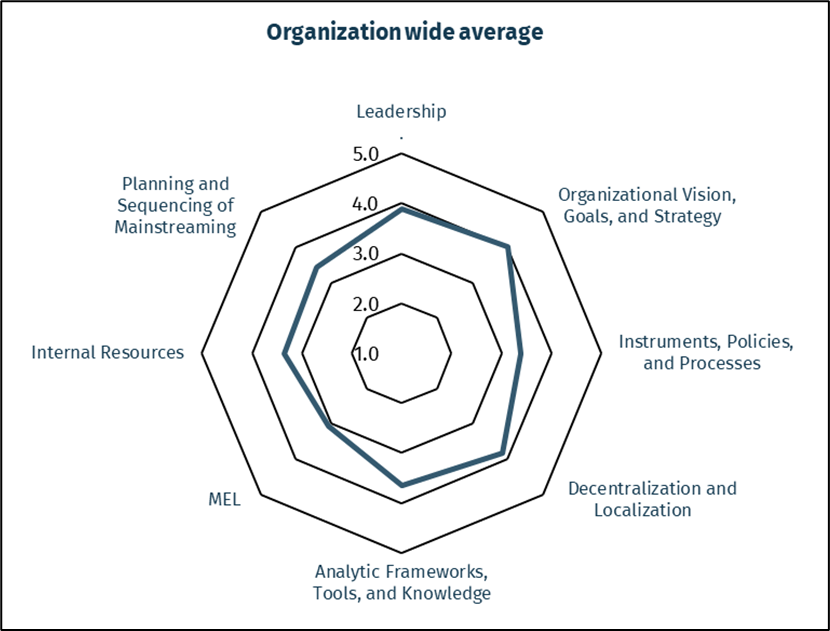
This summary shows a generally positive result, with none of the average scores falling below three – at the middle of the range of 1 to 5, and two (leadership and vision) at or very close to 4. The weakest elements are MEL and the allocation of internal resources to support scaling. One of the explanations for this positive result is that organizations were selected according to their willingness to undertake a case study on mainstreaming scaling, and these turned out to be organizations that are further along in mainstreaming than many of their peers. A second explanation for the relatively high average scores is that the sample of cases includes a large proportion of funders that are more focused on scaling (vertical funds, foundations, INGOs, etc.) than others (especially MDBs and official bilateral funders). We therefore disaggregated the AI analysis by funder type, distinguishing between the principal funder groups discussed in Section VI. Figures 6 and 7 (next page) show the results.
These results are consistent with the findings reported earlier in this Section. Foundations, innovation funders, and vertical funders are farthest along in mainstreaming scaling, followed by INGOs in the middle, while MDBs and bilaterals lag behind. This raises particular challenges since it is the large official funders that continue to have the greatest capacity to support scaling in the latter stages of the scaling pathway where the potential impact is greatest in terms of transformational impact at scale. Seven funders stand out with average scores above 4: Co-Impact, DGMT, GCC, GFF, Harvest Plus, the Syngenta Foundation, and SOFF.
Figure 8 also sheds light on which mainstreaming factors are most and least advanced for each type of funder organization. For example, for foundations, leadership, vision, and instruments are particularly strong, while MEL is relatively weak. Vertical funds are strong on leadership, vision, and decentralization/localization, but weaker on allocation of internal resources and MEL.
Figure 6. Mainstreaming Score by Funder Type – Overall Average
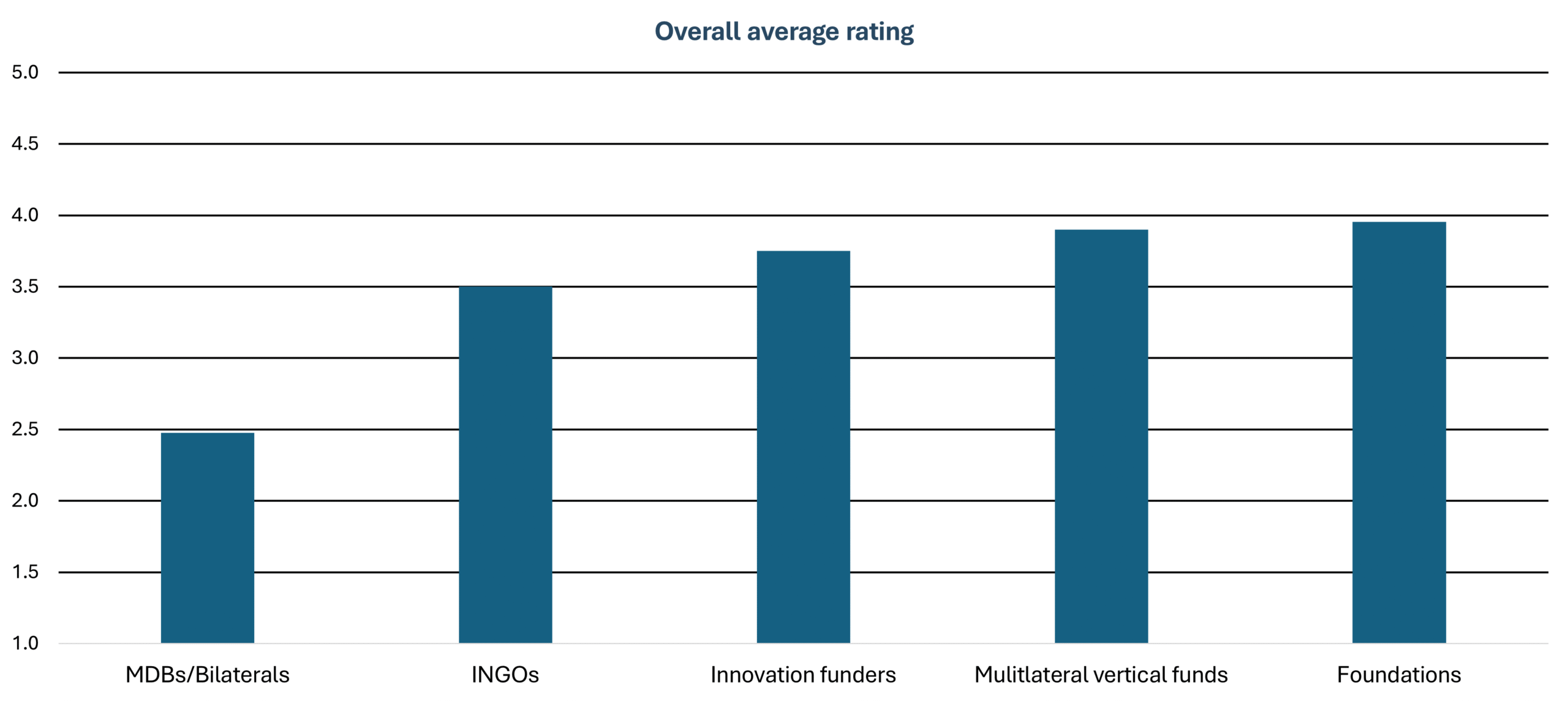
Figure 7. Mainstreaming Score by Funder Type and Factor
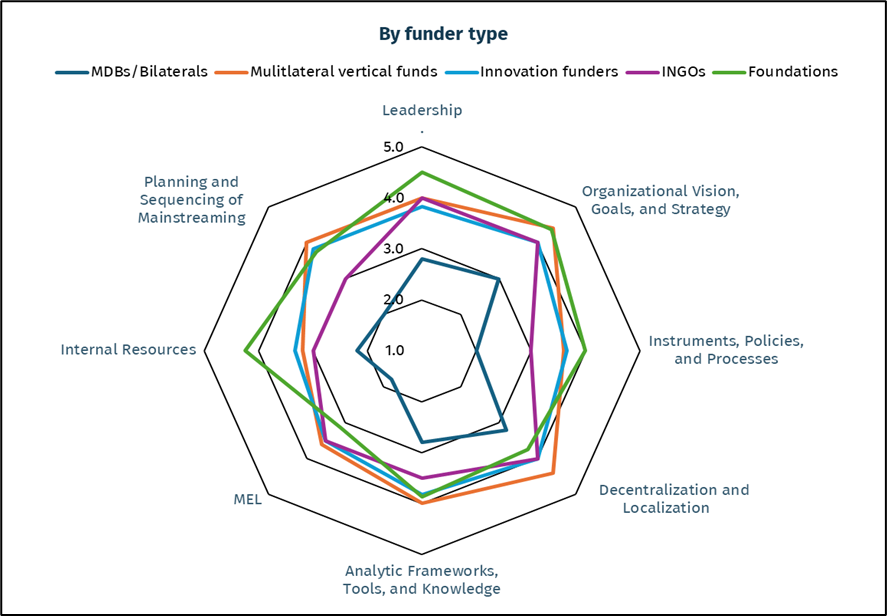
VI. Conclusions
The 28 case studies provide corroborating evidence – and many examples – in support of prior, anecdotal, observations regarding mainstreaming scaling in funder organizations. The cases also add a range of nuances and new insights regarding these earlier views, and, in some cases, contradict conventional wisdom. Following the introduction of the Mainstreaming Initiative in Section I, Section II gave an overview of funder roles and progress with mainstreaming to date. Sections III and V provided specific findings and lessons on (i) what are the principal transformational scaling practices that need to be mainstreamed by funders as they support scaling and (ii) how transformational scaling can be mainstreamed into the operational practices of funder organizations. Section V looked at mainstreaming efforts by different categories of funders. In conclusion, we summarize key findings, present some recommendations for the funder community as a whole, and issue a call for action in support of the Scaling Campaign 2026-2030 to be launched by the Scaling Community of Practice in early 2026.
A. Summary of Key Findings
We organize key findings as responses to the seven questions which the Mainstreaming Initiative addresses, as laid out in Section I.C above.
1. To what extent have funder organizations mainstreamed a systematic focus on scaling?
Scaling is a topic of growing interest in the funder community and mainstreaming is advancing across the 28 funder cases. When we started the Mainstreaming Initiative three years ago, we hoped to generate 12-15 case studies. The fact that we ended up working with 28 funders attests to the widespread and growing interest in the funder community to explore how they can best contribute to transformational impact at scale. There are important external and internal reasons that explain this growing interest. On the external side a primary reason is the current crisis in development and climate finance as a result of the cutbacks in official funding. These cuts have brought an end to what amounted to magical thinking that the solution to achieving impact at scale, the SDGs, and the Paris Climate Goals, was to raise more money. This reinforced what were already growing concerns about the shortfalls in achieving the SDGs and Paris goals and the resulting quest to achieve greater effectiveness and impact at scale with given domestic and external resources. Internally, many organizations are receiving feedback, whether from their own internal evaluation units, from recipients, or their governing bodies that the status quo of innovations and research without scaling, or repeated projects that do not in the aggregate solve problems, is no longer acceptable. Not surprisingly progress with mainstreaming is uneven across the 28 cases and even those furthest advanced can strengthen their operational approaches.
Across the 28 cases, mainstreaming is advancing but unevenly. Organizations with narrower mandates and flexible instruments — vertical funds, some foundations, and several innovation/research funders — are furthest along in embedding transformational scaling in strategies, instruments, staffing, and MEAL. By contrast, the large official funders, while signaling interest, have yet to align incentives, time horizons, and operating procedures to focus on long-term pathways to impact at scale throughout their organizations.
2. Which key dimensions of scaling should funders prioritize and support?
The distinction between transactional and transformational scaling is of central importance. We discovered during our work the importance of the distinction between transactional and transformational scaling, a distinction not previously made to our knowledge in the scaling or development effectiveness literature. We believe this is a key aspect to focus on for funders as they explore their scaling support strategies and mainstreaming priorities. We observed that many funders use the language of scale and scaling to signify more and bigger projects, and in some cases larger reach and bigger numbers, rather than “transformational scaling” as used in this report; delivering long-term impact at large scale beyond a project’s lifetime, emphasizing financial, political and implementation sustainability and measuring success in terms of impact relative to the size of the problem. While this too is changing, progress appears to be modest and uneven among many of the funders we studied.
Transformational scaling requires a long-term vision and scalability embedded from the beginning; an explicit and sustained focus on systemic change; persistence; a focus on equity, inclusion, localization and partnerships; and adaptative management. To be successful, funders have to mainstream support for these aspects into their corporate mission and vision, their operational policies, and practices, especially the pursuit and orientation of aligned partnerships. These need to be supported by their internal resource allocations, managerial priorities, organizational culture and staff incentives. Many organizations unintentionally default to transactional approaches because of governance, fiduciary, and reporting constraints rather than lack of conceptual clarity; if this shift is to be made, those drivers need to be addressed. Transformational scaling requires making deliberate trade-offs early on, including intertemporal ones – accepting slower initial uptake or narrower pilots in exchange for longer-term viability. Funders need to act as intermediaries and support the creation or strengthening of local intermediaries.
A focus on support for transformational scaling is easier for some categories of funder than for others, with large official funders most challenged although they could have the biggest impact. In general, the case studies suggest that innovation and research funders, foundations, selected INGOs, and vertical funds are furthest along in embedding transformational scaling in strategies, instruments, staffing, and MEAL. They have the strongest mandate for scaling, greater flexibility in their operations and a relatively high appetite for risk, even as their current mainstreaming approaches could still be strengthened. Mainstreaming transformational scaling is most challenging in larger, multi-sectoral, official funder organizations, most of which remain committed to traditional one-off, single-donor project approaches, and, while signaling interest, they have yet to align incentives, time horizons, and operating procedures to focus on long-term pathways to impact at scale throughout their organizations.
Since large official funders have the greatest potential to support transformational scaling with their large financial resources and their capacity to support systemic change, it is especially important that they focus more and more effectively on supporting transformational scaling. However, adoption of transformational scaling by these organizations implies a far reaching shift in how they define and measure success, in their operational policies and instruments, and in internal culture and incentives. Smaller more nimble funders like foundations can also support the larger MDBs and other International Financial Institutions to change organizational processes and incentives to support mainstreaming in ways that these larger institutions find difficult given how their existing operational procedures, budgeting, and planning function. Strengthening alignment across funders can lead to collective action and self-reinforcing synergies and is a core part of the SCoP’s call and Campaign (see below). Additional applied research on how to achieve organizational change towards transformational scaling in these organizations is urgently needed.
3. What factors enable or drive the mainstreaming of scaling within funder organizations?
Principal drivers of mainstreaming have been leadership, vision and goals, operational policies, internal resources and incentives, knowledge, and MEAL. Leadership at all levels of funder organizations has been the most important factor in the past and is clearly needed moving forward. In the absence of leadership from the top (the governing body and the top leadership team), it is difficult, if not impossible, to mainstream scaling throughout the organization. Many funders have now included impact at scale as an important element of their operational vision, but most funders invest too little in creating the operational policies, capacities, and incentives for front line staff to pursue scaling, among other things by not investing enough in resources in supporting scaling nor in focusing operational policies and MEAL on the scaling agenda. Where senior leadership is currently insufficiently committed to implement a systematic and persistent mainstreaming effort planned and sequenced as a long-term change management effort, middle management and staff can foster learning about scaling through applied research and case studies of successes and failures, and shared tools, frameworks, and approaches. This can at a minimum create the foundations for future mainstreaming through internal communities of practice and learning networks, and support bottom-up influencing and advocacy as well as peer-to-peer learning across organizations.
4. In which areas have funders made greater progress, and where has progress been more limited?
Overall the funders that have made the most progress are those whose leadership adopted a scaling focus and the organization has embodied it in its mission statements. However, in many cases a more explicit focus on transformational scaling is needed and the gap between high-level aspirations and implementation need to be closed by ensuring the other drivers are systematically and effectively put into place throughout the organizations. Many funders, especially among the official organizations, remain focused on transactional scaling. Among the mainstreaming enabling factors, the weakest generally have been the allocation of internal resources and incentives and the development of scaling-oriented MEAL. For effective mainstreaming, leadership needs to pursue all drivers and enablers as a mutually reinforcing set of change management actions. Foundations, vertical funds, and innovation funders tend to be strongest in this regard, while the large official funders are the least advanced in mainstreaming. But all types of funders can do better.
The ability and readiness to stay engaged and persistent over time in scaling support is an important strength of vertical funds, INGOs, and some foundations. Effective scaling of development and most climate innovations and interventions takes 10-15 years or longer. Funders that can stick with their national and local development partners in supporting scaling in their areas of engagement over time are typically more successful than those that engage in the traditional, one-off, 3-5-year project mode.
However, the handoff from one funder to the next, and ultimately to domestic actors, needs to be improved for all. For innovation and pilot project funders, this requires a focus on what happens after an innovation has been proven effective, or on what happens beyond a pilot project’s end. The key question they need to address throughout is to whom a successful intervention can be handed off so it can be sustained and scaled. Magical thinking that someone will pick up a good innovation or pilot project for scaling has proven to be just that in most cases, and will not do. At the same time, large funders who tend to operate later in the scaling pathways need to focus more effectively on partnering with the early-stage funders in identifying and then supporting the scaling of promising innovations and pilots. This does not mean that the secret to scaling is to pass innovations from one funder to another funder; this is true but only at intermediate stages. Ultimately, handoff has to take the form of integration into the domestic public or private sector or a combination of the two. This requires much greater emphasis on aligning programs and innovations with domestic constraints, building domestic capacity and business models, and much better recognition within and between funders about when programs are ready for absorption by domestic institutions and when domestic policy and political economy windows of opportunity are open up to receive them. Coordination across funders is especially important, since without it perverse incentives may arise on the ground where, for example, some funders are still offering smart subsidies and others are no longer. This is a case where country platforms can be particularly helpful.
5. What are the principal challenges encountered?
The traditional project model is a pervasive problem with its focus on one-off results, with its failure to consider the needed enabling conditions for sustainability and scalability, and with its lack of consideration of what happens beyond project end. It is likely unavoidable for most funders that they will use a project approach when they finance development and climate action. The problem is that the standard project approach is transactional in nature. Funders, especially the large official funders, tend to focus on and measure success in terms of how many projects are implemented, how much money is committed, whether the money is disbursed in a timely and transparent manner, and whether the projects achieve predetermined, limited project outputs. These are important objectives, but not sufficient for transformational scaling, for which projects need to be designed with a scaling perspective from the start, with a view to support necessary systems changes, engaging in partnerships that extend beyond project end, and monitoring and evaluating progress and success not only in terms of immediate impact, but also in terms of the sustainability and scalability of the intervention. As we demonstrated, some innovation funders, vertical funds, and foundations are finding ways to make the project model work in support of transformational scaling, at least in the early-to-middle stages of the scaling pathway. In principle, there is no reason why the large official funders in the later stages should not be able to do so also.
“Unfunded mandates” and the resulting disincentives to scaling are a hidden hazard. Evidence from the case studies is clear that, across all categories of funders, but especially for the official funders, frontline staff overload remains a major obstacle to mainstreaming scaling. Without dedicated resources and technical support needed to adopt a scaling approach, staff feel they just do not have the time and incentive to focus scaling – on top of all the other mandates that they have to deliver on without adequate resources –, with its requirement of incremental analytical and intermediation tasks, partnership development, and coordination essential for effective scaling. This appears to change only when scaling, partnerships, and systemic change come to be viewed as indispensable features of successful development, not add-on requirements, i.e., when staff are given clear directives, incentives, resources, and technical guidance.
Trade-offs do not get the attention they merit. The case studies reveal that funders face many trade-offs and resulting tensions across goals as they aim to mainstream scaling into their funding practices. Unfortunately, relatively few pay enough attention to the implications for scaling of equity and inclusion objectives, to the costs and complications of localization, partnerships and coordination, or to the implications of unintended consequences, political, distributional, environmental and otherwise. Funder organizations need to address these trade-offs in a transparent manner as part of their priority setting and resource allocation decisions, rather than leaving it to their operational staff to grapple with these tensions unassisted.
6. What lessons emerge for funders seeking to mainstream scaling?
The lessons for funders interested in mainstreaming scaling can be summarized in a single table (Table 4).
Table 4: Summary of main lessons for funder organizations
| Support key transformational scaling practices
· Initiate scaling from the beginning · Incorporate scalability criteria and assessment into all stages of scaling · Integrate support for systems change with scaling · Explicitly address equity and inclusion and anticipate unintended consequences · Double down on country ownership and localization · Invest in partnerships with other funders · Embed scaling into MEAL · Elevate and strengthen intermediary roles |
Put in place key enablers of mainstreaming transformational scaling
· Drive scaling through leadership · Focus vision, goals, and targets on transformational impact at scale · Align operational policies and practices and time horizons with scaling · Dedicate organizational resources and capacity to scaling · Develop analytical tools and knowledge and esp. an incentive and culture for scaling · Go beyond decentralizing operations in supporting localization and scaling. · Use M&E to drive effective mainstreaming · Plan for appropriate sequencing and adapting the mainstreaming process · Manage tradeoffs and tensions transparently |
The needle is moving in the right direction, but too slowly. While the pace of change is quickening and examples of mainstreaming good scaling practices are more widespread, the evidence suggests that, for most funders, changes in rhetoric are not yet matched by changes in internal systems, resources, incentives, and practices. The experience of engaging with the organizations profiled in this study confirms that many are actively involved in considering their next steps. The soul searching associated with recent seismic changes in the funding landscape are likely to provide impetus for deeper and wider change than might otherwise have seemed possible.
B. Lessons for the Funder Community as a Whole
Transformational scaling cannot proceed in the absence of genuine leadership by national governments, private sector actors, and other permanent, in-country stakeholders. While support of these efforts benefits from a greater and more effective focus on mainstreaming transformational scaling by individual external funders as advocated in this report, certain steps will be most effective if taken by the external funder community as a whole. These joint actions can be expressed in the form of six interlocking proposals:
- Integrate scaling into the global development effectiveness agenda. The international community has focused for decades on enhancing the development effectiveness of domestic and external resources. This includes, among many others, the Millennium Development Goal (MDG) and SDG movements, the Financing for Development Conferences, the High-Level Forums on Aid Effectiveness, the UNFCCC COPs etc. To our knowledge, none of them have had an effective focus on scaling development and climate impact and on what are the appropriate scaling pathways to achieve lofty global and national goals, such as the SDGs and the Paris Climate goals. The recently launched Future of Development Cooperation Coalition appears to be an exception in this regard. It is our recommendation that the scaling issue be given a central role in these international forums in future and that it be elevated as an explicit aspect of an SDG follow-up initiative for the post-2030 period. An effective focus on mainstreaming scaling in funder organizations will not only help them achieve better results on the ground; it can also help convince skeptical national governments and their tax payers, who are reducing their bilateral and multilateral assistance commitments, that they achieve more impact, more cost-effectively, and with greater accountability when scaling is mainstreamed.
- Create formal coordination mechanisms and institutions to facilitate linkage between small funders, innovators and innovation funders, and larger funders. We have seen a growing readiness by large and small funder organizations to partner with each other: the MDBs have pledged greater cooperation with each other and foundations have initiated partnerships with each other. However, what is still missing, if the Valley of Death problem is to be avoided, is an explicit focus on the hand-off of successful, tested innovations and interventions from the smaller to the larger funders and from larger funders to domestic actors, public or private. The International Development Innovation Alliance (IDIA) has begun to focus on this challenge, but there is a need a more visible and concerted effort at the level of the funder community at large to address this issue at global, regional and country levels. The OECD-DAC might be the most suitable organization to take a lead in this regard, having already developed a guidance document on scaling for its bilateral members, and as trusted partner with multilateral and private funder organizations. As with scaling more generally, this topic needs to be central to efforts to reconsider and redesign international cooperation.
- Invest greater resources in creating and strengthening the capacity of country-led, inclusive, transformational country platforms. The idea that better coordination of development and climate action at country level by development and climate actors is needed has a long history, involving efforts in aid coordination and consultative groups, joint and pooled funding mechanisms, and event joint country assistance strategies by external funders. Recently, the idea of a “country platform” has gained in prominence, especially with the establishment of climate action country platforms in selected countries. However, as we noted in this report, country platforms have also been established in other areas, especially the health sector. While country platforms are no silver bullet, they can make significant contributions to transformational impact at scale, as noted in Box 5 in the main text. Among the many scaling challenges they can address, they can particularly help resolve three areas: (i) bridging the Valley of Death by mobilizing donor and domestic funding for scaling; (ii) supporting institutionalization of scaling in national and international actors; and (iii) mobilizing and aligning the support of all stakeholders for the first two. However, to do so they need to be designed for and have a mandate to support transformational scaling. That means they have focus on supporting long-term development and climate strategies with effective alignment of domestic and external partners along long-term goals and scaling pathways; they need to be country-led and inclusive of national stakeholders; and they have to be effectively resourced and managed.
- Institutionalize intermediation for transformational scaling: mandate and fund intermediary organizations that broker doer/payer commitments, align policy and market conditions, and manage handoffs across funders and ultimately to domestic institutions. External funders can – and some do – serve as intermediaries in supporting transformational scaling pathways at country level. This role must be strengthened. It is equally critical that external funders support and strengthen national and local intermediary organizations through capacity building, including the country platforms mentioned in the previous paragraph. Too many donor collaboration efforts have failed for want of resources, secretariats, and ongoing backbone organizations. So too in the case of scaling, without effective and resourced intermediary organizations, neither crossing the Valley of Death nor institutionalization will ever be systematically integrated into international assistance and cooperation and efforts and scaling will continue to be the exception. For example, Public Development Banks can serve an important function in this regard, as they can serve as financial and capacity-building intermediaries for scaling pathways and also as a bridge between government, the private sector and the civil society organization community in getting them to focus on scaling more effectively.
- Integrate scaling into widely used MEAL frameworks such as the OECD-DAC evaluation guidelines. Throughout this paper we have stressed the importance of monitoring, evaluation, accountability, and learning as a driver for effective transformational scaling and its mainstreaming in funder organizations. A concerted effort by the multilateral organizations and networks, such as OECD-DAC, MOPAN, and EvalNet, with the support of thinktanks and consultancy organizations focused on monitoring and evaluation, such as IPA, J-PAL, 3ie, and others, should work towards integrating the scaling dimension explicitly and systematically in monitoring and evaluation methodologies and practice. A coalition of OECD-DAC/MOPAN/EvalNet and major funder evaluation offices should standardize core scaling indicators to drive comparable accountability for transformational outcomes.
- Document cases of success and failure in scaling. Identify how the ways that funders have mainstreamed and operationalized scaling contribute to those outcomes and improve based on those lessons. Our Mainstreaming Initiative has focused on how funders have integrated scaling into their missions, visions, strategies, operations, policies, and procedures. The assumption has been that, were they to do so, they would support more and more transformational scaling, and in turn those efforts would be more successful individually and collectively in achieving sustainable impact at scale. While we remain convinced that the logic of this theory of change is sound, looking in detail at cases as to how those linkages and logic works in practice would strengthen the case for mainstreaming of scaling and allow for further refinement of what is good practice in mainstreaming. To that end, individual and a consortium of funders should jointly document and evaluate what have been examples of success and failure in achieving transformational impact at scale with external assistance and how it relates to how funders have operationalized and supported scaling. This could provide useful lessons for the funder community and increased impetus for more effective mainstreaming of scaling.
C. A Call to Action
The SCoP calls upon the international community to join in a Scaling Campaign 2026-2030. The current crisis of development and climate finance demands a new paradigm of development assistance. The Scaling Community of Practice has concluded that the scaling agenda has to be at the center of this new paradigm. It has therefore developed a five-year Scaling Campaign 2026-2030 which has as its goal to embedding proven approaches to transformational scaling in how governments and development and climate institutions plan, fund, and deliver results that reach and sustain impact at the scale of the problem.
The Campaign builds on the experience with the Mainstreaming Initiative that we summarized in this report, but the Campaign aims to expand the focus to include – and indeed prioritize – engagement with country-level institutions that will be essential if there is to be widespread uptake of the scaling idea in the design and implementation of development and climate action. The SCoP has put forward a list of potential initiatives that it is ready to pursue together with technical and funder partners in support of the Campaign. This list identifies 16 potential initiatives that could serve as pillars for the Scaling Campaign. The SCoP is ready to engage with technical and funder partners to explore how best to pursue these and possible other initiatives on an urgent time table.